


thrive at work/People analytics
Explainer · People analytics
What people analytics is.
People analytics uses data about work and the workforce to make better decisions about people. It is only as good as the questions it starts with.
By Jerry Fiser, Founder & CEO · Reviewed by Marcin Bulik, Research Director · Updated November 8, 2026
What is people analytics?
People analytics, also called HR analytics or workforce analytics, is the use of data about employees and work to understand and improve decisions on hiring, retention, performance, engagement and wellbeing. It combines HR system data with survey data and business outcomes.
- People analytics uses workforce data to answer business questions.
- Start with a question, not a dashboard.
- Combine survey data with HR data such as turnover and absence.
- Report only for groups, and be open about what you collect.
Questions people analytics can answer.
Which teams are at risk of losing people? What predicts high performance? Where is burnout risk building? Which managers grow their people? Does our wellbeing program reduce absence?
| Question | Data to combine |
|---|---|
| Which teams are at risk of losing people? | Capacity and engagement scores with turnover history |
| Why do new hires leave in the first year? | Onboarding surveys with exit reasons |
| Did the workload change help? | Capacity scores before and after, with absence |
| Where should we train managers first? | Manager-related survey items by team |
Start with one of these, agree in advance what decision the answer will inform, and report results only for groups large enough to protect anonymity.

The data behind people analytics.
For the HR measures people analytics often starts with, see the CIPD factsheet on employee turnover and retention and the CIPD factsheet on absence management.
- HR systemsRecords. Headcount, tenure, turnover, absence, promotions, pay.
- SurveysExperience. Engagement, capacity, satisfaction, intention to stay.
- BusinessOutcomes. Productivity, quality, customer satisfaction, revenue.
Three benefits of people analytics.
- 1Better decisions. Evidence instead of anecdotes for workforce choices.
- 2Earlier warning. Signals of turnover or burnout risk before they show up in costs.
- 3Proof of impact. Show whether programs and changes actually worked.
Common people analytics pitfalls.
| Pitfall | How to avoid it |
|---|---|
| Reporting small groups | Show results only for groups of five or more |
| Confusing correlation with cause | Treat findings as signals to investigate, not proof |
| Analysis without a decision | Agree in advance what decision the analysis informs |
| Monitoring individuals | Analyze teams and patterns, not individual behavior |
| Ignoring the works council | Involve employee representatives early where the law requires it |
Four levels of maturity.
| Level | Question | Example |
|---|---|---|
| Descriptive | What happened? | Turnover rate by team |
| Diagnostic | Why did it happen? | Which conditions link to leaving |
| Predictive | What will happen? | Teams at risk of high turnover |
| Prescriptive | What should we do? | Which change has most effect |
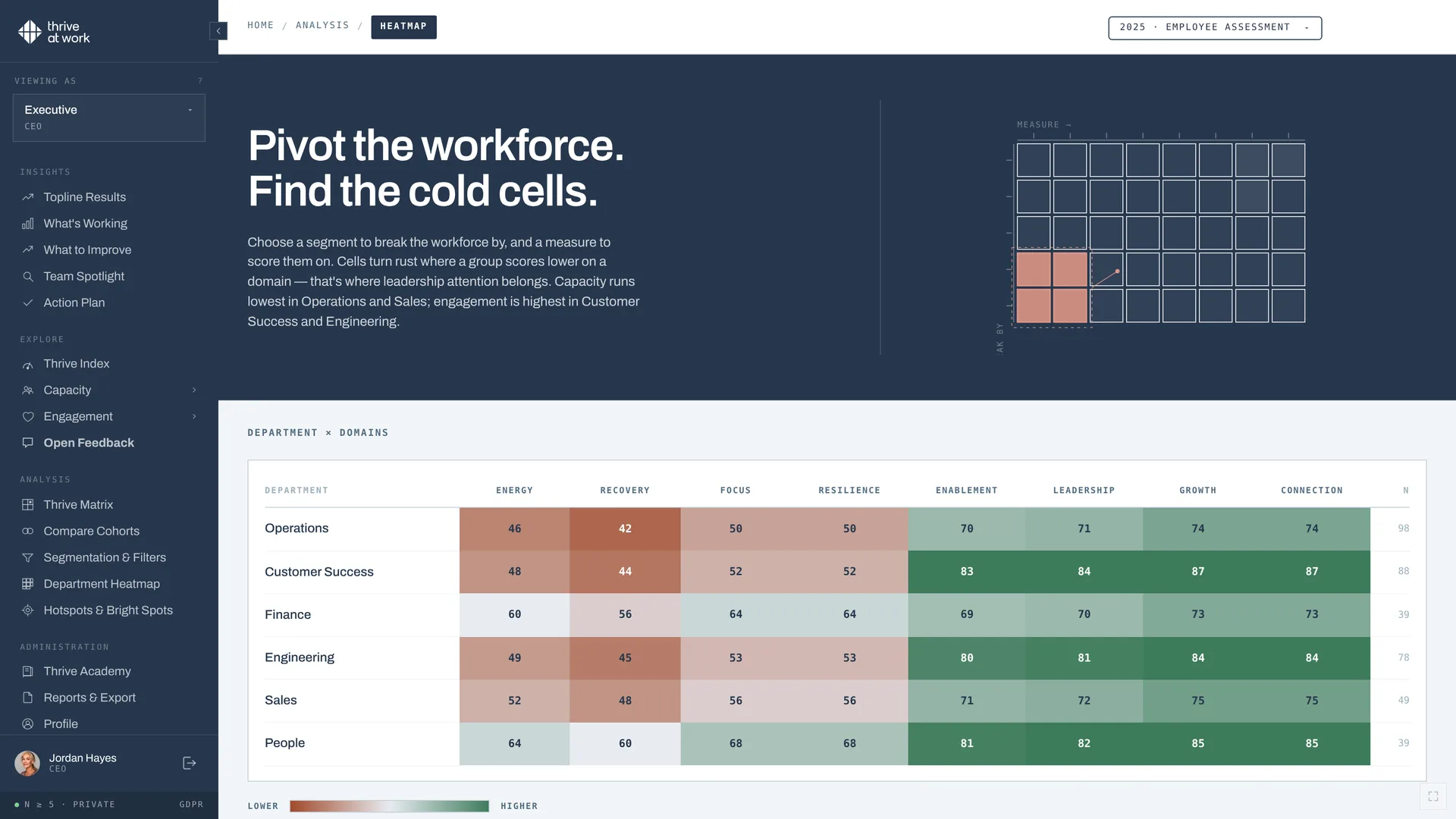
How to start with people analytics.
Pick one business question, gather the data that answers it, keep results anonymous and aggregated, and turn findings into a decision. Be transparent with employees about what data is used and why. Never use survey data to judge individuals.
Skills a people analytics team needs.
| Skill | Why it matters |
|---|---|
| HR knowledge | To ask the right questions and understand the context |
| Data and statistics | To analyze data correctly and avoid false conclusions |
| Data protection and ethics | To protect employees and comply with the law |
| Communication | To turn findings into decisions managers can act on |
| Business understanding | To link people data to outcomes leaders care about |
Small organizations rarely need a dedicated team. One analyst with good HR knowledge, clear data rules and support from IT can answer most early questions.
People analytics in action: five examples.
| Use case | Question answered |
|---|---|
| Turnover risk | Which teams are likely to lose people in the next six months? |
| Onboarding | Which hiring sources produce people who stay? |
| Manager effectiveness | Where do manager scores link to retention and performance? |
| Capacity and burnout | Where are energy and recovery falling fastest? |
| Program evaluation | Did the new flexible work policy change engagement or absence? |
Using data responsibly.
People analytics works only with trust. Tell employees what data you collect and why, report survey results only for groups of five people or more, and never use engagement or capacity data to judge individuals. Involve employee representatives early where they exist.
Avoid surveillance-style measures such as keystrokes or screen time. They say little about real output and damage trust. Focus instead on questions leaders can act on: Which teams are under strain? What conditions predict people leaving? Which changes made a difference?
Start small: one clear question, one or two data sources, and a decision that the answer will inform.
Data protection in people analytics.
People analytics processes personal data and often sensitive data. Set a clear purpose for each analysis, use the minimum data needed, report only on groups large enough to protect anonymity, and tell employees what is analyzed and why. In Europe, the GDPR applies, and in countries with works councils, many analyses require their involvement. Trust is the foundation: once employees believe data is used against them, survey answers become less honest and the analytics lose their value.
thrive at work measures engagement (purpose, leadership, connection, growth) and capacity (energy, recovery, focus, resilience) in one anonymous survey: the employee engagement survey.
Good people analytics work needs a survey people trust and results managers can act on. In Employee Experience Management (EXM) terms, thrive at work is an employee engagement platform that measures engagement and capacity to perform in one anonymous survey. See the employee survey platform or read more about employee engagement.
Sources.
- CIPD factsheet on employee turnover and retention. www.cipd.org
- CIPD factsheet on absence management. www.cipd.org
Common questions
What is the difference between people analytics and HR analytics?
Is people analytics ethical?
What is people analytics?
What data is used in people analytics?
What skills does people analytics require?

Add capacity data to your people analytics.
A 30-minute call covers what the thrive data adds.