

thrive at work/Presenteeism
Explainer · Presenteeism
What is presenteeism?
Presenteeism is being at work in body but not at full capacity. It is harder to see than absence, and often costs more.
By Jerry Fiser, Founder & CEO · Reviewed by Marcin Bulik, Research Director · Updated November 8, 2026
What is presenteeism in the workplace?
Presenteeism means working while ill, exhausted or otherwise unable to perform fully. The person is present, but their capacity is reduced. It includes working while sick, logging on from home when unwell, and being at the desk while too depleted to focus.
- Presenteeism means being at work but not at full capacity.
- It is invisible in attendance data, so it is often ignored.
- Remote work makes it easier: people log on instead of resting.
- Measure energy, recovery and focus to see it.
Presenteeism vs absenteeism.
Absenteeism is visible: someone is not at work and it is recorded. Presenteeism is invisible: the person is there, so nothing is recorded, but output, quality and safety suffer. Because it is not measured, it is often ignored.
Two kinds of presenteeism.
| Kind | What it looks like | Main risk |
|---|---|---|
| Sickness presenteeism | Working while ill, in person or remotely | Slower recovery, spreading illness |
| Depletion presenteeism | At work but too tired or strained to focus | Mistakes, lower output, burnout risk |
Common examples of presenteeism in the workplace.
- 1Working while ill. Coming in or logging on with a cold, flu or migraine.
- 2Working while exhausted. Present after weeks of overtime but unable to concentrate.
- 3Working through mental health problems. At work but struggling with anxiety or low mood.
- 4Caring responsibilities. Working while distracted by a sick child or relative.
- 5Fear-driven attendance. Showing up because of job insecurity or pressure to be seen.
Causes of presenteeism in the workplace.
Workload that makes absence feel impossible, a culture that rewards being seen, job insecurity, sick leave rules, remote work that blurs the line between resting and working, and chronic strain that never quite becomes sick leave.
The CIPD Health and wellbeing at work report tracks presenteeism alongside absence. The CIPD factsheet on wellbeing at work covers what employers can change.
Effects of presenteeism on people and output.
Lower productivity, more mistakes, spread of illness, slower recovery, and over time a higher risk of burnout and longer absence. Working from home has made presenteeism easier: people who would stay in bed log on instead.
Because presenteeism is never recorded, its cost is easy to miss. People who work at reduced capacity make more mistakes, take longer to finish work and may spread illness to colleagues. thrive research found that people in the lowest quarter for capacity (the energy, focus, recovery and resilience a person has available) lost 71 more days a year to not working effectively than those in the highest.

How to measure presenteeism.
Attendance data cannot show presenteeism. Survey measures can: energy across the week, quality of recovery, and time for focused work.
Established presenteeism questionnaires.
Researchers have built short questionnaires that ask people how much their health got in the way of their work. Three are widely used:
| Questionnaire | What it asks about | Good for |
|---|---|---|
| Stanford Presenteeism Scale (SPS-6) | Whether a health problem made it harder to finish work or to stay focused | A quick check in a pulse or health survey |
| WHO Health and Work Performance Questionnaire (HPQ) | Absence, hours worked and self-rated performance over recent weeks | Estimating lost working time across a population |
| Work Limitations Questionnaire (WLQ) | How often health limited time management, physical tasks, mental tasks and output | A detailed view of which parts of work suffer |
For most employers, a few plain questions in a regular survey are enough to start: "In the past four weeks, how often did you work while feeling unwell?", "How often did tiredness lower the quality of your work?" and "Do you feel able to take sick leave when you need it?" Read the answers by team, next to energy and recovery scores, rather than by individual.
How to reduce presenteeism.
- 01Make it acceptable to be off. Leaders stay home when sick and say so.
- 02Cover the work. Plan backups so absence does not mean colleagues drown.
- 03Measure capacity. Energy, recovery and focus scores show reduced capacity that attendance data never will.
What a presenteeism-aware sick leave policy includes.
A clear policy says that people should stay home when they are ill, explains how work will be covered, avoids attendance rewards that push people to work sick, and lets managers model the behavior by taking sick leave themselves when needed.
Dealing with presenteeism with empathy.
People rarely work while ill because they want to. They worry about falling behind, letting colleagues down or how it looks. Managers can help by saying clearly that sick days mean being offline, arranging cover so work does not pile up, and asking about workload when someone seems to be close to exhausted.
Presenteeism in remote work.
Remote and hybrid work change how presenteeism looks. Without a commute or a visible office, it becomes easy to log on with a cold, to answer messages from bed, or to keep the laptop open long after the working day should have ended. Managers see a green status light, not a person who needs rest.
Three norms help: say clearly that sick days mean being offline, agree when the team is expected to respond and when it is not, and model it as a manager by not sending messages late. Then check capacity scores by team, because presenteeism shows up as low energy and poor recovery long before it shows up anywhere else.
Presenteeism signs to watch in remote teams.
Watch for people who stay online while unwell, answer messages late at night, or never take sick days.
Presenteeism, sick leave and the law.
Sick leave rules differ by country, but in many places employees have a right to paid or unpaid sick leave and employers must not penalize people for using it. Clear sick-leave policies, and managers who encourage people to rest when ill, reduce presenteeism. Pressure to work while sick can also create health and safety risks for others.
The manager’s role in reducing presenteeism.
Managers set the norm. When a manager works while ill, the team learns that this is expected. Send people home when they are unwell, arrange cover so work does not pile up, and say clearly that recovery comes first. People follow what managers do far more than what policies say.
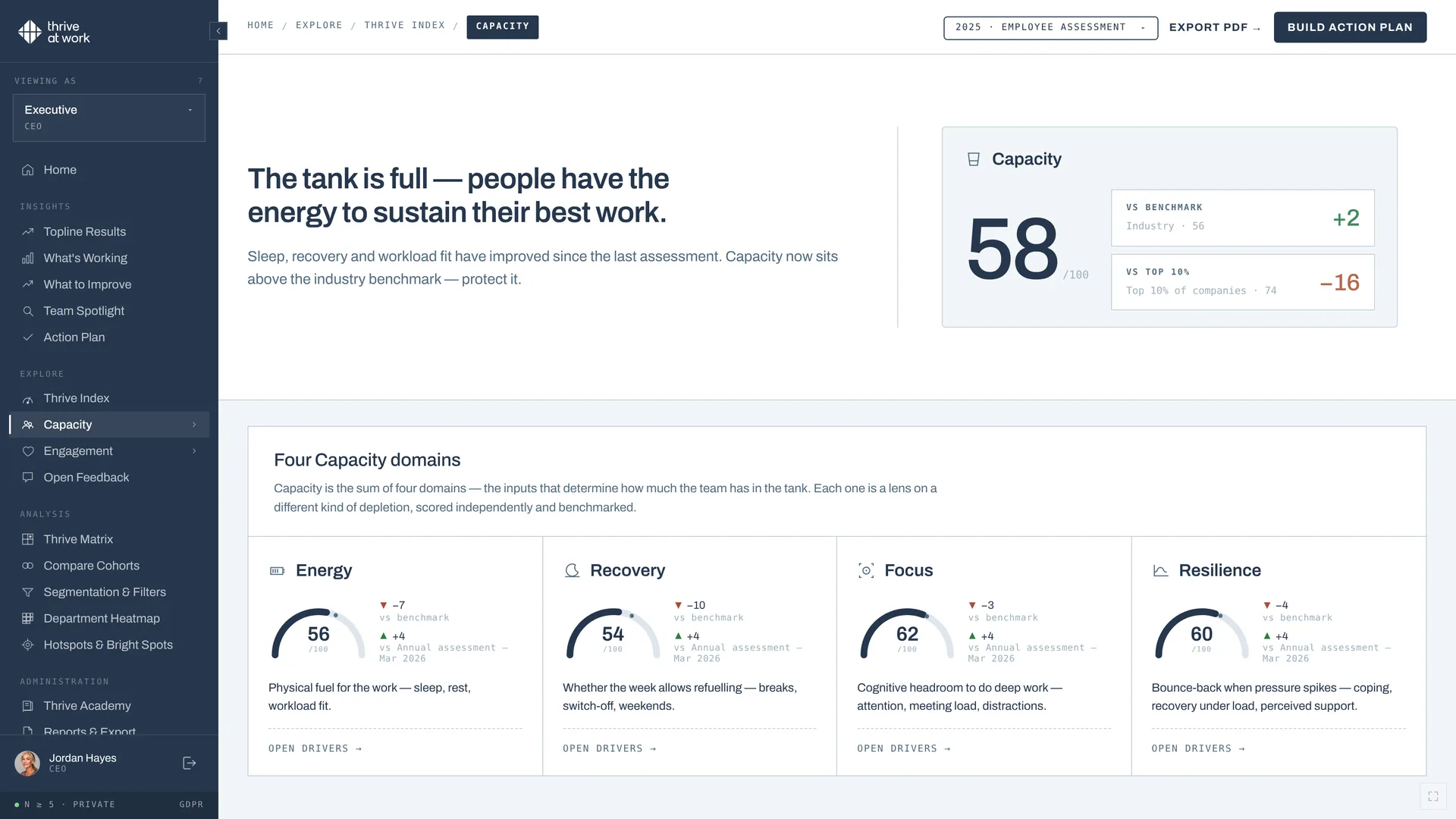
thrive at work measures four capacity domains (energy, recovery, focus and resilience) alongside four engagement domains in one anonymous survey: the employee capacity assessment.
Most presenteeism problems show up first as falling energy, recovery and focus. thrive at work is a workforce performance platform: an employee engagement platform that also measures capacity to perform, so you can see strain by team before it turns into absence or resignations. Read more about employee capacity.
Sources.
- CIPD Health and wellbeing at work report. www.cipd.org
- CIPD factsheet on wellbeing at work. www.cipd.org
- thrive index validation study. thrive at work, 2025–26. Methodology.
Common questions
Why is presenteeism a problem?
Is presenteeism worse when working from home?
How do you measure presenteeism?
What is an example of presenteeism?
Is presenteeism worse than absenteeism?
Why do employees come to work sick?

See the capacity attendance data hides.
A 30-minute call covers what a first measurement would show.