


thrive at work/Workplace culture
Explainer · Culture
What workplace culture is.
Culture is how work really gets done when nobody is reading the values poster: what gets rewarded, what gets tolerated and how people treat each other under pressure. This guide covers what it is, how to describe it in plain behaviors, the signs of a healthy and a toxic culture, and how to measure it.
By Jerry Fiser, Founder & CEO · Reviewed by Marcin Bulik, Research Director · Updated November 8, 2026
What is workplace culture?
Workplace culture is the shared values, beliefs and behaviors that shape how people work together in an organization. It shows in how decisions are made, how people communicate, how mistakes are handled, what gets rewarded and what gets tolerated. Leaders shape it most, through what they do and reward rather than what they say.
- Culture is what gets rewarded and tolerated, not what the values poster says.
- Describe it in behaviors: decisions, mistakes, conflict, promotions, after-hours norms.
- Constant urgency produces silence; workload is part of culture.
- Measure it by team through a survey plus turnover and absence data.
The three layers of workplace culture.
Organizational psychologist Edgar Schein described culture in three layers. The visible layer is artifacts: office layout, rituals, dress, how meetings run. Below that are espoused values: what the organization says it believes. The deepest layer is basic assumptions: the unspoken beliefs that actually drive behavior. When stated values and assumptions differ, people follow the assumptions.
The three layers follow Edgar Schein’s widely used model. The CIPD factsheet on organizational culture and change summarizes how culture is defined, measured and changed, and the CIPD factsheet on employee engagement links culture to engagement.
Elements of workplace culture.
| Element | What it covers | Example |
|---|---|---|
| Values | What the organization says matters | Openness, ownership, care |
| Behaviors | What people actually do every day | Raising problems early, sharing credit |
| Norms | Unwritten rules everyone follows | Whether people answer messages at night |
| Practices | Routines and processes | How decisions are made, how meetings run |
| Symbols | What signals status and priorities | Who gets the best workspace, what gets celebrated |
| Leadership | How leaders behave under pressure | Whether leaders admit mistakes |
When values and behaviors match, culture feels authentic. When they diverge, people follow the behaviors and stop believing the values.
How to describe workplace culture.
Describe culture through behavior, not adjectives. "Collaborative" means nothing until it becomes "people share work in progress and ask for help early."
| Question | What the answer reveals |
|---|---|
| How are decisions made, and who is told why? | Trust and transparency |
| What happens when someone makes a mistake? | Psychological safety |
| How is conflict handled? | Respect and directness |
| Who gets promoted, and why? | What is really valued |
| What happens at 6 pm and on holiday? | Workload norms and recovery |
| Who speaks in meetings? | Inclusion and voice |
Signs of a healthy workplace culture.
| Quality | What you see |
|---|---|
| Clarity | People know priorities and how their work fits |
| Trust | Decisions explained, commitments kept |
| Psychological safety | Problems and mistakes raised early |
| Fairness | Consistent treatment, transparent decisions |
| Growth | Learning and internal moves are normal |
| Sustainability | Workload people can keep up |
- 01Problems surface early. People raise bad news without fear.
- 02Credit is shared. Wins are attributed to the people who did the work.
- 03Decisions are explained. Including unpopular ones.
- 04Mistakes lead to learning. Teams review what went wrong without blame.
- 05Workload is discussable. People can say "I am at capacity."
- 06People take their vacations. And are not expected to answer email.

Why workplace culture matters.
Culture shapes whether people raise problems early, help each other, stay and do their best work. It affects hiring, because candidates increasingly ask about culture and read reviews from current and former employees. And it affects whether workload is sustainable: in a culture that rewards long hours, energy and recovery fall long before resignations appear.
Culture is also hard to copy. Competitors can match pay, benefits and tools; they cannot easily copy how decisions are made, how mistakes are handled and how people treat each other.
Signs of a toxic culture.
Blame, silence in meetings, favoritism, constant urgency, people working through illness, high turnover in specific teams, and a gap between stated values and rewarded behavior. A toxic culture is one where harmful behavior is tolerated because the person doing it delivers results. Chronic overload is part of it: a culture of constant urgency produces silence, because nobody has the time or energy to challenge anything.

How to fix a toxic workplace culture.
Start by naming the patterns honestly, using survey data and exit reasons rather than impressions. Address the behaviors leaders tolerate, especially from high performers, because tolerated behavior defines the culture more than any value statement. Protect people who speak up, make decisions more transparent and check progress with the same survey after six months. Fixing a toxic culture takes time, but a few visible decisions early on show that change is real.
How to measure workplace culture.
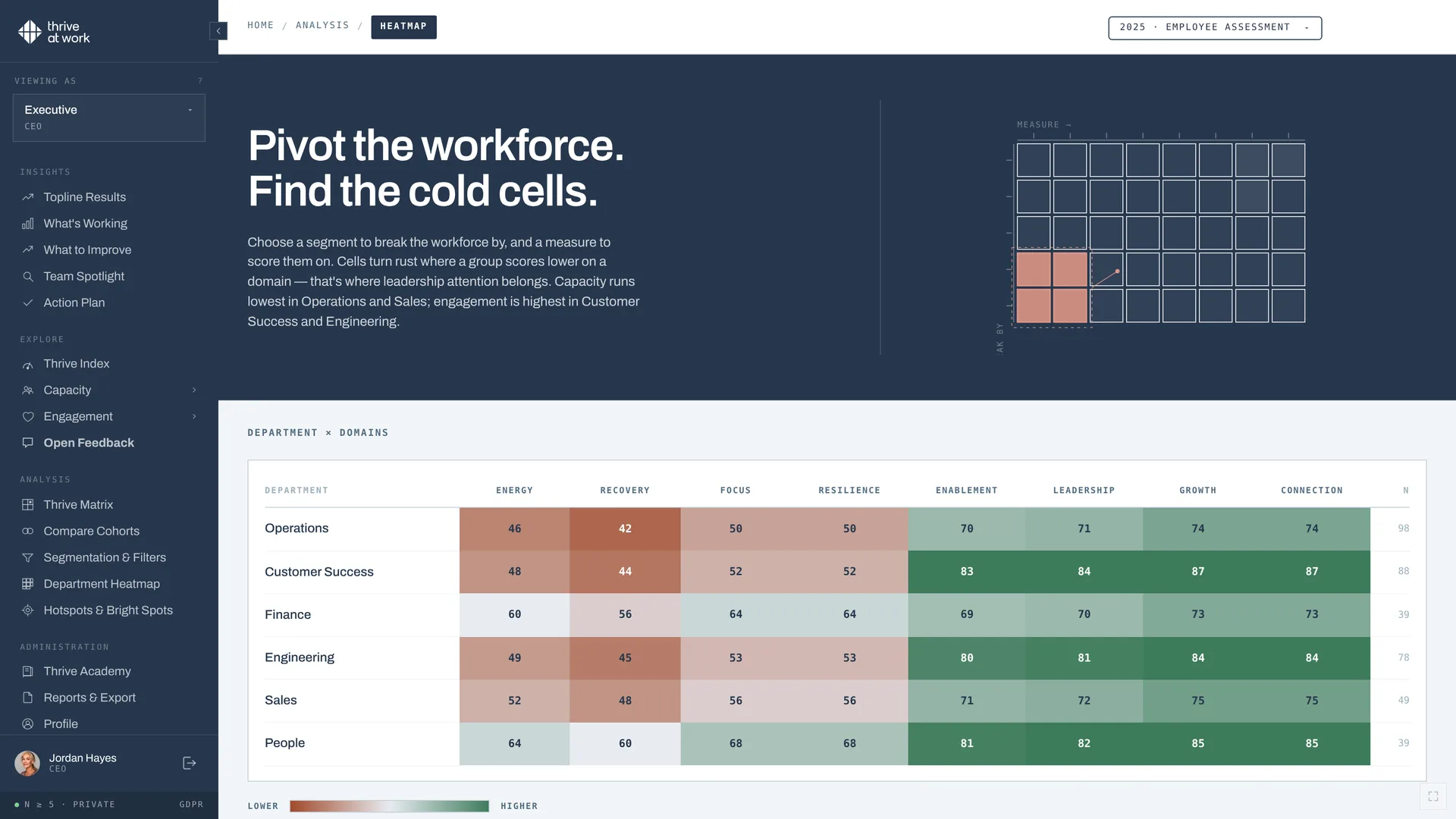
Culture can be measured through what people experience. An anonymous survey reported by team shows whether people feel safe to speak, trust leadership, are treated fairly and can sustain the pace. Combine it with outcome data: regretted turnover, absence, internal moves and promotion patterns. thrive at work measures leadership trust and connection alongside energy and recovery, because culture shows in both. See culture examples and how to improve workplace culture.
Workplace culture survey questions.
| Theme | Statements |
|---|---|
| Openness | Mistakes on my team are discussed openly. · I can disagree with a decision without fear. |
| Trust | Leaders do what they say they will do. · Decisions are explained to us. |
| Fairness | Recognition is shared fairly. · Promotions go to the people who deserve them. |
| Collaboration | Teams help each other to reach shared goals. · Information is shared openly between teams. |
| Sustainability | I can switch off in the evening. · Taking leave is encouraged here. |
Steps to build a strong workplace culture.
Define the few behaviors that matter most, model them from the top, build them into hiring, onboarding, recognition and promotion, and measure them by team. Culture becomes strong when the same behaviors are expected and rewarded everywhere, not only in the values statement. See how to improve workplace culture.
The role of leaders in workplace culture.
Culture follows what leaders do, especially under pressure. When a deadline slips, when results disappoint, when someone raises an uncomfortable truth, people watch how leaders react and adjust their own behavior accordingly. Leaders who want an open, sustainable culture need to show it first: admit mistakes, explain decisions, take their leave and thank people who bring bad news.
thrive at work measures four capacity domains (energy, recovery, focus, resilience) and four engagement domains (purpose, leadership, connection, growth) in one anonymous survey, reported by team from five people: the employee capacity assessment.
Culture shows up in how teams work every day. thrive at work is a workforce performance platform: an employee engagement platform that measures engagement and capacity to perform by team, so culture work starts from evidence. Read more about employee engagement.
Sources.
- CIPD factsheet on organizational culture and change. www.cipd.org
- CIPD factsheet on employee engagement. www.cipd.org
Common questions
What does workplace culture mean?
How do you describe workplace culture?
Why is culture important in the workplace?
What makes a good workplace culture?
Who is responsible for workplace culture?

See your culture in numbers.
A 30-minute call covers what a first measurement would show.