


thrive at work/Engagement survey questions
Template · Survey questions
Employee engagement survey questions.
Good survey questions are short, specific and about behavior people can actually judge. Below are 100 statements grouped by theme, the scale to use, the open questions worth adding and the mistakes that make results useless. Download the full bank as a PDF.
By Jerry Fiser, Founder & CEO · Reviewed by Marcin Bulik, Research Director · Updated November 8, 2026
What questions should be in an employee engagement survey?
Statements about purpose, leadership, the direct manager, belonging, growth, recognition and fairness, voice, workload and intention to stay, answered on a five-point agreement scale, plus two or three open questions. Keep it under fifteen minutes, keep it anonymous, and report results only for groups large enough to protect anonymity.
- Cover the drivers you can act on, not just the engagement score.
- Use one five-point agreement scale and statements with one idea each.
- Add workload and energy questions; engagement alone misses burnout risk.
- Keep it under 15 minutes, anonymous, and report by team from five people.
What an employee engagement survey measures.
An employee engagement survey measures how committed people are to their work and their organization, and what drives that commitment. A good one covers the drivers you can act on (manager, growth, recognition, workload) as well as the outcome (pride, advocacy, intention to stay). Without the drivers you know the score but not what to change.
One gap in most engagement surveys: they ask whether people want to contribute, not whether they have the energy to keep doing it. thrive research shows that engaged employees who are burning out lose three times as many days to not working effectively. The workload and capacity questions below close that gap.
For background on what engagement surveys measure and how results are used, see the CIPD factsheet on employee engagement and the Gallup State of the Global Workplace report.
Employee engagement survey questions by theme.
Purpose and meaning
- I understand how my work contributes to our goals.
- The work I do is meaningful to me.
- I am proud to tell people where I work.
- Our mission makes me feel my job is important.
- I know what our organization is trying to achieve this year.
- I would recommend this organization as a place to work.
- I can see the impact of my work on customers or colleagues.
- My team’s goals are clear to me.
- I believe in what this organization does.
- My work makes good use of my skills.
Leadership and trust
- I trust the decisions of senior leadership.
- Leaders explain the reasons behind important decisions.
- Senior leaders act in line with our stated values.
- I am confident in the direction of the organization.
- Leadership communicates openly, including bad news.
- I believe action will be taken on the results of this survey.
- Senior leaders are visible and approachable.
- I understand how my team’s work fits the overall strategy.
- Leaders here treat people fairly.
- When things go wrong, leaders take responsibility.
My manager
- My manager gives me useful feedback.
- I can talk to my manager about problems.
- My manager cares about me as a person.
- My manager keeps their commitments.
- My manager helps me prioritize when there is too much to do.
- My manager recognizes good work.
- My manager supports my development.
- My manager involves me in decisions that affect my work.
- My manager notices when I am under too much pressure.
- I have regular one-to-one conversations with my manager.
Connection and belonging
- I feel part of my team.
- People on my team help each other.
- I can be myself at work.
- I have a good friend or close colleague at work.
- Other teams cooperate when we need them.
- People here treat each other with respect.
- People like me can succeed here.
- I have someone at work I can turn to for advice.
- People from different backgrounds are treated fairly here.
- Collaboration between teams works well.
Growth and development
- I have learned something new in the last six months.
- I can see a future for myself here.
- I have had a conversation about my development in the last six months.
- I have opportunities to use my strengths every day.
- I know what I need to do to progress.
- I have the tools and resources I need to do my job well.
- I have a clear idea of how I can progress here.
- I get the training I need to do my job well.
- I have had a meaningful conversation about my development in the last six months.
- My job lets me try new things.
Recognition and fairness
- When I do good work, it is noticed.
- Recognition here is fair.
- I am paid fairly for the work I do.
- Promotions go to the people who deserve them.
- Rules are applied consistently to everyone.
- My contribution is valued.
- My pay is fair compared with similar roles elsewhere.
- I understand how pay and promotion decisions are made.
- Workloads are shared fairly in my team.
- I feel valued for the work I do.
Voice and safety
- I can raise concerns without fear of negative consequences.
- My ideas are taken seriously.
- It is safe to admit a mistake on my team.
- People can disagree openly here.
- I feel informed about changes that affect me.
- My opinion was asked before recent changes.
- When I speak up, I see something change.
- I can disagree with my manager without negative consequences.
- Concerns raised in surveys lead to action.
- I know how to raise a concern if something is wrong.
Workload and capacity
- My workload is manageable.
- Over the past two weeks I have woken up feeling rested.
- I can switch off from work in the evenings.
- I have time for focused work most days.
- I recover quickly from busy periods.
- I rarely feel overwhelmed at work.
- I can switch off from work in my free time.
- I have enough time for focused work.
- I recover quickly after a busy period.
- I rarely feel overwhelmed by my work.
Intention to stay
- I see myself working here in two years.
- I rarely think about looking for a job elsewhere.
- If I were offered a similar job elsewhere, I would stay.
- I would rejoin this organization if I left.
- I feel committed to this organization.
- I would encourage a friend to apply here.
- I feel proud of what this organization achieves.
- I expect to grow my career in this organization.
- I intend to be working here a year from now.
- I rarely feel like quitting.
Open questions
- What should we keep doing?
- What is the one thing we should change first?
- What gets in the way of doing your best work?
- What would make you more likely to stay?
- Is there anything else you would like leadership to know?
- What is one thing your manager could do differently?
- What would make you more likely to stay for the next two years?
- What is one thing your manager could start doing?
- What should leadership know that it may not hear?
- What would help you recover after busy periods?

Engagement survey questions for managers and leaders.
| Audience | Additional statements |
|---|---|
| People managers | I have the authority to make decisions for my team. · I get the support I need to manage my team well. · I can raise problems my team cannot solve and get a response. · My own workload leaves time for my team. |
| Senior leaders | I have a clear view of how my teams are doing. · Our leadership team agrees on priorities. · I get honest feedback about my leadership. |
| Frontline teams | My schedule is predictable enough to plan my life. · I have the equipment I need on every shift. · My supervisor listens when I raise a problem. · There are enough people on my shift to do the work safely. |
| Remote employees | I feel connected to my team even when we are not together. · I can switch off at the end of the working day. · I get the same opportunities as colleagues in the office. |
Scale and format for engagement survey questions.
| Choice | Recommendation | Why |
|---|---|---|
| Scale | Five points, strongly disagree to strongly agree | Easy to answer, easy to compare over time |
| Wording | Statements, one idea each | One scale fits all; no double questions |
| Time frame | "Over the past two weeks" for workload and energy | Anchors answers in recent experience |
| Length | 30 to 60 statements, under 15 minutes | Completion drops on long surveys |
| Open questions | Two or three at the end | Explain the scores without adding fatigue |
| Reporting | By team, minimum group of five | Protects anonymity, shows where to act |
Why agreement scales suit engagement survey questions.
Agreement scales let people answer statements quickly and make results easy to compare between teams and years.
How to create an employee engagement survey from these questions.
- 1Pick themes. Choose six to eight themes that matter most to you.
- 2Select 30 to 60 statements. Four to eight per theme, plus one or two open questions.
- 3Keep the scale consistent. Five points, from strongly disagree to strongly agree.
- 4Test it. Ask a small group to complete it and flag unclear wording.
- 5Launch with a clear message. Purpose, time needed, anonymity, when results arrive.
How long an employee engagement survey should be.
Most annual engagement surveys use 30 to 60 statements and take 10 to 15 minutes. Shorter is better if it still covers the drivers you need. Every question should earn its place: if you would not act on the answer, remove it.
| Survey | Length | Purpose |
|---|---|---|
| Annual engagement survey | 30 to 60 statements | Full picture of drivers and outcomes |
| Pulse survey | 5 to 15 statements | Track priorities between full surveys |
| Lifecycle survey | 5 to 10 statements | Onboarding, exit and other key moments |
Mistakes that ruin results.
- 01Double questions. "I am happy with pay and benefits" cannot be answered honestly.
- 02Leading wording. "How much do you enjoy our great culture?" produces flattering, useless data.
- 03No action afterward. The next survey's response rate depends on visible change after this one.
- 04Results too fine-grained. Reporting groups of three breaks anonymity and honesty with it.
- 05Changing questions every year. Keep a stable core so trends mean something.
Wording tips for engagement survey questions.
Write statements in the first person, keep each to one idea and use everyday words. "My manager helps me prioritize" is clearer than "Managerial support for prioritization is adequate". Avoid absolute words such as always and never, and test new statements with a few employees before launch.
How to analyze engagement survey results.
Start with participation, then look at scores by theme and by team. The lowest-scoring theme in each team is usually the best place to act. Compare with the last survey, because change is more informative than level. Read engagement next to the workload and capacity items: high engagement with low energy marks teams that need relief, not motivation. Group open answers into themes and share the top three with each team.
Reading engagement survey results: an example.
The following example is illustrative. A team of 14 scores well on purpose and team connection, average on growth, and low on workload and recovery. Its intent to stay has fallen since the last survey. The open comments mention two large projects running at the same time and evening work.
Reading the drivers together shows that the risk sits in capacity, not commitment. People still care about the work but cannot keep up the pace. The team agrees to move one project deadline, protect one focus day a week and review workload in the next pulse. A motivation or recognition program would have missed the point.
After the engagement survey.
Share results within three weeks. Ask each team to choose one or two priorities and an owner. Report back on what changed before the next survey. See employee engagement strategies for what to do with the results.
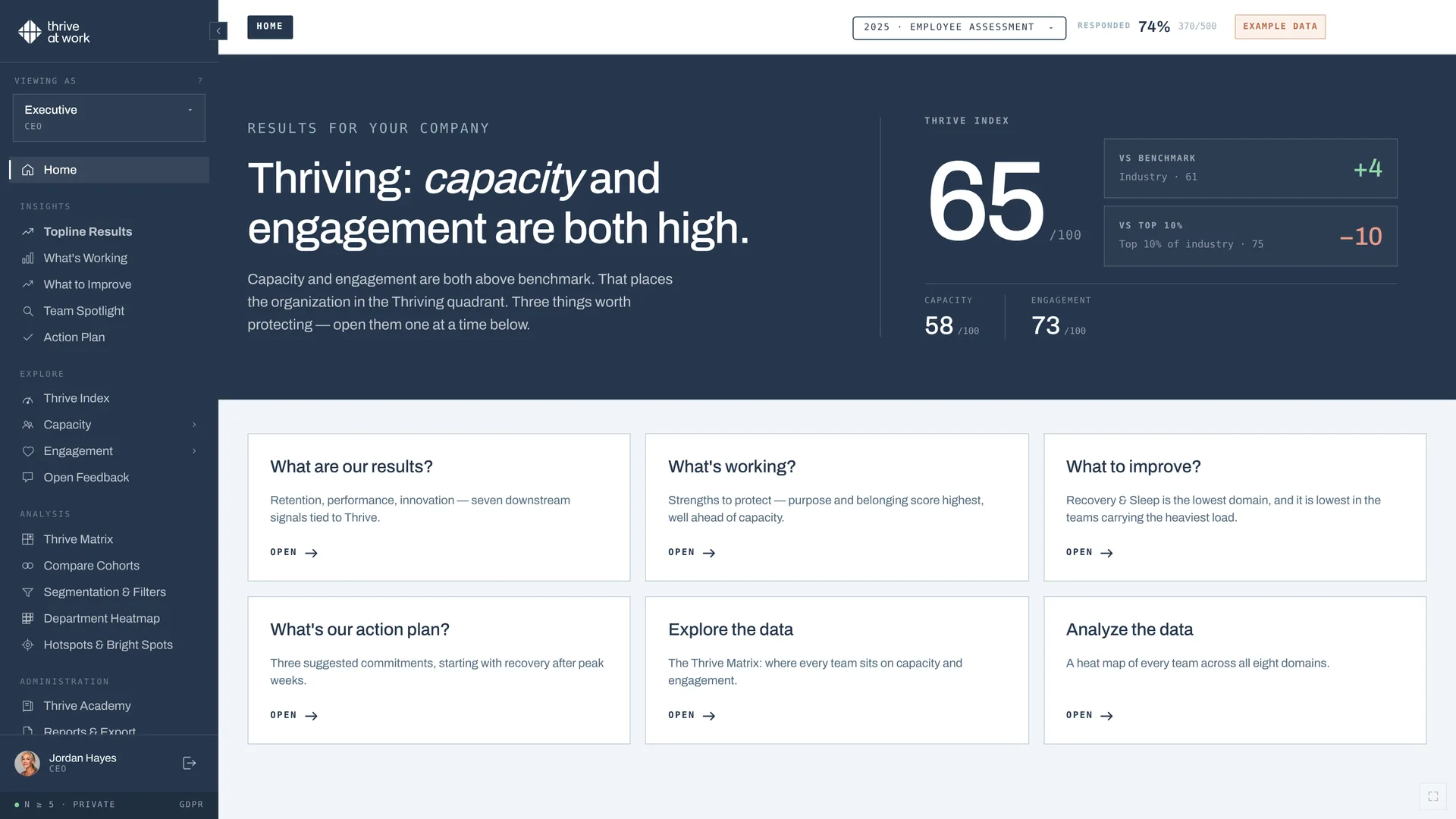
An action plan template for engagement survey results.
| Field | Example |
|---|---|
| Priority | Workload in the support team |
| Evidence | Lowest scores on workload and recovery; comments on evening work |
| Action | Hire one temporary agent for the peak season; pause the internal reporting project |
| Owner | Head of support |
| Date | Agreed with the team, reviewed monthly |
| How we will know | Workload and recovery scores in the next pulse; overtime hours |
thrive at work measures four capacity domains (energy, recovery, focus, resilience) and four engagement domains (purpose, leadership, connection, growth) in one anonymous survey, reported by team from five people: the employee capacity assessment.
Good engagement survey work needs a survey people trust and results managers can act on. In Employee Experience Management (EXM) terms, thrive at work is an employee engagement platform that measures engagement and capacity to perform in one anonymous survey. See the employee survey platform or read more about employee engagement.
Sources.
- CIPD factsheet on employee engagement. www.cipd.org
- Gallup State of the Global Workplace report. www.gallup.com
- thrive index validation study. thrive at work, 2025–26. Methodology.
Common questions
How many questions should an employee engagement survey have?
What is an employee engagement survey?
Should engagement surveys be anonymous?
How often should we run an engagement survey?
Can I use these questions for free?

55 validated statements, eight domains.
A 30-minute call covers how the thrive survey is built and what it reports.