


thrive at work/Employee survey questions
Template · Employee survey
Employee survey questions and template.
An employee opinion survey works when every question earns its place. Here are tested examples by topic and a simple template to start from.
By Jerry Fiser, Founder & CEO · Reviewed by Marcin Bulik, Research Director · Updated November 8, 2026
What is a good sample employee survey?
A good employee survey has 20 to 50 short statements across topics such as job satisfaction, management, teamwork, processes and workload, answered on a five-point agreement scale, plus two open questions. It is anonymous, takes under fifteen minutes and reports by team.
- Write statements, not questions, and test one idea per item.
- Use one agreement scale throughout so results compare.
- Group items by theme and keep the survey under 15 minutes.
- End with one or two open questions, then share results quickly.
Which employee survey do you need?
| Survey | Purpose | Length | How often |
|---|---|---|---|
| Engagement survey | Full picture of engagement and its drivers | 30 to 60 items | Once or twice a year |
| Pulse survey | Track a few priorities between full surveys | 5 to 15 items | Monthly or quarterly |
| Satisfaction survey | How people rate conditions and benefits | 15 to 30 items | Yearly |
| Experience survey | Moments in the employee journey | 5 to 10 items per stage | At each stage |
| Exit survey | Why people leave | 10 to 15 items | At resignation |
The purpose of employee survey questions.
Employee survey questions turn experience into information leaders can act on. Good questions are specific enough to point to a fix, simple enough to answer honestly in seconds, and stable enough to compare over time. Each question should link to a decision: if nobody would act on the answer, the question does not belong in the survey.
An employee survey template.
Start with an introduction that explains why the survey exists and how anonymity is protected. Then group statements by topic, use one agreement scale throughout, add two open questions at the end and close with a thank-you and the date results will be shared.

Employee survey questions by topic.
Wellbeing and capacity
- I usually have enough energy for my work.
- Over the past two weeks I have woken up feeling rested.
- I can switch off from work in my free time.
- I recover quickly after a busy period.
- My workload is manageable.
- I rarely feel overwhelmed by my work.
- I have enough time for focused work.
Manager effectiveness
- My manager gives me useful feedback.
- My manager helps me prioritize when there is too much to do.
- I can talk to my manager about problems.
- My manager recognizes good work.
- My manager supports my development.
- My manager treats everyone on the team fairly.
- My manager keeps their commitments.
Work environment
- I have the tools and equipment I need.
- I can concentrate where I work.
- Our processes help rather than slow me down.
- I know where to find the information I need.
- Meetings are a good use of my time.
- I feel physically safe at work.
- Remote and office colleagues are treated equally.
Team and collaboration
- People on my team help each other.
- I feel part of my team.
- Collaboration with other teams works well.
- I can disagree with colleagues without negative consequences.
- New colleagues are welcomed and supported.
- We celebrate success as a team.
- I trust the people I work with.
Growth and career
- I have learned something new in the last six months.
- I can see a path to grow here.
- I get the training I need.
- I have had a useful conversation about my development recently.
- Internal opportunities are open to people like me.
- My job uses my skills well.
- I am encouraged to try new approaches.
Leadership and communication
- I understand our strategy.
- Leaders explain the reasons behind important decisions.
- I trust senior leadership.
- I receive the information I need to do my job.
- Leaders are visible and approachable.
- I understand how my work contributes to our goals.
- Communication about change is timely.
Fairness and inclusion
- I am treated with respect.
- Promotions go to the people who deserve them.
- Pay is fair for the work I do.
- People from all backgrounds can succeed here.
- Workloads are shared fairly.
- I can be myself at work.
- Concerns about unfair treatment are taken seriously.
Change
- I understand why recent changes were made.
- I was informed early enough.
- My views were considered.
- I have the support I need to adapt.
- I feel confident about the future of my team.
- Changes are followed through.
- I know who to ask about changes.
Satisfaction and commitment
- Overall, I am satisfied with my job.
- I would recommend this organization as a place to work.
- I see myself here in two years.
- I am proud to work here.
- I am willing to go beyond what is expected.
- I rarely think about looking for a job elsewhere.
- My work is meaningful to me.
Open questions
- What should we keep doing?
- What should we change first?
- What gets in the way of your best work?
- What would make you more likely to stay?
- What should leadership know that it may not hear?
- What is one thing your manager could start doing?
- Is there anything else you would like to tell us?
- JobSatisfaction. I enjoy the work I do. My job makes good use of my skills.
- ManagementLeadership. My manager communicates clearly. I get the information I need to do my job.
- TeamCollaboration. My team works well together. Other teams cooperate when we need them.
- ProcessImprovement. Our processes help me get work done. I know how to suggest an improvement. Good ideas get acted on quickly.
- ToolsResources. I have the equipment and software I need.
- WorkloadBalance. I can finish my work in normal hours. I can take breaks during the day.
- FutureCommitment. I plan to be working here a year from now.
More employee survey questions: leadership, change, inclusion and wellbeing.
| Topic | Survey questions |
|---|---|
| Senior leadership | I trust the decisions made by senior leaders. · Leaders communicate openly about how the organization is doing. · Leaders act in line with our stated values. · I understand the reasons behind recent strategic decisions. |
| Change | Changes that affect me are explained in advance. · I have the information I need to adapt to changes. · I was able to give input on changes that affect my work. · Changes are implemented in a way that makes sense. |
| Inclusion | People here are treated fairly regardless of background. · I can be myself at work. · Different perspectives are valued on my team. · I have the same opportunities to grow as others. |
| Wellbeing and capacity | I usually have energy left at the end of the working day. · I can switch off from work in the evening. · My workload is manageable. · I get enough uninterrupted time for focused work. |
| Safety and speaking up | I can raise a concern without fear of negative consequences. · It is safe to admit a mistake on my team. · When I raise a problem, something happens. |
| Communication | I get the information I need to do my job. · I hear about important news from my manager before I hear it elsewhere. · Communication between teams works well. |
| Tools and resources | I have the equipment I need to do my job well. · Our systems help rather than slow me down. · I can find the information I need quickly. |
| Pay and benefits | I am paid fairly for the work I do. · I understand how pay decisions are made. · Our benefits meet my needs. |
Lighter employee survey questions for team check-ins.
Not every survey needs to be formal. In team check-ins, a few lighter questions can open honest conversation: What was the best part of your week? What is one thing that would make next week easier? Which colleague helped you recently, and how? What should we stop doing as a team? Keep these separate from the anonymous survey, because they are about conversation rather than measurement.
Answer scales for employee survey questions.
The answer scale shapes the data as much as the questions. A five-point agreement scale, from strongly disagree to strongly agree, is the most common because it is easy to answer and easy to compare over time. A seven-point scale gives more detail but takes longer and adds little in practice. A 0 to 10 scale suits single questions such as the recommendation question.
| Scale | Best for | Watch out for |
|---|---|---|
| 5-point agreement | Most statements in engagement and experience surveys | Write statements, not questions, so agreement makes sense |
| Frequency (never to always) | Behaviors and states, such as feeling rested | Define the period, such as the past two weeks |
| 0 to 10 | A single recommendation or likelihood question | Do not mix with 5-point items in one index |
| Yes / no | Facts, such as whether a one-to-one took place | Too blunt for opinions |
| Open text | Explaining scores and collecting ideas | Limit to two or three questions |
Keep the same scale throughout a survey and across years. Changing the scale breaks trends, because scores on different scales cannot be compared directly.
Employee survey questions for remote and hybrid work.
Remote and hybrid work raises specific questions: Do I have what I need to work well from home? Do I feel as included as colleagues in the office? Are our availability expectations clear? Can I switch off at the end of the day? Are meetings set up so remote participants can contribute equally? Add four or five of these to your main survey if a large part of your workforce is remote.
Employee survey questions for frontline workers.
My schedule is predictable enough to plan my life. · I have the equipment I need on every shift. · There are enough people on my shift to do the work safely. · My supervisor acts when I raise a problem. · I get breaks during my shift. Keep frontline surveys short and make sure they work on a personal phone during working time.
How to word employee survey questions.
Write statements, not questions, so one scale fits everything. Avoid double questions ("pay and benefits"). Avoid leading words ("our excellent managers"). Use the language employees use, not HR terms. Test the survey on five people before launch.
The CIPD factsheet on employee engagement discusses how employee surveys fit into a wider listening strategy, and the Gallup State of the Global Workplace report shows how engagement is benchmarked across countries.
How many employee survey questions to ask.
Twenty to fifty statements suit a full survey, five to fifteen a pulse. Each extra question costs attention and lowers completion, especially on phones. Start from the decisions the survey should inform and keep only the questions that inform them. The rule of thumb is simple: if nobody would act on it, leave it out, and if a team would act on it, make sure that team sees the result within weeks.
How to avoid bias in employee survey questions.
| Problem | Biased version | Better version |
|---|---|---|
| Double-barreled | My manager is supportive and gives useful feedback. | My manager supports me when things get difficult. (and a separate item on feedback) |
| Leading | How much do you enjoy our excellent training program? | The training I received helps me do my job better. |
| Vague timeframe | I often feel tired. | In the past two weeks, I had energy left at the end of most working days. |
| Jargon | I have adequate psychological safety. | It is safe to admit a mistake on my team. |
| Absolute terms | I am never given recognition. | Good work on my team gets noticed. |
| Negative wording | I do not feel unable to raise concerns. | I can raise a concern without worrying about the reaction. |
Test new questions with a handful of employees before launch. If people ask what a question means, rewrite it.
How to create an employee survey in six steps.
- 1Set the purpose. Decide what you want to learn and what you are willing to change.
- 2Choose the themes. Pick five to eight themes and 30 to 60 statements for a full survey.
- 3Write clear statements. One idea each, a clear time frame, a single agreement scale.
- 4Protect anonymity. Report only for groups of five or more; check open answers.
- 5Announce it well. Explain the purpose, the time needed and when results will be shared.
- 6Act and report back. Share results within weeks and agree actions by team.
Piloting employee survey questions.
Before launch, ask five to ten employees from different roles to complete the survey and tell you which questions were unclear, too long or uncomfortable. Fix those questions, check the survey works on a phone and confirm how long it takes.
How to analyze employee survey results.
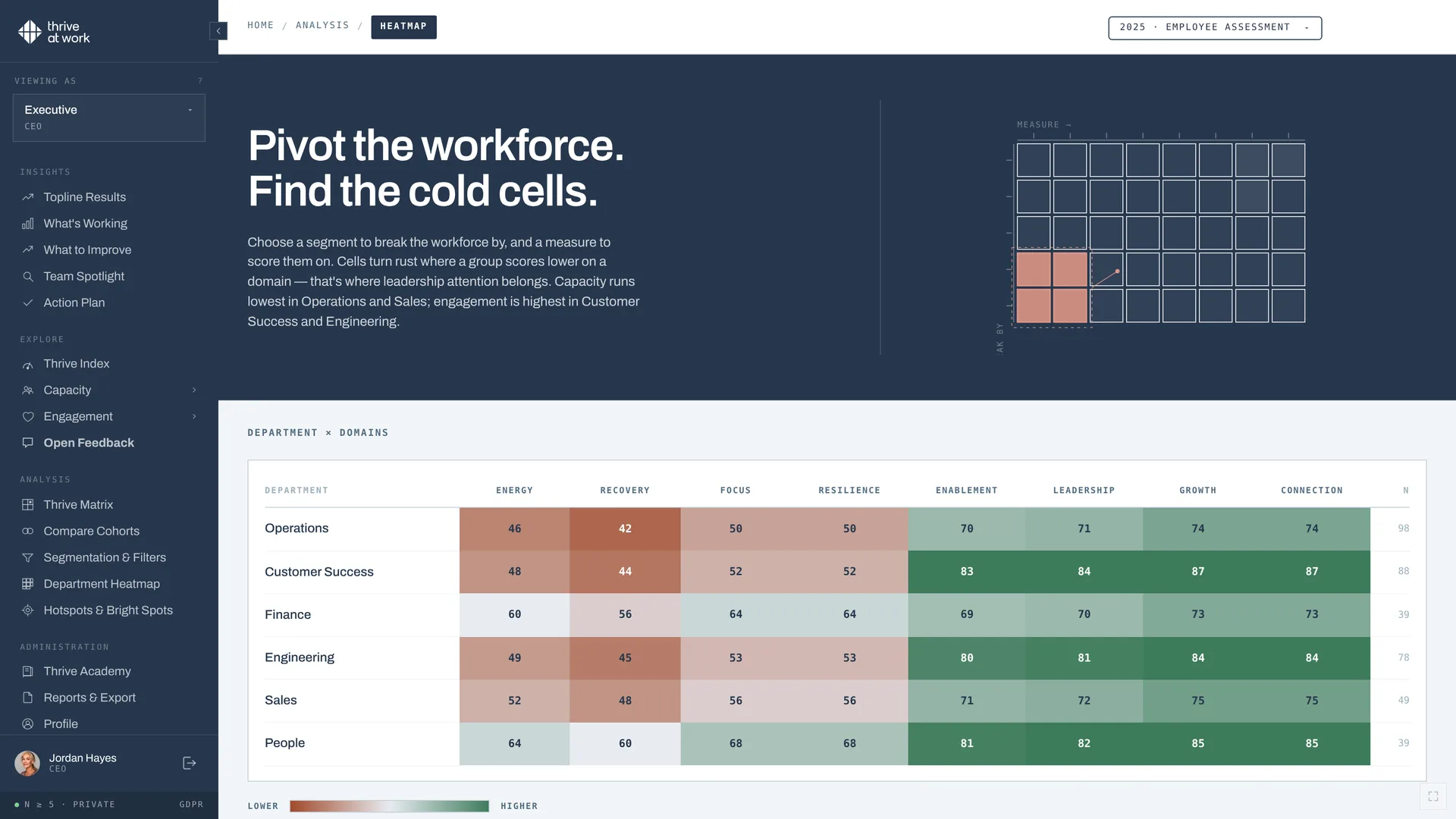
Start with participation by team, so you know which results are representative. Then look at the highest and lowest scores, and at the change since the last survey, which is usually more informative than the absolute level. Compare teams, because problems concentrate. Group open answers into themes and count how often each appears. Finally, read related measures together: an engagement score next to energy and recovery tells you whether people want to give more and whether they can.
Comparing employee survey results.
Compare each team with its own last survey first, then with the company. Changes over time are more meaningful than differences between teams doing different work.
Keeping employee survey answers anonymous.
People answer honestly only when they trust that answers cannot be traced back to them. Three rules protect anonymity. Report results only for groups of five or more people. Do not allow filters that combine into smaller groups, such as one department by age and tenure. And read open answers without names or details that identify the writer, removing such details before sharing.
Explain these rules before the survey, in the invitation and in the survey itself. Say clearly who sees what: company results for everyone, team results for each team and its manager, and no individual answers for anyone. If a survey is confidential rather than anonymous, say so.
Common mistakes with employee survey questions.
Most survey problems come from the wording. Double-barreled items such as "My manager is supportive and gives clear feedback" ask two things at once, so nobody can answer honestly. Leading items such as "How much do you enjoy our great culture?" push people toward a positive answer. Negative wording mixed with positive wording confuses people halfway through.
The other common mistake is asking about things you are not willing to change. If pay will not move this year, a pay question raises expectations you cannot meet. Ask about what you can act on, keep a stable core of items so you can compare over time, and test the survey on a small group before sending it to everyone.
What to do after the employee survey.
- 1Thank people within a day. Say how many took part and when results will be shared.
- 2Share company results within two weeks. Include the low scores, not only the good news.
- 3Give teams their own results. Groups of five or more, discussed in a team meeting.
- 4Agree few priorities. One for the company, one or two per team.
- 5Name owners and dates. Write them where people can see them.
- 6Report progress. Mention changes made because of the survey in regular updates.
- 7Close the loop before the next survey. Show what changed since last time.
thrive at work measures engagement (purpose, leadership, connection, growth) and capacity (energy, recovery, focus, resilience) in one anonymous survey: the employee engagement survey.
Good employee survey work needs a survey people trust and results managers can act on. In Employee Experience Management (EXM) terms, thrive at work is an employee engagement platform that measures engagement and capacity to perform in one anonymous survey. See the employee survey platform or read more about employee engagement.
Sources.
- CIPD factsheet on employee engagement. www.cipd.org
- Gallup State of the Global Workplace report. www.gallup.com
Common questions
What is an employee opinion survey?
How long should an employee survey take?
What are good questions to ask in an employee survey?
Should employee surveys be anonymous?
How many questions should an employee survey have?
What is a good response rate for an employee survey?
What are good questions for an employee opinion survey?

Skip the template. Use a validated survey.
A 30-minute call covers what the thrive survey measures and reports.