


thrive at work/Employee Experience Management
Explainer · EXM
Employee Experience Management (EXM).
Employee Experience Management is the practice of listening to employees across their working life and acting on what they say, continuously, not once a year.
By Jerry Fiser, Founder & CEO · Reviewed by Marcin Bulik, Research Director · Updated November 8, 2026
What is Employee Experience Management?
Employee Experience Management (EXM) is a continuous approach to measuring and improving how employees experience their work, across the whole employee lifecycle. It combines regular surveys, lifecycle feedback and HR data with action planning, so organizations can find and fix the moments that matter most.
- EXM means listening to employees across their journey and acting on it.
- It combines surveys, HR data and feedback loops.
- Software helps, but action planning is what changes experience.
- Include capacity, not just sentiment.
What an Employee Experience Management program covers.
- ListeningSurveys. Annual and pulse surveys, lifecycle surveys at key moments.
- InsightAnalysis. Results by team, driver analysis, links to retention and performance.
- ActionPlans. Team-level action plans and follow-up.
- LearningDevelopment. Guidance for managers and employees on what to change.

The moments that matter in Employee Experience Management.
| Moment | Why it matters | What to measure |
|---|---|---|
| Hiring | First impression; sets expectations | Candidate experience, offer acceptance |
| Onboarding | Decides early retention | Readiness at 30 and 90 days |
| First manager change | A common point where people reconsider | Trust and clarity after the change |
| Promotion or move | Tests whether growth is real | Support in the new role |
| Parental leave and return | A point where many leave | Support before, during and after |
| Reorganization | Uncertainty drains energy | Understanding of the change, workload |
| Exit | The most candid feedback | Reasons, what would have kept the person |
Why employee experience management matters.
People decide whether to stay, how much effort to give and what they tell others about their employer based on many small moments: the first day, a difficult conversation with a manager, a tool that never works, a promotion decision. Managing that experience deliberately, rather than reacting when people leave, protects retention, performance and reputation.
Trust as the basis of Employee Experience Management.
EXM only works when employees trust that feedback is anonymous and leads to change.
Benefits of Employee Experience Management.
A continuous EXM program gives organizations three things that an annual survey alone cannot. It shows problems at the moment they occur, such as a poor onboarding experience, rather than months later. It connects experience to outcomes, by reading survey data next to turnover, absence and performance. And it shows whether changes work, because the same moments are measured again.
For employees the benefit is that feedback leads somewhere. When people see that what they said during onboarding changed the next group’s first weeks, they keep answering honestly.
Employee Experience Management vs engagement surveys.
An engagement survey is one listening tool. EXM is the full system around it: continuous listening, analysis and action. The most useful EXM programs measure not only how people feel about work but whether they have the capacity to sustain it.
The CIPD factsheet on employee engagement places engagement within the wider employee experience, and the Gallup State of the Global Workplace report shows which engagement and wellbeing indicators are tracked globally.
Employee Experience Management compared with related approaches.
| Approach | Focus | Typical rhythm |
|---|---|---|
| Annual engagement survey | Commitment at one point in time | Once a year |
| Employee Experience Management (EXM) | The whole lifecycle, continuously, with action | Ongoing |
| People analytics | Analysis of HR and survey data to answer questions | Project-based or ongoing |
| Performance management | Goals, feedback and evaluation of individuals | Ongoing, with reviews |
How to implement employee experience management.
- 1Map the journey. List the moments that matter most for your people.
- 2Set a listening plan. Annual survey, pulses and stage surveys.
- 3Equip managers. Team results plus simple practices to try.
- 4Fund priority fixes. Decide what leadership will change.
- 5Review quarterly. Track actions and re-measure.
First steps in Employee Experience Management.
Start with one stage that matters most, often onboarding or exit, and one regular survey on engagement and capacity. Share results quickly, act on a few priorities, and report back. Add more listening points only when the organization reliably acts on the ones it has.
Who does what.
| Role | Responsibility |
|---|---|
| Leadership | Sets priorities, funds changes, explains decisions |
| People team | Runs listening, shares results, supports action planning |
| Managers | Discuss results with their team and own two or three actions |
| Employees | Answer honestly, take part in choosing and testing changes |
Programs stall when everything sits with the people team. Results change only when managers own actions in their own teams and leaders remove the obstacles managers cannot.
The manager’s role in Employee Experience Management.
Managers turn experience data into change. Give them their team’s results quickly, in a form they understand without training, with one or two suggested priorities. Ask them to discuss results with the team, agree a change and report back. Support them with a route to escalate issues they cannot fix themselves, such as staffing or tools.
Employee Experience Management maturity levels.
| Level | What it looks like | Next step |
|---|---|---|
| 1. Annual survey | One survey a year, results shared slowly | Share faster; act on few priorities |
| 2. Survey plus lifecycle | Onboarding and exit surveys added | Connect lifecycle data with HR data |
| 3. Continuous listening | Pulses, lifecycle surveys and HR data combined by team | Measure capacity as well as sentiment |
| 4. Experience management | Managers act on team results; changes are tracked and re-measured | Link experience to business outcomes |
The role of technology in employee experience management.
Technology makes listening easier: automated surveys at key moments, dashboards by team, action planning and integration with HR data. It does not replace the human part. Results only change experience when managers discuss them with their teams and leaders fund the fixes. Choose tools that make that loop easy, protect anonymity and measure capacity as well as sentiment.
AI in Employee Experience Management.
AI is increasingly used to summarize open comments, spot themes across large numbers of responses and suggest actions. Used well, it saves analysts many hours and helps managers see patterns quickly. Used carelessly, it can expose individuals, especially in small teams where a comment can be traced to its writer.
Apply the same rules as for any survey analysis: minimum group sizes, no output that identifies individuals, human review of suggested actions and clear information for employees about how their answers are processed. In Germany and other countries with works councils, AI tools that process employee data usually require works council involvement.
What to look for in Employee Experience Management software.
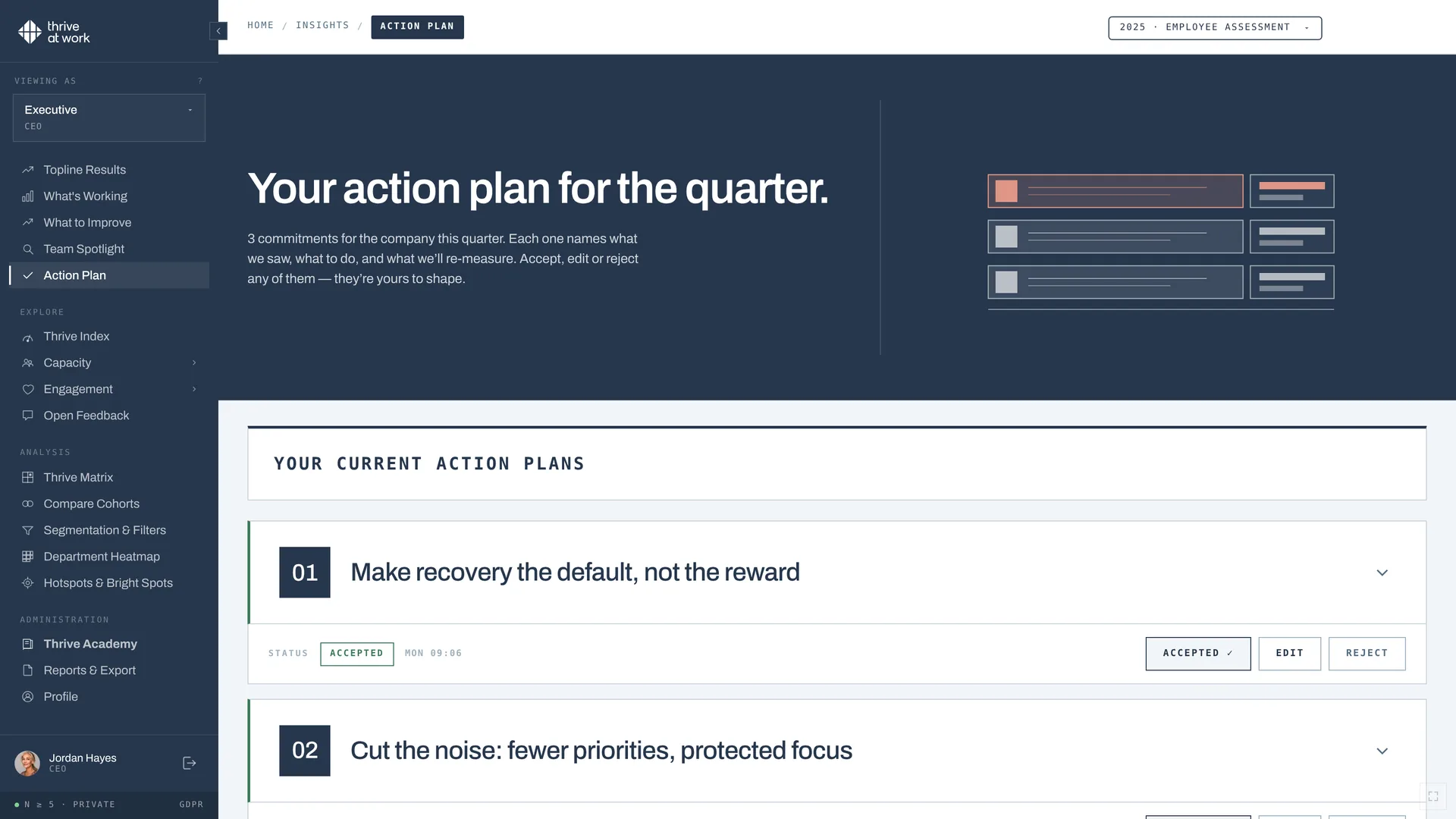
Validated questions, strong anonymity rules, reporting by team, action planning, and measures that predict outcomes such as retention and burnout risk. thrive at work is a workforce performance platform that measures capacity and engagement together. See how to choose an employee experience platform.
Look for anonymous surveys with minimum group sizes, results by team that managers can understand without training, and simple action planning. Check that it measures what predicts outcomes you care about, including capacity: energy, focus, recovery and resilience, not only sentiment.
Ask vendors how results translate into action, how long a survey takes, and how data is protected. thrive at work uses one survey of statements across eight domains, about 12 minutes, with results from groups of five people or more.
Common Employee Experience Management mistakes.
The most common mistake is collecting more feedback than the organization can act on. Too many surveys with no visible change make people stop answering. Fewer listening points with clear follow-up work better.
The second is measuring only sentiment. People can feel positive about their team and still be running out of energy. Including capacity (energy, focus, recovery and resilience) shows whether the experience is sustainable, not just pleasant.
How to measure an EXM program.
Track three things: whether people take part and trust the process, whether teams act on results, and whether experience and capacity scores improve at the moments you targeted. Read them next to turnover and absence by team to see whether the program changes outcomes.
thrive at work measures engagement (purpose, leadership, connection, growth) and capacity (energy, recovery, focus, resilience) in one anonymous survey: the employee engagement survey.
Good EXM work needs a survey people trust and results managers can act on. In Employee Experience Management (EXM) terms, thrive at work is an employee engagement platform that measures engagement and capacity to perform in one anonymous survey. See the employee survey platform or read more about employee engagement.
Sources.
- CIPD factsheet on employee engagement. www.cipd.org
- Gallup State of the Global Workplace report. www.gallup.com
Common questions
What does EXM stand for?
Is EXM the same as employee engagement?
What is employee experience management?
What is an EXM platform?
Why is employee experience management important?

EXM that measures capacity as well as engagement.
A 30-minute call covers what the platform measures and reports.