


thrive at work/Improving employee productivity
Guide · Productivity
How to improve employee productivity.
Productivity rises when people have clear priorities, time to focus and the energy to do their best work. It rarely rises because someone is watching harder.
By Jerry Fiser, Founder & CEO · Reviewed by Marcin Bulik, Research Director · Updated November 8, 2026
How can you improve employee productivity?
Clarify priorities, protect time for focused work, cut unnecessary meetings and approvals, give people the tools and skills they need, and keep workload sustainable so energy and recovery stay high. Measure output and outcomes, not hours.
- Productivity rises when obstacles fall: fewer interruptions, clearer priorities.
- Long hours lower output over time.
- Energy, focus and recovery drive sustainable productivity.
- Measure outcomes, not activity or screen time.
What is employee productivity?
Employee productivity is the value a person or team produces relative to the time and resources used. In practice it means delivering the right work, at the right quality, on time, without burning people out. Output per hour is part of the picture, but for knowledge work the bigger question is whether time goes to the work that matters most.
Why employee productivity matters.
Productivity is the link between the work people do and what the organization achieves. When it rises because work gets simpler, everyone gains: customers get faster service, teams finish more of what matters and people go home on time. When it rises because people work longer and harder, the gain is short and the cost arrives later as mistakes, absence and resignations.
For knowledge work the question is less how much people do and more whether their time goes to the work that matters most. A team that spends half its week in meetings and messages can look busy and still deliver little. Productivity improves fastest when that time comes back.
What drives employee productivity.
| Driver | Why it matters |
|---|---|
| Clear priorities | People spend time on what matters most |
| Focus time | Complex work needs uninterrupted blocks |
| Good tools and processes | Less time lost to friction |
| Skills and training | People can do the work well and fast |
| Manager support | Obstacles get removed quickly |
| Engagement | People care about the outcome |
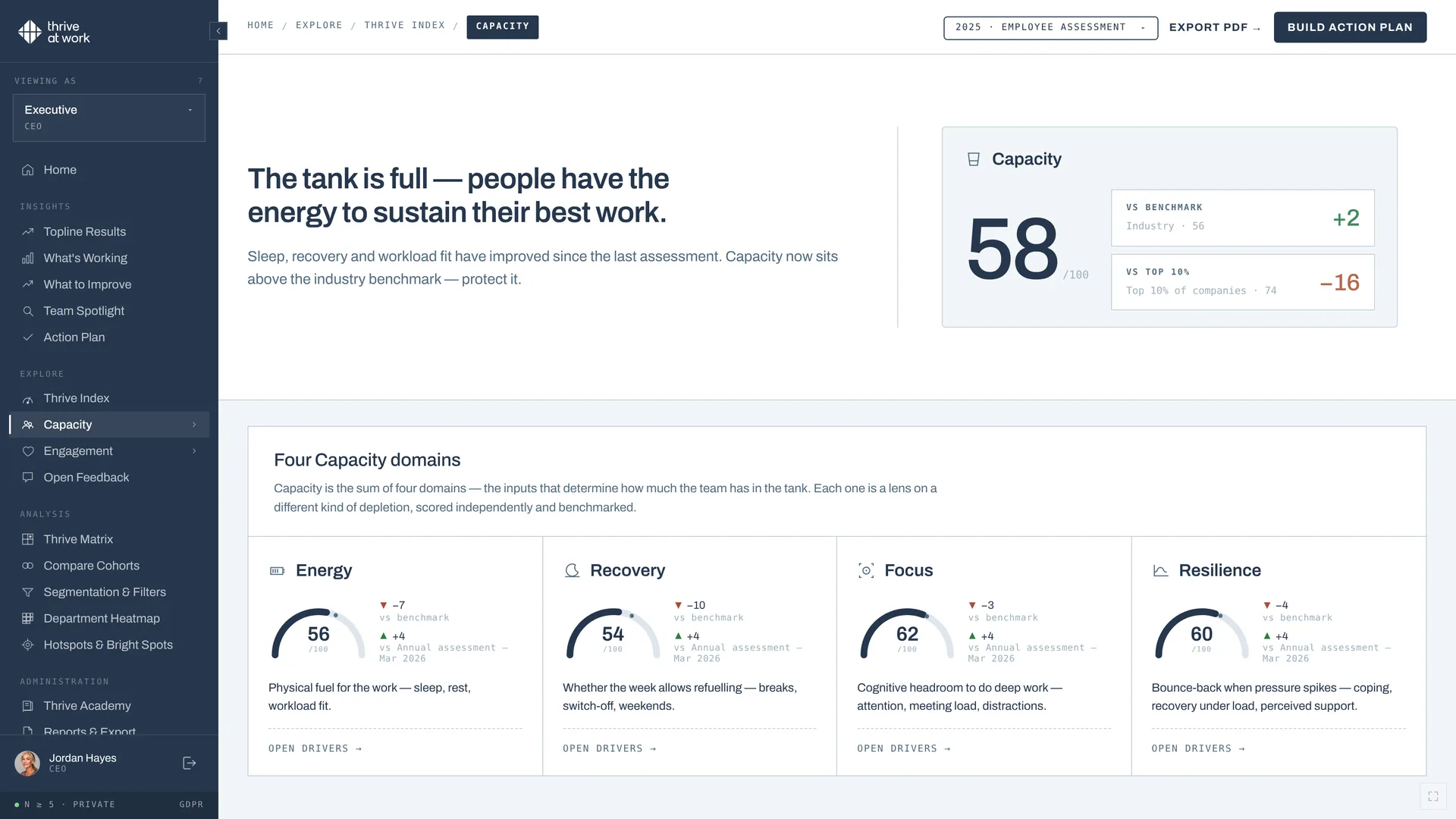
| Capacity | Energy, recovery and focus make sustained output possible |
thrive research found that people with the least capacity, meaning energy, focus, recovery and resilience, delivered 56% of priority work on time, against 86% for those with the most.
Factors that affect employee productivity.
| Level | Factors |
|---|---|
| Organization | Clear strategy, sensible staffing, decision rights, processes, tools |
| Team | Priorities, meeting load, handovers, collaboration norms |
| Manager | Clarity of goals, feedback, removing obstacles, workload decisions |
| Individual | Skills, energy, focus, recovery, motivation |
Most productivity programs focus on the individual level, with training and tools. The larger gains usually sit at the organization and team levels, where a single decision, such as cutting a recurring meeting or clarifying who decides, gives time back to everyone.
How engagement affects productivity.
Engaged people care about the outcome, take initiative and help colleagues, all of which raise productivity. But engagement only turns into output when people have the capacity to act on it. A highly engaged team that is running out of energy will keep trying, make more mistakes and eventually burn out. Read engagement and capacity together to see where productivity can grow and where it needs protecting.
Capacity: the productivity factor most measures miss.
Output measures show what was delivered. They do not show what it cost. A team can keep output high for months while its energy, focus and recovery fall, and the drop in output arrives only when people start making mistakes, taking short absences or resigning.
Measuring capacity next to output gives an early warning. When capacity falls in a team, productivity is likely to follow, and there is still time to act on workload, recovery and focus.
Productivity and burnout: the trade-off that is not one.
Pushing for more hours can raise output for a short time, but sustained overwork lowers focus, increases mistakes and leads to absence and turnover. The most productive organizations treat recovery as part of performance: realistic workloads, quieter periods after peaks and norms that let people switch off. Measuring energy, recovery and focus alongside output shows whether today’s productivity is sustainable or borrowed from next quarter.
Sustainable productivity in practice.
Sustainable productivity means delivering steadily without running people down. In practice it looks like planned workload, protected focus time, real breaks and leave, and quick action when energy falls. Teams that work this way deliver less in their best week but more over a year.
The biggest blockers to employee productivity.
| Blocker | Fix |
|---|---|
| Constant interruptions | Protected focus time, fewer meetings |
| Unclear priorities | One ranked list per team |
| Too much work in progress | Limit open projects |
| Poor tools | Ask teams what slows them down |
| Low energy | Sustainable hours and real breaks |
thrive research found that people in the lowest quarter for capacity (the energy, focus, recovery and resilience a person has available) lost 71 more days a year to not working effectively than those in the highest. In working time, that is worth about €19,800 a year per employee.
The best question for finding productivity blockers.
Ask every team: "What wasted the most time last week?" The answers are specific, comparable across teams and point straight to a fix. Repeat the question monthly and track whether the same answers keep coming back.
Common causes of low employee productivity.
| Cause | How it shows | First fix |
|---|---|---|
| Unclear priorities | People work hard on the wrong things; deadlines collide | One ranked list per team, agreed with the manager |
| Too many meetings | Little time for focused work; work moves to evenings | Cancel or shorten recurring meetings; default to written updates |
| Constant interruptions | Tasks take far longer than they should | Agreed quiet hours; batch messages |
| Too much work in progress | Many tasks started, few finished | Limit open projects per person |
| Slow approvals | Work waits for sign-off | Raise approval limits; clarify who decides |
| Poor tools and processes | Workarounds, duplicate entry, searching for information | Ask the team what wastes time and fix one thing a month |
| Skills gaps | Work redone, slow progress on new tasks | Training, pairing, clear examples |
| Low energy and recovery | More mistakes, slower work, short absences | Sustainable hours, real breaks, workload relief |
Most low productivity comes from conditions, not from people. Before concluding that someone is underperforming, check whether the same causes affect the whole team.
How to improve employee productivity: practical ways.
On hours and health, the WHO and ILO analysis of long working hours found working 55 or more hours a week linked to higher risk of heart disease and stroke. The CIPD factsheet on wellbeing at work covers how wellbeing and performance connect.
- 01Fewer priorities. Agree the top three per person each week.
- 02Protected focus time. Blocks without meetings or notifications.
- 03Fewer meetings. Cut, shorten or make asynchronous.
- 04Remove obstacles. Fix slow approvals, tools and handovers.
- 05Train. Close skill gaps that slow work down.
- 06Delegate decisions. Let people decide without waiting.
- 07Protect recovery. Tired people are slower and make more mistakes.
- 08Give feedback. Short, frequent feedback beats annual reviews.

Employee productivity improvement examples.
The following examples are illustrative. A support team that answered every message as it arrived introduced two daily blocks without chat and a triage rule for urgent requests; tickets closed per day rose and evening work fell. A product team with five weekly status meetings replaced three with a written update; the time saved went into planned work. A finance team with a slow approval chain raised approval limits for routine spending; month-end close moved forward by days.
In each case the change was small, removed a step rather than adding one, and was checked after a month against the team’s own baseline.
12 ways to increase employee productivity.
- 1Set fewer priorities. Rank the work and agree what can wait.
- 2Protect focus blocks. Two or three meeting-free blocks a week.
- 3Cut meetings. Shorter, fewer, with clear agendas and decisions.
- 4Limit work in progress. Finish before starting new projects.
- 5Fix broken tools. Ask teams what slows them down.
- 6Automate repetitive tasks. Free time for judgment and creativity.
- 7Train people. Skills gaps cost time every day.
- 8Delegate decisions. Fewer approvals, faster work.
- 9Set response-time norms. Not everything needs an instant reply.
- 10Give regular feedback. Small course corrections early.
- 11Recognize progress. Motivation follows visible progress.
- 12Protect recovery. Sustainable pace beats bursts and crashes.
Protecting time for focused work.
Focused work is where most valuable output comes from, and it is the first thing lost when calendars fill up. Agree team-wide focus blocks, reduce standing meetings, set expectations for message response times, and make it normal to turn notifications off.
Then look at recovery. People cannot focus well on poor sleep and no breaks. Long hours raise output for a short time and lower it after that. Protecting a stopping time is a productivity measure, not a perk.
A simple focus rule.
Agree two mornings a week without meetings and keep them for the team’s most important work.
What managers can do this week.
Managers influence productivity more than any tool. They decide what the team works on, how many priorities run in parallel, how often people are interrupted and whether obstacles get removed quickly. The most productive teams usually have managers who say no to low-value work, protect focus time, make decisions quickly and check regularly whether the workload is realistic.
A simple weekly habit helps: ask each person what they are working on, what is in their way and what can wait. Remove one obstacle each week. Over a quarter, that habit often does more for output than any productivity program.
- 1Cancel one recurring meeting. Replace it with a short written update.
- 2Rank the priorities. Give each person one clear top priority.
- 3Remove a blocker. Ask the team what slows them down and fix one thing.
- 4Protect focus time. Agree two blocks a week with no meetings or messages.
Using one-to-ones to improve productivity.
Ask three questions in every one-to-one: What is your top priority this week? What is getting in the way? What can I take off your plate? The answers show where time is lost and give the manager a concrete obstacle to remove. Over weeks, this habit returns more time than most productivity tools.
Productivity in remote and hybrid teams.
Remote work can improve focus and remove commuting, but it can also fragment the day with messages and video calls. Agree core hours for collaboration, keep other time free for focus, write decisions down so people do not need meetings to stay informed, and use office days for work that benefits from being together.
Hybrid productivity tips that work.
Hybrid work changes where time is lost. At home, people often focus better but lose time to unclear priorities and slow answers. In the office, collaboration is easier but focus suffers. Plan the week around this: use office days for collaboration, workshops and onboarding, and home days for focused work.
Agree response times for different channels, so people know when an answer is needed now and when it can wait. Write decisions down, so that people who were not in the room can act on them. And make availability explicit, including when the working day ends, so that flexible hours do not turn into longer hours.
Why employee monitoring rarely increases productivity.
Tracking keystrokes, screen time or mouse movement measures activity, not value. It often lowers trust, encourages people to look busy rather than do the important work and can harm the very focus that drives output. Measure outcomes instead and ask teams what gets in the way.
Productivity, trust and autonomy.
People do their best work when they have a clear goal and room to decide how to reach it. Autonomy is not the absence of management; it is management by outcome rather than by activity. Managers who agree what good looks like and then step back get more ownership than managers who check every step.
Trust also changes what people report. In a team where problems can be raised safely, blockers surface early and get fixed. In a team where bad news is punished, problems stay hidden until they become expensive. Raising a problem should feel like part of the job, not a risk.
Productivity tools that help, and those that do not.
Useful tools remove steps: shared task boards that make priorities visible, templates that remove repeated work, automation for routine steps and good search so people find information quickly. Tools that add messages, notifications and dashboards without removing work tend to lower productivity. Before adding a tool, ask what it replaces and how much time it saves each week.
How to cut meetings without losing alignment.
- 1List every recurring meeting. With its purpose, length and attendees.
- 2Cancel those without a decision or clear purpose. Replace status updates with a written note.
- 3Shorten the rest. Default to 25 or 50 minutes instead of 30 or 60.
- 4Invite fewer people. Share notes with those who only need to know.
- 5Protect focus blocks. Agree times when no meetings are scheduled.
- 6Review after a month. Ask the team whether anything important was lost.
How to measure employee productivity.
Measure output per role (tickets resolved, projects delivered, sales closed), quality and customer outcomes. Hours and keystrokes measure activity, not productivity, and monitoring software tends to reduce trust. Survey measures of focus and energy show the conditions for productivity.
| Metric | What it shows | Watch out for |
|---|---|---|
| Work delivered on time | Reliability on priorities | Gaming deadlines |
| Quality and rework | Whether speed costs quality | Hidden rework |
| Cycle time | How long work takes from start to finish | Comparing unlike work |
| Customer outcomes | Value created for customers | Lagging signal |
| Capacity scores | Whether the pace is sustainable | Read by team, never individually |
Balancing productivity measures.
Combine output measures with quality and capacity measures. Output alone can rise while quality and energy fall; reading all three together shows whether gains will last.
A 30-day plan to improve employee productivity.
- 1Week 1: ask. Ask each team what slows them down most. Collect a list and pick the top three.
- 2Week 1: measure the baseline. Note current output on two or three measures the team already tracks, plus energy and focus in a short pulse.
- 3Week 2: clear the calendar. Cancel one recurring meeting per team and protect two focus blocks a week.
- 4Week 2: rank priorities. Give every person one clear top priority and say what can wait.
- 5Week 3: remove a blocker. Fix the most-named obstacle, such as an approval step or a broken tool.
- 6Week 3: limit work in progress. Agree a maximum number of open projects per person.
- 7Week 4: check. Compare output and the pulse with the baseline; ask the team what changed.
- 8Week 4: decide. Keep what worked, drop what did not, pick the next blocker.
Employee productivity checklist for managers.
| Question | Yes / no |
|---|---|
| Does every person know their top priority this week? | |
| Does every person have at least two blocks of uninterrupted time a week? | |
| Have we cancelled or shortened a recurring meeting this quarter? | |
| Do people know who decides what, without escalating? | |
| Are approvals fast enough that work rarely waits? | |
| Do people have the tools and training they need? | |
| Is workload sustainable without regular evening work? | |
| Do we measure outcomes rather than hours or activity? | |
| Have we asked the team what slows them down in the past month? | |
| Do energy and recovery hold during busy periods? |
Every "no" points to a concrete improvement. Start with the one the team names first.
thrive at work measures engagement (purpose, leadership, connection, growth) and capacity (energy, recovery, focus, resilience) in one anonymous survey: the employee engagement survey.
Productivity data only tells part of the story when people are running low. thrive at work is a workforce performance platform: an employee engagement platform that measures capacity to perform (energy, recovery, focus and resilience) next to engagement, by team. Read more about employee capacity.
Sources.
- WHO and ILO analysis of long working hours. www.who.int
- CIPD factsheet on wellbeing at work. www.cipd.org
- thrive index validation study. thrive at work, 2025–26. Methodology.
Common questions
What reduces employee productivity most?
Does employee monitoring increase productivity?
What are the best ways to improve productivity at work?
How do you measure employee productivity?
Does remote work increase productivity?
What are the main factors that affect employee productivity?
How can managers improve team productivity quickly?
What is the fastest way to improve employee productivity?
Does working longer hours increase productivity?
How do you measure productivity in knowledge work?
Do productivity tools help?

Find what is slowing your teams down.
A 30-minute call covers what focus and energy scores show.