


thrive at work/How to prevent employee burnout
Guide for HR · Burnout prevention
How to prevent employee burnout.
Burnout is prevented by changing the conditions people work in, not by asking tired people to be more resilient. This guide covers what causes it, the steps that work in order, what to do when someone is already burning out, and how to know whether prevention is working.
By Jerry Fiser, Founder & CEO · Reviewed by Marcin Bulik, Research Director · Updated November 8, 2026
How can companies prevent employee burnout?
Measure strain early, then change the conditions that cause it: match workload to the people available, give people control over how they work, protect recovery time, train managers to spot early signs, recognize effort fairly and act on unfair treatment. Wellbeing programs help only when the workload itself is sustainable. Re-measure after three to six months to see whether conditions changed.
More guides on burnout.
Burnout self-check · Stages of burnout · Nurse burnout · Teacher burnout · Compassion fatigue vs burnout · Returning to work after burnout · Mindfulness and burnout · Coping with stress at work · Eustress vs distress
- Burnout comes from six work conditions: workload, control, reward, community, fairness and values.
- Remove work before adding wellbeing programs.
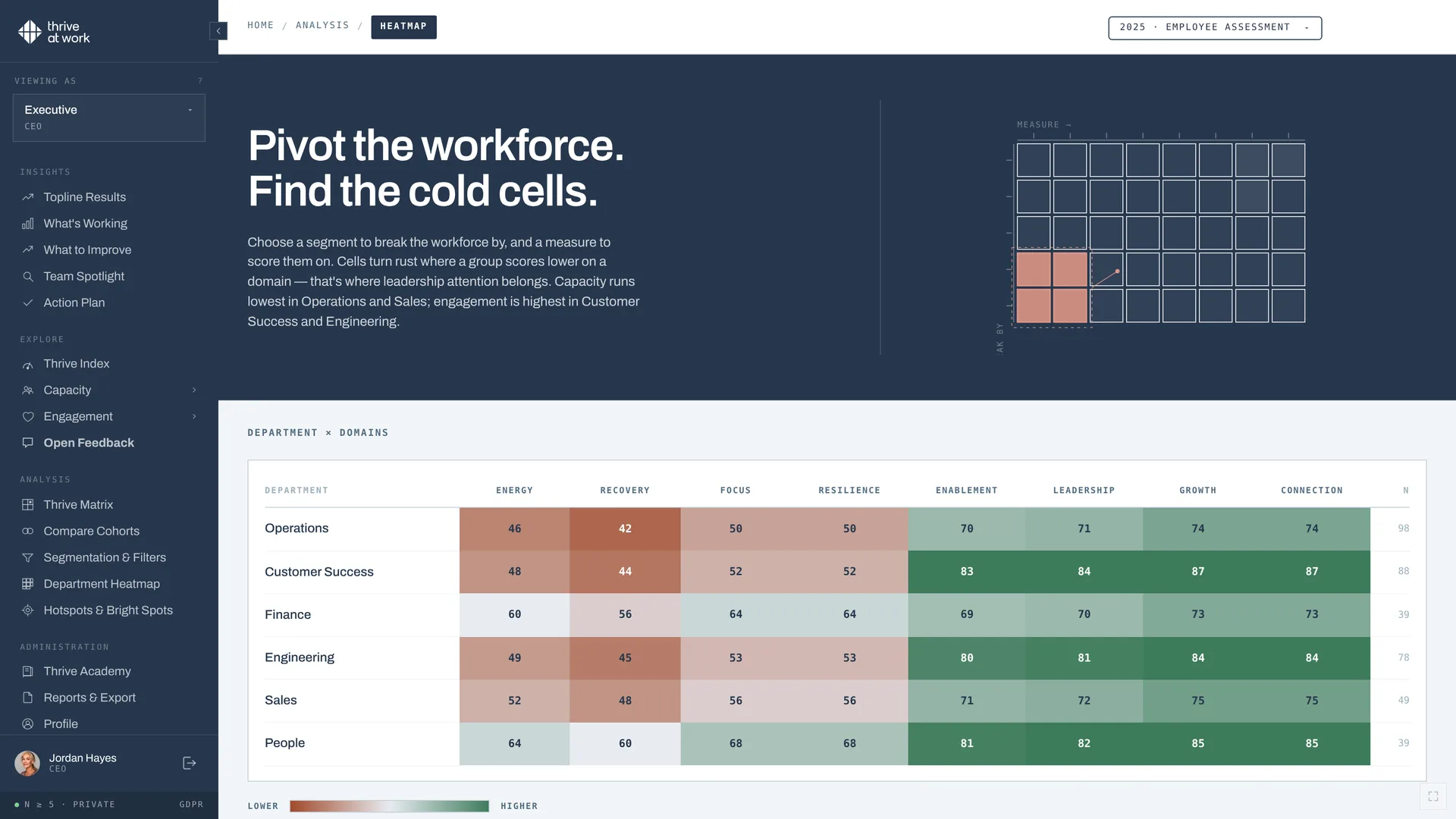
- Measure capacity by team; risk concentrates, often in the best teams.
- Re-measure in three to six months; recovery moves first.
The six conditions behind employee burnout.
Burnout is an occupational phenomenon, as the World Health Organization, ICD-11 puts it: it comes from chronic workplace stress that has not been managed. Burnout researchers Christina Maslach and Michael Leiter describe six areas of work life where a mismatch between the person and the job builds strain.
| Condition | What goes wrong | What prevention looks like |
|---|---|---|
| Workload | More work than people and hours available | Plan capacity before committing to deadlines; stop projects when teams are full |
| Control | Little say over how, when and in what order work is done | Agree outcomes and let teams choose the route |
| Reward | Effort goes unnoticed | Specific, timely recognition and fair pay |
| Community | Conflict, isolation, low support | Time together, managers who check in, action on conflict |
| Fairness | Favoritism and opaque decisions | Explain decisions; apply rules consistently |
| Values | Work clashes with what people believe in | Connect work to purpose; do not ask people to cut corners |
How to spot early signs of employee burnout.
Prevention works best before anyone is exhausted. Early signs show up as poorer sleep and energy, shorter tempers, fewer ideas and more small mistakes. In teams, watch for rising short absences, quieter meetings and the same few people doing all the urgent work. Survey measures of recovery often fall first, which is why measuring capacity, not only engagement, helps. See signs of burnout at work.
Team-level warning signs of burnout.
Watch team patterns as well as individuals: overtime rising for several weeks, more short absences, quieter meetings, more irritation in conversations and falling energy and recovery scores in surveys. Several signs at once in one team call for a workload review, not individual coaching.
The cost of employee burnout for businesses.
Burnout costs money long before anyone resigns. Exhausted people work at reduced capacity, make more mistakes and take more time off, and colleagues absorb the extra work. When people do leave, replacement adds recruiting, onboarding and ramp-up costs. thrive research found that people in the lowest quarter for capacity (the energy, focus, recovery and resilience a person has available) lost 71 more days a year to not working effectively than those in the highest. In working time, that is worth about €19,800 a year per employee. Estimate your own exposure with the cost of burnout calculator.
What thrive research shows about capacity and burnout.
thrive research shows how much capacity matters. In the validation study, the share of people who did not report running out of energy rose from 17% among the lowest-scoring tenth of employees to 79% among the highest-scoring tenth. See the methodology and estimate your own exposure with the cost of burnout calculator.
How to prevent employee burnout: eight steps.
The WHO guidelines on mental health at work recommend organizational interventions, such as changes to workload and schedules, alongside manager training and individual support. The UK Health and Safety Executive guidance on work-related stress gives a step-by-step risk assessment.
- 01Measure capacity, not just engagement. Ask about energy, recovery, focus and resilience as well as motivation. Engagement alone misses people who are committed but depleted.
- 02Find the hot spots. Look at results by team and role. Burnout risk concentrates in specific places, often the highest-performing teams.
- 03Remove work before adding programs. Cut meetings, reports and low-value projects in the teams under most strain. A wellbeing program on top of an overloaded week is one more task.
- 04Protect recovery. Out-of-hours norms, real vacations, no messages expected in the evening. Leaders go first and say so.
- 05Give control. Let teams shape how and when they work where possible. Control is one of the strongest buffers against strain.
- 06Train managers. Managers need to recognize early signs, hold the first conversation and know which levers they can pull. See the signs of burnout at work.
- 07Recognize effort fairly. Lack of recognition and perceived unfairness are strong drivers of burnout.
- 08Measure again. Re-measure after three to six months. Recovery usually falls first, so it is also the first place improvement shows.
Five things to do this month to prevent employee burnout.
Look at team workload against the people available and move or drop one project. Protect two blocks of focused time a week. Make sure everyone has planned leave in the calendar. Ask managers to hold a short workload conversation with each person. Measure energy and recovery so you can see whether the changes help.
A burnout prevention plan in four steps.
- 1Assess. Measure energy, recovery, workload and engagement by team in an anonymous survey.
- 2Identify what needs to change. Pick the two or three conditions that matter most in each team, such as workload, control or support.
- 3Act. Change those conditions: remove work, add resources, clarify priorities, protect recovery.
- 4Monitor and adjust. Measure the same items again after three months and adjust.
A burnout prevention plan template.
| Step | What to decide | Example |
|---|---|---|
| Measure | Which teams, how often, which measures | Capacity and engagement survey every six months, pulse quarterly |
| Prioritize | Which teams need action first | Teams where capacity fell most since the last survey |
| Act on conditions | Which demands to remove or resources to add | Pause one project, add cover in peak weeks, protect focus time |
| Equip managers | What managers need to spot and act on strain | Training in workload conversations; monthly check-ins |
| Support individuals | Where people can get confidential help | Counseling service, clear route to occupational health |
| Review | When and how to check whether it worked | Re-measure the same statements after three months |
Preventing burnout: what managers can do this week.
Ask each person, "What is the one thing making work hard right now?" and act on one answer. Look at who has not taken leave in six months. Check who is carrying the most critical projects and move one. End meetings five minutes early. None of this needs a budget.
Managers decide most of the daily conditions that create or prevent burnout. The most effective habits are simple: regular one-to-ones that ask about workload and energy, saying no to extra work when the team is full, recognizing effort as well as results, and checking in after intense periods. Give managers their team’s survey results and two or three practices to try, and check back after a quarter.

Policies that help prevent employee burnout.
| Policy | What it does |
|---|---|
| Right to disconnect or availability norms | Protects evenings and weekends |
| Workload planning | Matches demand to the people available |
| Leave that people actually take | Makes recovery normal, not exceptional |
| Flexible work where possible | Gives control over when and where work happens |
| Manager training | Helps managers notice strain and act early |
| Confidential support | Gives people somewhere to turn early |
Policies only work if leaders model them. A right to disconnect means little if senior people send messages at midnight.
A right-to-disconnect practice for preventing burnout.
Clear rules on availability protect recovery. Agree when people are expected to answer messages, use scheduled sending for messages outside working hours, and make it normal not to reply in the evening. Leaders set the tone: when leaders send messages at night, people assume they are expected to answer. Several European countries have legal rights to disconnect; even without a law, a team agreement makes recovery possible.
Preventing burnout in remote teams.
Remote teams need deliberate boundaries: agreed response times, meeting-free blocks, short breaks between video calls and a clear end to the working day. Managers should check in on workload more often, because the usual visual cues are missing.
Preventing burnout in frontline and shift work.
Frontline workers face different strains from office workers: unpredictable schedules, understaffed shifts, physical demands and little control over the pace of work. Prevention focuses on these conditions: enough people on each shift, schedules published well in advance, real breaks, working equipment and supervisors who act when people raise problems.
Survey frontline teams in a way that fits their day: short, on a phone, during working time, with results shared in pre-shift huddles.
What employees can do to prevent burnout.
Organizations carry most of the responsibility, but individual habits help people hold up while conditions change. Protect sleep and a regular stopping time, take breaks away from the screen, keep up movement and time with people outside work, and raise workload problems early instead of absorbing them. None of this fixes an impossible workload, but it slows the slide while the workload is being fixed.
When an employee is already burning out.
- 1Talk privately. Listen first. Describe what you have noticed without labels.
- 2Give immediate relief. Fewer tasks, clearer priorities, time off if needed.
- 3Refer to support. Employee assistance program, occupational health or a doctor. Do not diagnose.
- 4Plan the return. A gradual return with agreed limits and regular check-ins.
- 5Look at the team. One burned-out person is often the first visible sign of a wider problem.
Supporting a return after burnout.
Plan a gradual return with reduced hours and workload, agree regular check-ins and adjust as needed.
How to measure burnout risk before people leave.
| Measure | Why it helps | How often |
|---|---|---|
| Energy and recovery | Usually fall first | Each pulse or survey |
| Workload manageability | Shows where demand outruns capacity | Each pulse or survey |
| Engagement | Shows who is still giving extra effort | Once or twice a year |
| Short absences by team | Early behavioral signal | Monthly |
| Overtime and leave not taken | Shows where recovery is missing | Monthly |
Read engagement and capacity together. On the Thrive Matrix, high engagement with low capacity is the quadrant called Burning out: the people most likely to leave suddenly.
thrive at work measures four capacity domains (energy, recovery, focus, resilience) and four engagement domains (purpose, leadership, connection, growth) in one anonymous survey, reported by team from five people: the employee capacity assessment.
Most burnout problems show up first as falling energy, recovery and focus. thrive at work is a workforce performance platform: an employee engagement platform that also measures capacity to perform, so you can see strain by team before it turns into absence or resignations. Read more about employee capacity.
Sources.
- World Health Organization, ICD-11. www.who.int
- WHO guidelines on mental health at work. www.who.int
- UK Health and Safety Executive guidance on work-related stress. www.hse.gov.uk
- thrive index validation study. thrive at work, 2025–26. Methodology.
Common questions
What is the most effective way to prevent burnout?
Are wellbeing programs enough to prevent burnout?
How do you deal with employee burnout?
What role do managers play in burnout prevention?
How do you measure burnout risk?
How can employees avoid burnout?
What causes employee burnout most often?
Can employee burnout be prevented?
What are the three main causes of burnout?

Prevent burnout with a number, not a guess.
A 30-minute call covers what a first capacity measurement would show for your teams.