


thrive at work/Signs of burnout at work
Guide for managers · Burnout
Signs of burnout at work.
Burnout rarely arrives suddenly. It shows up first in sleep, patience and focus, then in how a person talks about their work, and only much later in a resignation. This guide is for managers and HR: what to look for, in people and in teams, and what to do when you see it.
By Jerry Fiser, Founder & CEO · Reviewed by Marcin Bulik, Research Director · Updated November 8, 2026
What are the signs of burnout at work?
The signs follow the three dimensions the World Health Organization uses: exhaustion that rest does not fix, growing mental distance or cynicism about the job, and reduced effectiveness. In practice managers see it first as poor sleep and fatigue, irritability, slipping focus and more mistakes, longer hours with less output, withdrawal from the team, and talk about work that has turned negative. In teams it shows as rising short absences, quiet meetings and resignations that seem to come out of nowhere.
More guides on burnout.
Burnout self-check · Stages of burnout · Nurse burnout · Teacher burnout · Compassion fatigue vs burnout · Returning to work after burnout · Mindfulness and burnout · Coping with stress at work · Eustress vs distress
- Burnout has three dimensions: exhaustion, mental distance and reduced effectiveness.
- The earliest signs are sleep and recovery, not mood.
- Team patterns, such as rising short absences, are easier to act on than individual signs.
- Engaged people are often most at risk, and engagement surveys can hide it.
The three dimensions behind the signs of burnout.
The World Health Organization, ICD-11 describes burnout as an occupational phenomenon that results from chronic workplace stress that has not been successfully managed. It is not classified as a medical condition. Every sign below belongs to one of its three dimensions, which makes them easier to spot and to talk about without diagnosing anyone.
| Dimension | What it feels like | What a manager sees |
|---|---|---|
| Exhaustion | Drained, tired after a full night, weekends no longer reset | Low energy in meetings, more sick days, slower responses |
| Mental distance or cynicism | Detached, negative, going through the motions | Sarcasm about the job or customers, cameras off, fewer ideas |
| Reduced effectiveness | Effort no longer makes a difference | More mistakes, missed deadlines, longer hours for less output |
Early signs of burnout at work.
These appear months before anyone says the word burnout. They are also the easiest to reverse.
- 01Sleep stops working. Waking up tired after a full night, or lying awake thinking about work. Recovery is usually the first thing to fall.
- 02Weekends stop resetting. Monday feels as heavy as Friday. Time off is spent catching up or recovering, not living.
- 03A shorter fuse. More irritation with colleagues, customers or family, often over small things.
- 04Focus slips. Reading the same email three times, more small errors, difficulty starting demanding work.
- 05Longer hours, less output. Working more to keep up and still falling behind. This is often praised as commitment.
- 06Skipping breaks and holidays. Lunch at the desk, vacation postponed, out-of-office never switched on.

Later signs of burnout at work.
- 07Exhaustion that rest does not fix. Physical and mental tiredness that a weekend or a week off barely touches.
- 08Cynicism. Talking about the job, the company or customers with growing detachment or bitterness.
- 09Withdrawal. Fewer contributions, skipping optional meetings, stepping back from colleagues.
- 10Loss of meaning. Work that used to matter feels pointless.
- 11Self-doubt. The sense that nothing you do is good enough, even when results are fine.
- 12Physical symptoms. Headaches, stomach problems, getting ill more often. These need a doctor, not a manager, to interpret.
Physical, emotional and behavioral signs of burnout.
| Physical | Emotional | Behavioral |
|---|---|---|
| Tiredness that sleep does not fix | Feeling drained or empty | Withdrawing from colleagues |
| Headaches, tension, getting ill more often | Cynicism about the job | Working longer for less output |
| Disturbed sleep | Irritability and impatience | Missing deadlines, more mistakes |
| Changes in appetite | Feeling that effort makes no difference | Avoiding meetings or switching off cameras |
No single sign proves burnout. A cluster of signs that lasts for weeks, especially exhaustion plus distance from work, is the signal to act.
Signs of burnout in teams.
Individual signs are easy to miss or to explain away. Team patterns are harder to ignore, and they point at the conditions behind burnout rather than at one person.
For employer guidance beyond spotting signs, see the WHO guidelines on mental health at work and the CIPD factsheet on stress at work.
- 13Short absences rising. A cluster of one- and two-day absences in one team.
- 14Quiet meetings. Less challenge, fewer ideas, the same few voices.
- 15Resignations that feel sudden. They rarely are. The strain was visible earlier to anyone measuring it.
- 16Top performers fading. The most committed people often run out first, because they keep going longest.
- 17Engagement high, energy low. Survey scores look healthy while people describe themselves as tired.

Team-level signs of burnout to track.
Rising overtime, more short absences, quieter meetings and falling energy scores in surveys are team-level signs worth tracking every month.
Signs of burnout in remote employees.
Remote burnout is harder to see. Watch for messages sent late at night, cameras that stay off in meetings that used to be lively, slower replies, fewer contributions in shared channels and a drop in quality. Ask directly in one-to-ones how people are coping, and look at team-level survey measures of energy and recovery.
Why the most engaged people are most at risk.
Burnout needs sustained effort under sustained load, and commitment is what supplies the effort. Engaged people volunteer, say yes and stay late. They also answer engagement surveys positively and honestly, so a strong engagement score can hide a team that is running out.
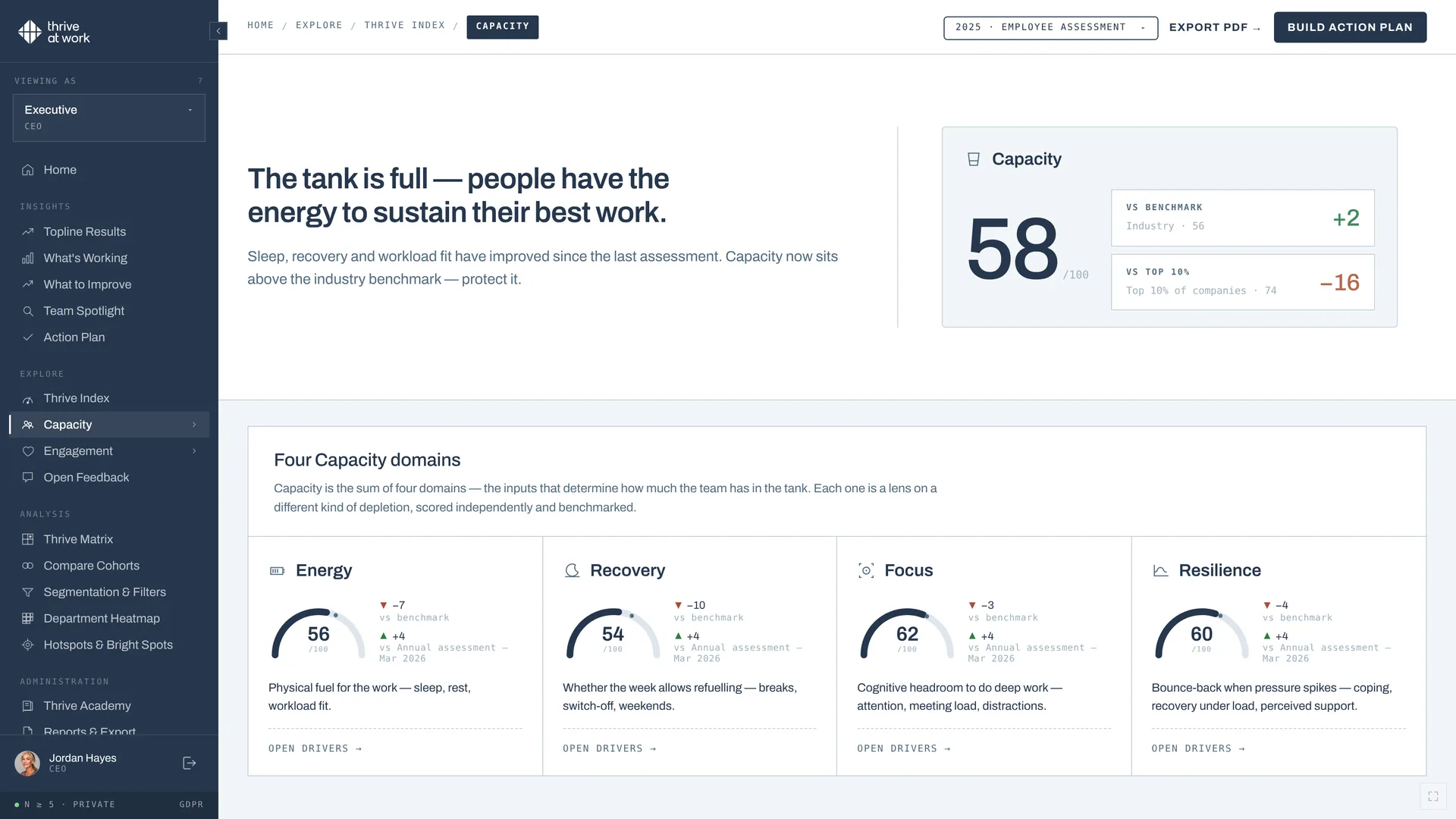
thrive research shows the cost of that pattern: employees who are highly engaged but burning out lose three times as many days to not working effectively. People with the least capacity delivered 56% of priority work on time, against 86% for those with the most. That is why thrive at work measures capacity next to engagement and reads the two together on the Thrive Matrix, where this group sits in the quadrant called Burning out.
Burnout, stress or depression?
| Stress | Burnout | Depression | |
|---|---|---|---|
| Core feeling | Too much | Too little: energy, connection, effect | Low mood across life |
| Scope | Usually tied to a situation | Specific to work | Not limited to work |
| Engagement | Still trying hard | Pulling away from the work | Loss of interest in most things |
| What helps | Reducing pressure | Changing work conditions and recovery | Clinical assessment and treatment |
Managers should never diagnose. The job is to notice, ask, change what the organization controls and point people to professional support, such as an employee assistance program, occupational health or a doctor, when signs persist.
A quick self-check for signs of burnout.
- 1Energy. Do I wake up tired even after a full night’s sleep?
- 2Recovery. Do weekends and evenings no longer reset me?
- 3Distance. Have I become cynical or detached about work I used to care about?
- 4Effect. Do I feel my effort no longer makes a difference?
- 5Duration. Has this lasted more than a few weeks?
The first conversation.
- 1Pick a private moment. Not in a performance review. Say what you have noticed in neutral terms: "You have been working late most nights and seem tired."
- 2Ask, then listen. "How are you finding the workload at the moment?" Let silence do some of the work.
- 3Agree one change now. Remove a task, move a deadline, protect time off. Something concrete this week.
- 4Offer support. Point to the employee assistance program or occupational health, without pressure.
- 5Follow up. Check in again within a week, and look at whether the same pattern shows in the rest of the team.
What to do when you see signs of burnout at work.
For a manager, the first step is a private conversation that describes what you have noticed without diagnosing, followed by one concrete change to workload or priorities. For HR, the next step is to check whether the same signs appear across a team, because burnout usually has shared causes. For an individual, it is to talk to someone early, at work and, if symptoms are strong, to a doctor. See how to prevent employee burnout.
Three things managers can do this week about signs of burnout.
First, ask the person how they are doing, in private and without judgment. Second, look at their workload and remove or move one task. Third, agree a check-in within a week. If signs are severe or lasting, point the person to confidential support and occupational health.
thrive at work measures four capacity domains (energy, recovery, focus, resilience) and four engagement domains (purpose, leadership, connection, growth) in one anonymous survey, reported by team from five people: the employee capacity assessment.
Most burnout problems show up first as falling energy, recovery and focus. thrive at work is a workforce performance platform: an employee engagement platform that also measures capacity to perform, so you can see strain by team before it turns into absence or resignations. Read more about employee capacity.
Sources.
- World Health Organization, ICD-11. www.who.int
- WHO guidelines on mental health at work. www.who.int
- CIPD factsheet on stress at work. www.cipd.org
- thrive index validation study. thrive at work, 2025–26. Methodology.
Common questions
What is the first sign of burnout?
How do I know if an employee is burned out or just stressed?
Can someone be burned out and still perform well?
Should managers ask employees about burnout?
How does employee burnout affect organizations?
What causes employee burnout?
What is the difference between stress and burnout?

See the signals at team level.
A 30-minute call covers how capacity measurement shows strain months before people leave.