


thrive at work/Work engagement
Explainer · Engagement
What work engagement means.
In research, work engagement is a state of mind: energy, dedication and absorption in the work itself. It is close to employee engagement, but not the same.
By Jerry Fiser, Founder & CEO · Reviewed by Marcin Bulik, Research Director · Updated November 8, 2026
What is work engagement?
Work engagement is a positive, fulfilling state of mind at work, described by researchers Wilmar Schaufeli and Arnold Bakker through three dimensions: vigor (energy and persistence), dedication (enthusiasm and pride) and absorption (being fully focused). It is commonly measured with the Utrecht Work Engagement Scale.
- Work engagement is a state of vigor, dedication and absorption in the work.
- Employee engagement is broader: commitment to the organization.
- Work engagement and burnout are related but not simple opposites.
- Engaged people can still burn out if capacity runs low.
The three dimensions of work engagement.
| Dimension | What it means | Example statement |
|---|---|---|
| Vigor | High energy and persistence at work | At work, I feel full of energy. |
| Dedication | Enthusiasm, pride and a sense of meaning | I am proud of the work I do. |
| Absorption | Being fully focused, time passes quickly | Time flies when I am working. |
The three dimensions come from the Utrecht Work Engagement Scale; the scale and the research behind it are published on the research site of Wilmar Schaufeli. The CIPD factsheet on employee engagement compares this with organizational definitions of engagement.

Vigor, dedication and absorption: what each dimension of work engagement looks like.
| Dimension | What it means | How it shows at work | What erodes it |
|---|---|---|---|
| Vigor | High energy, mental resilience and persistence | Starting the day ready, keeping going when work gets hard | Long hours, poor sleep, no recovery between busy periods |
| Dedication | Strong involvement, enthusiasm, pride, sense of meaning | Caring about the outcome, talking about work with pride | Unclear purpose, decisions that ignore the people doing the work |
| Absorption | Full concentration, time passes quickly | Long stretches of focused work, losing track of time | Constant interruptions, too many meetings, too many open tasks |
The three dimensions usually move together, but not always. Vigor is the first to fall under heavy load, while dedication can stay high for months. That is why highly dedicated people can look engaged while they are running low on energy.
Work engagement vs employee engagement.
Work engagement is about the relationship between a person and their work. Employee engagement, as used by HR, is broader: it includes commitment to the organization, trust in leadership and intention to stay. A person can love their work and still plan to leave the employer.
Work engagement and related concepts.
| Concept | What it means | How it differs from work engagement |
|---|---|---|
| Employee engagement | Commitment to the organization and its goals | Broader; includes attitudes to the employer |
| Job satisfaction | Contentment with the job | Passive; people can be satisfied without energy or involvement |
| Flow | Full absorption in a single activity | A short state; engagement is more lasting |
| Workaholism | Compulsive drive to work | Driven by pressure, not enjoyment; recovery is poor |
| Burnout | Exhaustion, distance, reduced efficacy | The opposite pole on energy and involvement |
Levels of work engagement.
| Level | What it looks like |
|---|---|
| Highly engaged | Energetic, absorbed, proud of the work; gives extra effort |
| Engaged | Reliable and committed; does good work consistently |
| Neutral | Does what is asked; little extra energy |
| Disengaged | Detached, low energy, minimal effort |
| Actively disengaged | Openly negative; may undermine others |
Levels shift over time. A person can move from highly engaged to exhausted within months if demands stay high and recovery stays low, which is why engagement should be read together with capacity.
What each level of work engagement means for managers.
Highly engaged people need protection more than motivation: their risk is overwork. Moderately engaged people respond well to clearer goals, recognition and growth. People with low engagement need a conversation about what has changed, starting with workload and energy, because exhaustion often looks like disinterest.
Examples of work engagement in everyday work.
| High work engagement | Low work engagement |
|---|---|
| A nurse finishes a shift tired but satisfied, and looks forward to the next one | A nurse counts the hours and dreads the next shift |
| A developer loses track of time while solving a hard problem | A developer switches between tasks all day and finishes nothing |
| A sales rep talks about a customer win with pride | A sales rep describes the job only in terms of targets |
| A team volunteers ideas to simplify a process | A team does exactly what is asked and no more |
Low work engagement is not laziness. It often reflects conditions: work that has lost meaning, too little control, constant interruptions or exhaustion.
The job demands and resources model of work engagement.
A widely used way to understand work engagement is the job demands and resources model. Job demands are the parts of work that require sustained effort, such as workload, time pressure and emotional demands. Job resources are the parts that help people achieve goals and grow, such as autonomy, feedback, support from colleagues and managers, and development opportunities.
Resources fuel engagement; demands, when they are high for long periods without enough resources, drain energy and lead toward burnout. The practical message is clear: to raise work engagement, increase resources and keep demands within limits people can sustain.
When job demands lower work engagement.
Demands lower engagement when they are chronic, unclear or outside a person’s control, such as constant interruptions, conflicting priorities or long-term understaffing. Challenging demands that come with support and clear goals tend to raise it.
Job resources that raise work engagement.
In the job demands and resources model, engagement grows when people have enough resources to meet the demands of their job. Resources can sit in the job, the team or the person.
| Type | Examples | What managers can do |
|---|---|---|
| Job resources | Autonomy, variety, feedback, clear goals | Agree outcomes and leave room for how; give regular feedback |
| Social resources | Supportive manager, helpful colleagues, fair treatment | Hold one-to-ones; encourage help across the team |
| Organizational resources | Career opportunities, recognition, explained decisions | Make next steps visible; explain the why behind changes |
| Personal resources | Energy, recovery, optimism, confidence | Protect recovery time; build skills step by step |
Demands are not the enemy. Challenging work raises engagement when resources keep pace. Engagement falls when demands keep rising and resources do not.
Why work engagement matters.
Engaged people focus better, take more initiative, help colleagues and stay longer. Teams with high work engagement adapt more easily to change. The benefits hold only while energy lasts: engagement without capacity turns into overcommitment, and overcommitment is a common route to burnout.
Work engagement and business outcomes.
Research across many studies links work engagement with better performance, more helping behavior, fewer absences and lower intention to leave. These are associations, observed when engaged and less engaged groups are compared, rather than proof that engagement alone causes the outcomes.
The practical point is that engagement is an early signal. It changes before turnover, absence and performance figures do, which gives managers time to act. Read it next to capacity: engagement shows whether people want to give effort, capacity shows whether they can keep it up.
Engagement and burnout.
Researchers often describe work engagement as the positive opposite of burnout: vigor against exhaustion, dedication against cynicism. In practice the two can sit together for a while. Highly dedicated people can keep going while their energy runs down, which is why thrive at work measures capacity separately from engagement.
Research often describes work engagement and burnout as linked states. Engagement combines high energy with strong identification with the work; burnout combines exhaustion with distance from it. People do not simply switch from one to the other, but sustained high demands without enough resources can move highly engaged people toward exhaustion. That is why the most engaged people are sometimes the first to burn out.
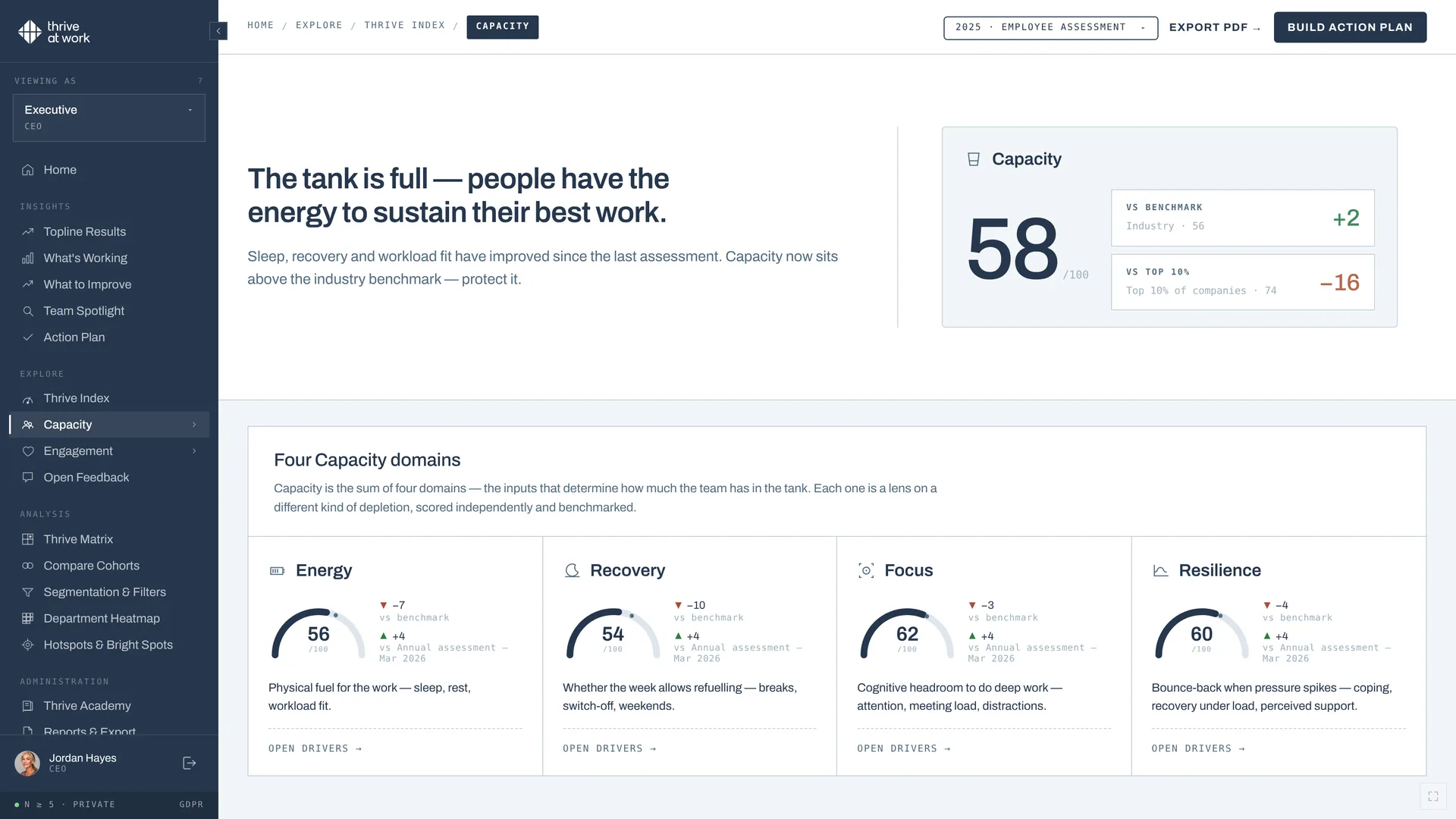
The practical lesson is to watch both at once. Engagement scores tell you whether people are willing; capacity measures such as energy, recovery and focus tell you whether they can keep going. thrive research shows that employees who are highly engaged but burning out lose three times as many days to not working effectively.
Measuring work engagement.
Work engagement is usually measured with short scales of statements about energy, dedication and absorption, rated for how often people feel that way. Measure it by team and read it together with capacity measures such as recovery and focus.
High scores with falling recovery are a warning sign: people are still absorbed in their work but running down the energy that makes it possible. That combination often comes before burnout, so treat it as a reason to look at workload, not as a success.
| Measure | Example statement |
|---|---|
| Vigor | At work, I feel full of energy. |
| Dedication | My job inspires me. |
| Absorption | I get carried away when I am working. |
| Job resources | My manager gives me useful feedback. |
| Job demands | I have enough time to do my work well. |
| Recovery | I can switch off after work. |
Measure engagement together with the resources and demands behind it, by team, so results point to specific changes.
Run a full survey once or twice a year to set priorities, then use short pulses to track progress. Measure again after major changes, such as a reorganization, a new manager or a shift to hybrid work, because engagement and capacity often move quickly at those moments.
Questions used to measure work engagement.
Work engagement is usually measured with short scales of statements rated by how often people feel that way. The statements below follow the three dimensions and can be used in a team survey; they are written in plain language rather than copied from a published scale.
| Dimension | Example statements |
|---|---|
| Vigor | At work, I feel full of energy. · I can keep going for a long time at work. · When I get up in the morning, I look forward to work. |
| Dedication | My work is meaningful to me. · I am proud of the work I do. · My work inspires me. |
| Absorption | Time passes quickly when I am working. · I am fully focused when I work. · I get carried away by my work. |
Add statements about energy and recovery outside work, such as "I can switch off in the evening". High absorption combined with poor recovery is a warning sign rather than a success.
How to raise work engagement.
Work engagement grows when people have the resources to meet the demands of the job: clear goals, enough autonomy, useful feedback, supportive colleagues and a manager who removes obstacles. It falls when demands rise with no matching resources.
That is why engagement programs that focus only on mood often fade. Look at the job itself: Is the workload realistic? Do people have time for focused work? Can they recover between busy periods? thrive research measures energy, focus, recovery and resilience next to engagement for exactly this reason.
- 1Give more autonomy. Let people decide how to reach agreed goals.
- 2Make feedback regular. Short, specific feedback every week or two.
- 3Connect work to impact. Share customer stories and results.
- 4Create learning moments. Stretch tasks, peer learning, time to practice.
- 5Remove obstacles. Fix the tools and processes that waste time.
- 6Protect recovery. Plan quieter periods after intense ones.
- 7Celebrate progress. Notice small wins, not only big results.
A plan to raise work engagement in a team.
- 1Measure by team. Survey engagement and capacity, reported for groups of five or more.
- 2Find the weakest dimension. Low vigor points to load and recovery; low dedication to purpose; low absorption to interruptions.
- 3Ask the team. Share results and ask what is behind the weakest area.
- 4Change one condition. Remove a demand or add a resource, such as a focus day or clearer goals.
- 5Check in monthly. Discuss progress and energy in one-to-ones.
- 6Measure again. Check the same statements after three to six months.
What managers can do to raise work engagement.
Managers shape most of the job resources that fuel engagement. They decide how much autonomy people have, how often feedback happens, whether problems get solved and whether work feels meaningful. Simple habits make a difference: regular one-to-ones focused on obstacles and growth, recognition that names specific contributions, involving people in decisions about their work and protecting time for focused work.
Using one-to-ones to raise work engagement.
A regular one-to-one is the simplest tool for work engagement. Ask what gave the person energy this week and what drained it, what got in the way of focused work and what they would like to learn next. Then remove one obstacle. Over time these conversations raise vigor, dedication and absorption more than any program.
What employees can do to stay engaged.
Engagement is not only the employer’s job. People can shape their own work, sometimes called job crafting: taking on tasks that use their strengths, building relationships with colleagues who energize them, and reframing how their work helps others. They can also protect the recovery that keeps engagement sustainable, by setting boundaries and raising workload problems early.
Protecting your own work engagement.
Notice what gives you energy at work and what drains it, protect time for focused work, take real breaks, and talk to your manager early when workload keeps rising.
When work engagement becomes overwork.
There is a difference between being absorbed in work and being unable to stop. Engaged people enjoy their work and can switch off. People who overwork feel driven to keep working, feel guilty when they stop and often recover poorly. From the outside both look committed.
Signs that engagement is turning into overwork include regular evening and weekend work, difficulty switching off, skipped holidays and rising irritability. Managers can help by noticing late messages, asking about recovery and making it normal to stop. See signs of overworking.
Work engagement in remote and hybrid work.
Remote work can support engagement through autonomy and fewer interruptions, but it can also weaken connection and feedback, two important job resources. Teams that stay engaged remotely tend to have regular one-to-ones, clear goals, visible recognition and deliberate time together. Watch recovery closely, because absorption in work can turn into long hours when there is no commute to end the day.
Practical tips for work engagement in remote teams.
Agree clear outcomes rather than monitoring activity, protect focus time from constant messages, hold regular one-to-ones on video, and make sure remote colleagues get the same recognition and growth opportunities as those in the office. Ask about switching off, because remote work blurs the end of the day.
Raising work engagement in a team: an example.
The following example is illustrative. A design team scores high on dedication but low on vigor and absorption. Comments mention constant requests from other teams and no time to finish work. The team agrees a single intake channel for requests, two meeting-free mornings a week and a weekly review of priorities with the product lead. Three months later, absorption and vigor have risen, and the team reports finishing more of its planned work.
thrive at work measures engagement (purpose, leadership, connection, growth) and capacity (energy, recovery, focus, resilience) in one anonymous survey: the employee engagement survey.
Good engagement work needs a survey people trust and results managers can act on. In Employee Experience Management (EXM) terms, thrive at work is an employee engagement platform that measures engagement and capacity to perform in one anonymous survey. See the employee survey platform or read more about employee engagement.
Sources.
- research site of Wilmar Schaufeli. www.wilmarschaufeli.nl
- CIPD factsheet on employee engagement. www.cipd.org
- thrive index validation study. thrive at work, 2025–26. Methodology.
Common questions
What are the three dimensions of work engagement?
Is work engagement the opposite of burnout?
What is work engagement?
How is work engagement measured?
What increases work engagement?
What are examples of work engagement?
Is work engagement the same as job satisfaction?
Can you be too engaged at work?

Measure engagement and the energy behind it.
A 30-minute call covers what a first measurement would show.