

thrive at work/AI readiness assessment
Guide · HR and AI
AI readiness assessment: check your people, not just your data.
Most AI readiness checklists look at data, systems and budgets. Rollouts usually stall for a different reason: people are tired, unsure or stretched. This guide covers the people side.
By Jerry Fiser, Founder & CEO · Reviewed by Marcin Bulik, Research Director · Updated November 8, 2026
What is an AI readiness assessment?
An AI readiness assessment checks whether an organization is prepared to adopt AI well. Technical readiness covers data, systems and security. People readiness covers skills, trust in leadership, clarity about roles, and whether teams have the capacity, meaning energy, focus and time, to learn new ways of working. A rollout needs both.
- Readiness has a technical side and a people side; most checklists cover only the first.
- People readiness covers skills, trust, clarity and capacity.
- Teams that are already depleted adopt AI slowly and burn out faster.
- Assess by team, not company-wide, and repeat after rollout.
- Use results to sequence the rollout, not just to score it.
Two kinds of readiness.
| Technical readiness | People readiness | |
|---|---|---|
| Questions | Is our data clean? Are systems secure? Do we have budget? | Do people have the skills, trust, clarity and capacity to change how they work? |
| Owner | IT, data, security | HR, leaders, managers |
| Typical gap | Data quality | Workload and trust |
| Measured by | Audits, architecture reviews | Surveys, interviews, team data |
Technical readiness decides whether AI can be deployed. People readiness decides whether it will be used well.
Five dimensions of people readiness.
- 1Skills. Can people use AI tools safely and well for their tasks?
- 2Trust. Do people believe leaders will use AI fairly and tell them the truth about jobs?
- 3Clarity. Do people know where AI is expected, allowed and off limits?
- 4Capacity. Do teams have the energy, focus and time to learn something new?
- 5Engagement. Do people care enough about the work to want it done better?
Why capacity is the missing dimension.
Learning a new way of working takes energy. A team that is already stretched will treat AI as one more demand. In a 2024 survey by the Upwork Research Institute, 77% of employees who used AI said it had added to their workload, and 47% did not know how to achieve the gains expected of them. Teams with low capacity at the start are the most likely to end up in that group, and the most likely to slide toward AI burnout.
thrive research shows how wide the range is: the share of people who did not feel regularly overwhelmed rose from 15% in the lowest-scoring tenth to 98% in the highest-scoring tenth. Starting an AI rollout in a team at the bottom of that range is a different project from starting it at the top.
AI readiness assessment questions.
| Dimension | Example statements (agree to disagree) |
|---|---|
| Skills | I know how to use AI tools for the main tasks in my role. I know how to check AI output for errors. |
| Trust | I trust leaders to be honest about how AI will affect jobs here. I believe AI will be used fairly. |
| Clarity | I know which tasks I am expected to use AI for. I know which data I must not put into AI tools. |
| Capacity | My workload leaves time to learn new tools. Over the past two weeks I have had energy left at the end of the day. |
| Engagement | I care about improving how my team works. I would recommend this organization as a place to work. |
| Open | What would make AI genuinely useful in your work? What worries you most? |
Keep it short, anonymous and repeatable, and report only for groups large enough to protect anonymity.
How to read the results.
Read results by team, not as one company score. A useful approach is to sort teams into four groups: ready (high capacity, high trust), willing but stretched (high engagement, low capacity), capable but skeptical (high capacity, low trust) and not ready (low on both). Each group needs a different start.
| Group | What to do first |
|---|---|
| Ready | Start pilots here and let these teams teach others |
| Willing but stretched | Remove work before adding tools; protect learning time |
| Capable but skeptical | Explain plans, involve them in design, be specific about jobs |
| Not ready | Fix workload and trust first; AI can wait a quarter |

Running an AI readiness assessment: step by step.
- 01Agree the purpose. Tell people why you are asking and what you will do with the answers.
- 02Involve employee representatives. In Germany, check works council rights before you start.
- 03Run a short anonymous survey. Ten to twenty statements, plus two open questions.
- 04Add a technical review. Data, systems and security, owned by IT.
- 05Read results by team. Use the four groups to sequence the rollout.
- 06Share results and the plan. Within a few weeks, with named next steps.
- 07Re-assess after rollout. Same questions, three to six months later.

Common mistakes.
Assessing only technology. Averaging across the company, which hides the teams most at risk. Asking about AI enthusiasm instead of workload. Running the assessment once and never again. And launching pilots in the busiest teams because they "need help most", which often makes them the first to burn out.
AI literacy and the EU AI Act.
Article 4 of the EU AI Act asks employers that use AI to take measures to support the AI literacy of staff who work with it. An AI readiness assessment gives a starting point for that: it shows which teams need training first and in what.
Measuring capacity with thrive at work.
thrive at work measures engagement and capacity (energy, recovery, focus and resilience) by team in one anonymous assessment and places teams on the thrive matrix. Used before an AI rollout, it shows which teams can absorb change now and which need relief first. Used after, it shows whether AI gave time back.
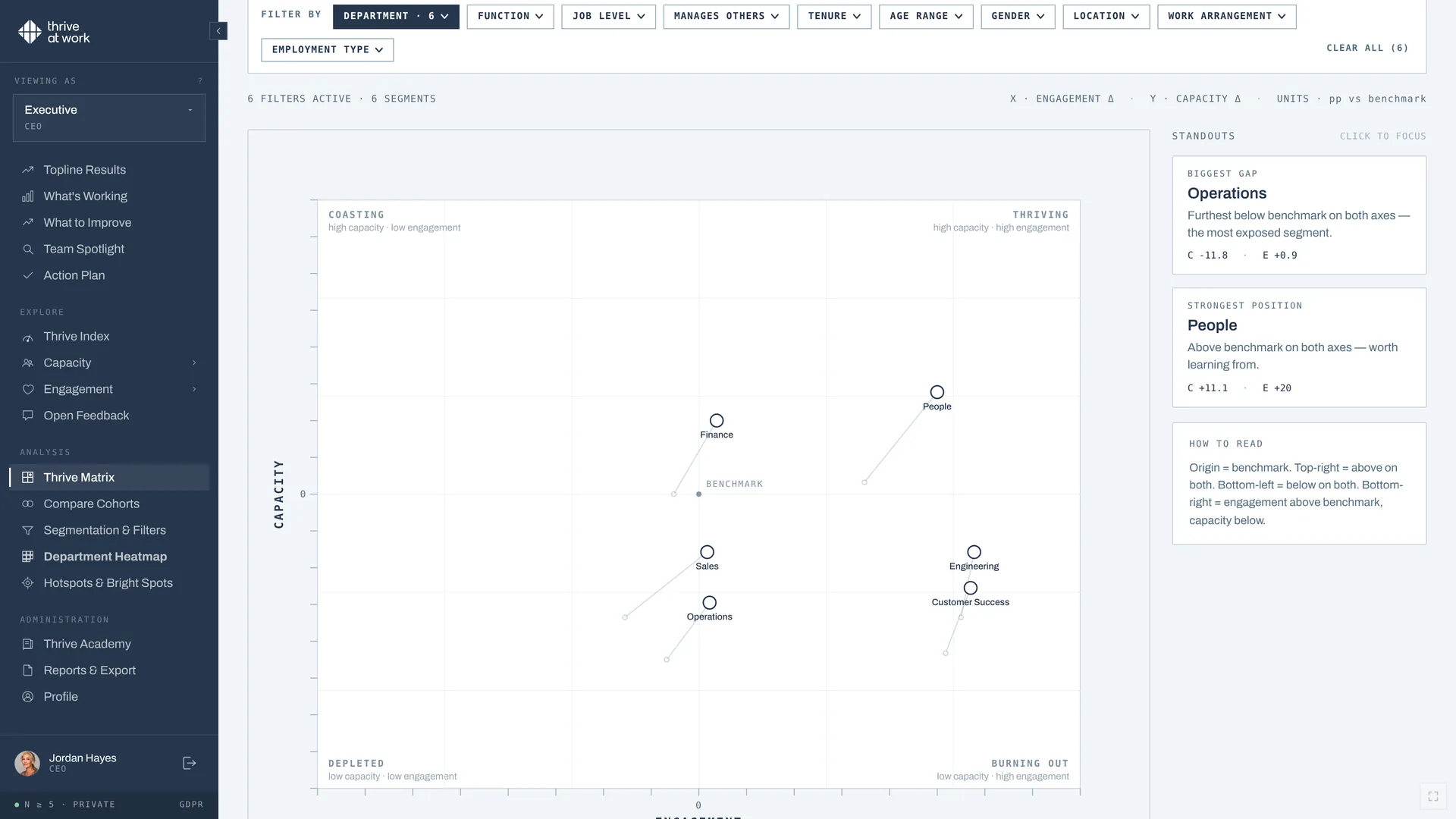
thrive at work measures engagement (purpose, leadership, connection, growth) and capacity (energy, recovery, focus, resilience) in one anonymous assessment: see how the assessment works.
AI rollouts are judged on adoption and output. thrive at work is a workforce performance platform: an employee engagement platform that also measures capacity to perform, meaning energy, recovery, focus and resilience, by team. That shows whether AI is giving people time back or quietly adding load. Read more about employee capacity.
Sources.
- Upwork Research Institute. www.upwork.com
- Article 4 of the EU AI Act. artificialintelligenceact.eu
- thrive index validation study. thrive at work, 2025–26. Methodology.
Common questions
What does an AI readiness assessment include?
Why measure capacity before an AI rollout?
How long should an AI readiness survey be?
How often should you assess AI readiness?
Who should own AI readiness?

Know which teams are ready for AI.
A 30-minute call covers what a capacity baseline would show before your rollout.