

thrive at work/AI anxiety at work
Guide · AI and people
AI anxiety at work: what people worry about, and what helps.
Many employees feel uneasy about AI: about their jobs, their skills and how their work will be judged. Ignoring that worry does not make it go away. It makes it quieter and more expensive.
By Jerry Fiser, Founder & CEO · Reviewed by Marcin Bulik, Research Director · Updated November 8, 2026
What is AI anxiety at work?
AI anxiety at work is worry or unease employees feel about artificial intelligence: fear of losing their job, of falling behind in skills, of being judged against AI output, or of being monitored. It is a normal reaction to uncertainty. Left unaddressed, it lowers trust, focus and willingness to try new tools, and it can push good people to leave.
- AI anxiety is worry about jobs, skills, judgment and monitoring.
- It is a reaction to uncertainty, so clear information reduces it.
- Silence from leaders makes it worse; honest timelines make it better.
- Anxious people use AI less, not more.
- Measure trust, workload and capacity by team during AI changes.
What AI anxiety means at work.
AI anxiety is not a diagnosis. It describes a range of worries that appear when AI enters someone's job. Some people worry about their role disappearing. Others worry that their skills will be out of date, that their work will be compared with a machine, or that AI will be used to watch them. These worries can sit alongside real enthusiasm for the tools.
Five common worries.
- 1"Will my job still exist?". The most common fear, and the one leaders most often avoid discussing.
- 2"Am I falling behind?". Colleagues seem faster with AI, and there is no time to learn.
- 3"How will my work be judged?". Unclear whether AI-assisted work counts, or whether targets will rise.
- 4"Am I being watched?". Concern that AI will be used to monitor activity or score people.
- 5"What if it gets it wrong?". Fear of being blamed for errors in AI output.
How AI anxiety affects performance.
Worry uses attention. People who are anxious about their future spend energy on it that would otherwise go into their work. They are also less likely to experiment with new tools, raise problems or admit mistakes, the exact behaviors an AI rollout depends on. Over time, uncertainty pushes people who have options to look elsewhere, and those are usually the people an organization most wants to keep.
Who feels AI anxiety most?
Worry tends to be strongest where roles are changing fastest and information is thinnest: people in writing, analysis, customer service and administrative roles, people early in their careers who fear fewer entry-level jobs, and people who have watched earlier waves of automation reduce teams. Managers feel it too, often privately, because they are expected to lead a change they do not fully understand.
AI anxiety and technostress.
Research on technostress calls the fear of being replaced "techno-insecurity" and the stress of constant change "techno-uncertainty". AI raises both. Anxiety often comes with AI fatigue: people work harder to prove their value while also learning new tools, a combination that drains energy fast.
What leaders can do.
- 01Say what will change. Name the tasks AI will take on and the roles it will affect, with timelines.
- 02Say what will not change. People need to hear what is safe as clearly as what is not.
- 03Explain how work is judged. Make clear how AI-assisted work counts and whether targets will change.
- 04Rule out covert monitoring. State plainly how AI will and will not be used to assess people.
- 05Invest in skills. Training in work time shows people they have a future.
- 06Involve employees. Ask teams to help decide where AI fits in their work.
- 07Keep talking. Short, regular updates beat one big announcement.

What managers can say.
Managers carry most of these conversations. Useful openings: "What worries you most about the AI changes?" "Which parts of your job do you want help with, and which do you want to keep?" "What would you need to feel confident with these tools?" Listen first. If you do not know the answer to a question about jobs, say so and find out.

A conversation guide for managers.
| Step | What to say or ask |
|---|---|
| Open | "I want to talk about the AI changes and how they affect you." |
| Listen | "What worries you most? What are you curious about?" |
| Be specific | "Here is what we know about your role, and here is what we don't know yet." |
| Agree support | "Which training or time would help you feel confident?" |
| Follow up | "Let's check in again in two weeks." |
Workers' rights and AI.
In Europe, rules give employees some certainty. Under Article 26 of the EU AI Act, employers that use high-risk AI systems at work, which includes many systems used for hiring, promotion and performance decisions, must inform workers' representatives and affected workers before use. In Germany, works councils have information and co-determination rights when AI is introduced; see KI und Betriebsrat. Explaining these protections reduces worry.
How to measure AI anxiety by team.
Add a few statements to your regular pulse: whether people understand how AI will affect their role, whether they trust leaders' plans, and whether their workload is manageable. Read them by team alongside energy and focus. thrive at work measures engagement and capacity together, so you can see teams where trust or energy is falling during an AI change and act before people leave.
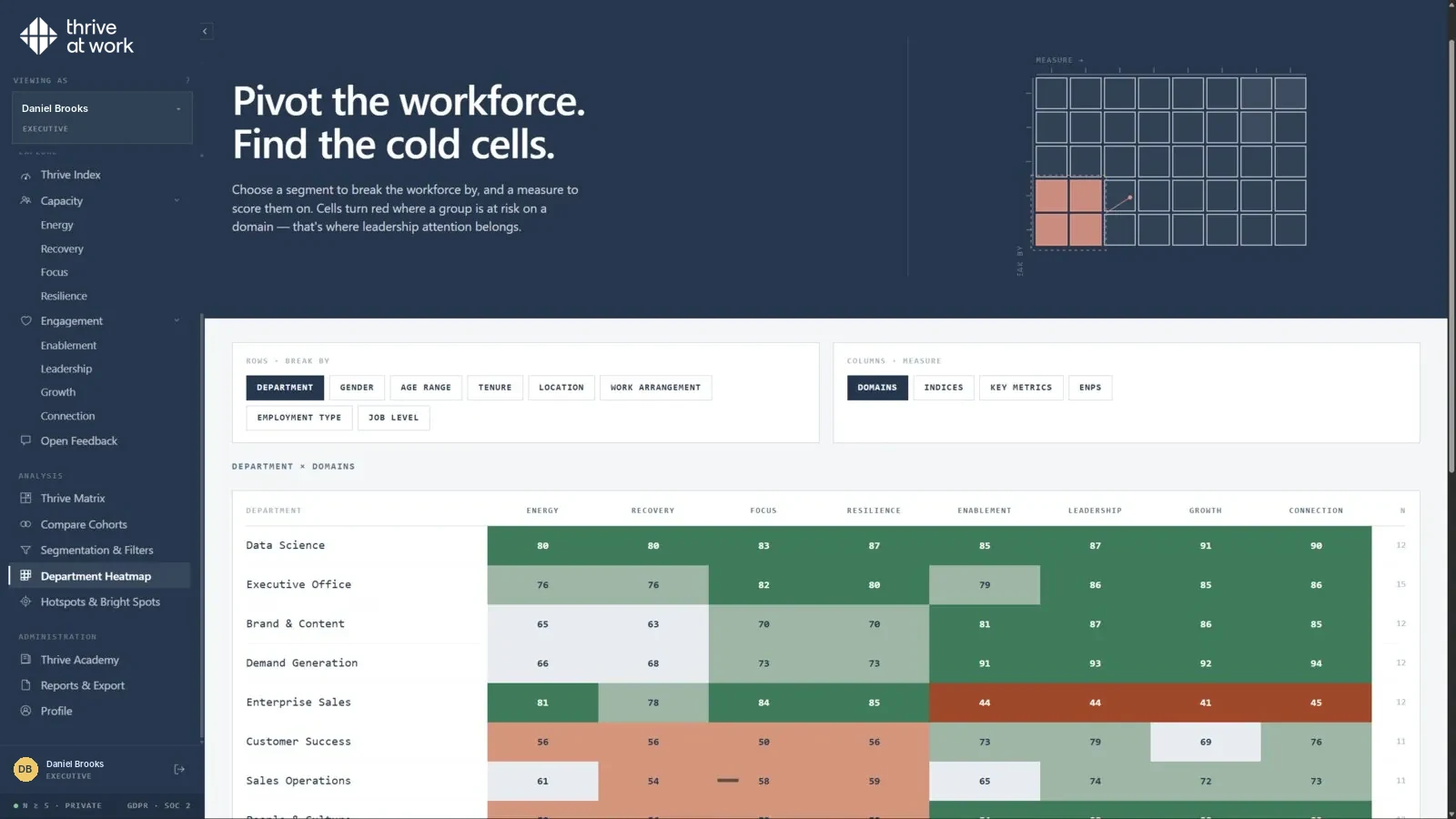
thrive at work measures engagement (purpose, leadership, connection, growth) and capacity (energy, recovery, focus, resilience) in one anonymous assessment: see how the assessment works.
AI rollouts are judged on adoption and output. thrive at work is a workforce performance platform: an employee engagement platform that also measures capacity to perform, meaning energy, recovery, focus and resilience, by team. That shows whether AI is giving people time back or quietly adding load. Read more about employee capacity.
Sources.
- Article 26 of the EU AI Act. artificialintelligenceact.eu
Common questions
Is AI anxiety normal?
How do you reduce employee anxiety about AI?
Does AI anxiety affect performance?
Should managers talk about job security?
How can HR track AI anxiety?

Know where AI worry is costing you.
A 30-minute call covers measuring trust and capacity during AI change.