


thrive at work/Workplace stress
Explainer · Workplace stress
Workplace stress: causes and signs.
Workplace stress is not a personal weakness. It is a signal that demands and resources are out of balance, and it usually has a cause the organization can find.
By Jerry Fiser, Founder & CEO · Reviewed by Marcin Bulik, Research Director · Updated November 8, 2026
What is workplace stress?
Workplace stress is the harmful reaction people have when the demands of their job exceed their resources to cope. It becomes a risk when it is intense, frequent or long-lasting, and it is driven mostly by how work is designed: workload, control, support, relationships, role clarity and change.
More guides on burnout.
Burnout self-check · Stages of burnout · Nurse burnout · Teacher burnout · Compassion fatigue vs burnout · Returning to work after burnout · Mindfulness and burnout · Coping with stress at work · Eustress vs distress
- Workplace stress comes mostly from how work is designed, not from weak individuals.
- Six areas cover most causes: demands, control, support, relationships, role and change.
- Team signals such as absence and turnover arrive later than individual ones.
- Measure by team, change one condition, then measure again.
The six causes of workplace stress.
Most workplace stress falls into six areas, the same ones the UK Health and Safety Executive Management Standards use for risk assessment.
The six causes follow the UK Health and Safety Executive guidance on work-related stress. The World Health Organization fact sheet on mental health at work and European Agency for Safety and Health at Work (EU-OSHA) on psychosocial risks describe the same work factors as psychosocial risks.
- DemandsWorkload. Too much work for the time and people available, or a work environment that adds strain.
- ControlSay over the work. Little influence over how, when or in what order work gets done.
- SupportHelp when needed. Too little encouragement, resources or practical help from managers and colleagues.
- RelationshipsConflict. Unresolved conflict, poor behavior or a climate where people do not feel safe to speak.
- RoleClarity. Unclear or conflicting expectations about what the job is.
- ChangeHow it is handled. Change announced rather than explained, with no chance to ask questions.
10 common stressors in the workplace.
| Stressor | What it looks like |
|---|---|
| Workload | More tasks than time, with no end date |
| Low control | Little say over how or when work is done |
| Unclear role | Conflicting priorities or expectations |
| Poor support | Little help from the manager or colleagues |
| Conflict | Tension, incivility or bullying |
| Change | Reorganizations that are not explained |
| Long hours | Regular overtime and evening work |
| Constant availability | Messages after hours and on weekends |
| Job insecurity | Uncertainty about the future of the role |
| Lack of recognition | Effort that nobody notices |
Most of these sit within the six areas used for stress risk assessment, which makes them easier to measure and act on by team.
Signs of workplace stress in people and teams.
In individuals, stress shows up as poor sleep, irritability, trouble concentrating, headaches, withdrawal and working longer hours with less to show for it.
In teams, it shows up as more sick days, more mistakes, conflict, people leaving, and a drop in the quality of discussion. The team signals often arrive later than the individual ones, which is why measuring early matters.

Effects of workplace stress on health and work.
In the short term, stress narrows attention and makes people more irritable and less patient. Over weeks and months, chronic stress disturbs sleep, lowers energy and makes it harder to recover between busy periods. At work it shows up as more errors, slower decisions, more short absences and, eventually, resignations.
For employers the cost appears in several places at once: lost focus, absence, turnover and the extra load on colleagues who cover. thrive research found that people with the least capacity, meaning energy, focus, recovery and resilience, delivered 56% of priority work on time, against 86% for those with the most.
Chronic stress lowers focus, increases mistakes and sick days, and pushes people to leave. thrive research found that people in the lowest quarter for capacity (the energy, focus, recovery and resilience a person has available) lost 71 more days a year to not working effectively than those in the highest. In working time, that is worth about €19,800 a year per employee.
Why workplace stress matters for organizations.
Chronic workplace stress is linked to burnout, absence and turnover. It also hides well: committed people keep delivering while their reserves fall. thrive research shows that a team can report strong engagement while its capacity is low, the pattern described in committed but depleted.
Pressure, stress and burnout.
| Healthy pressure | Stress | Burnout | |
|---|---|---|---|
| Duration | Short | Weeks | Months |
| Effect on focus | Sharpens it | Scatters it | Dulls it |
| Recovery | Evenings reset it | Takes longer | Rest no longer works |
| What helps | Nothing needed | Reducing demands, more control | Changing conditions and recovery time |
What employers are responsible for with workplace stress.
In many countries employers must assess and manage work-related risks to health, including stress. In practice that means identifying where stress comes from, taking reasonable steps to reduce it and checking that those steps work. Individual support, such as counseling, helps people cope, but it does not replace changing the conditions behind the stress.
How organizations reduce workplace stress.
- 01Find the hot spots. Measure strain by team, not just company-wide. Stress concentrates in specific teams and roles.
- 02Work on the causes. Match each hot spot to one of the six areas and change one condition at a time.
- 03Involve the team. People closest to the work know which demands can go. Ask them first.
- 04Measure again. Re-measure after a few months to see whether the change worked.
Workplace stress in remote work.
Remote work removes some stressors, such as commuting, and adds others: longer days, constant messages, isolation and unclear boundaries. Agreed response times, clear priorities and regular contact with the manager reduce the load.
In Germany, psychological strain is a mandatory part of the workplace risk assessment: Gefährdungsbeurteilung psychischer Belastung.
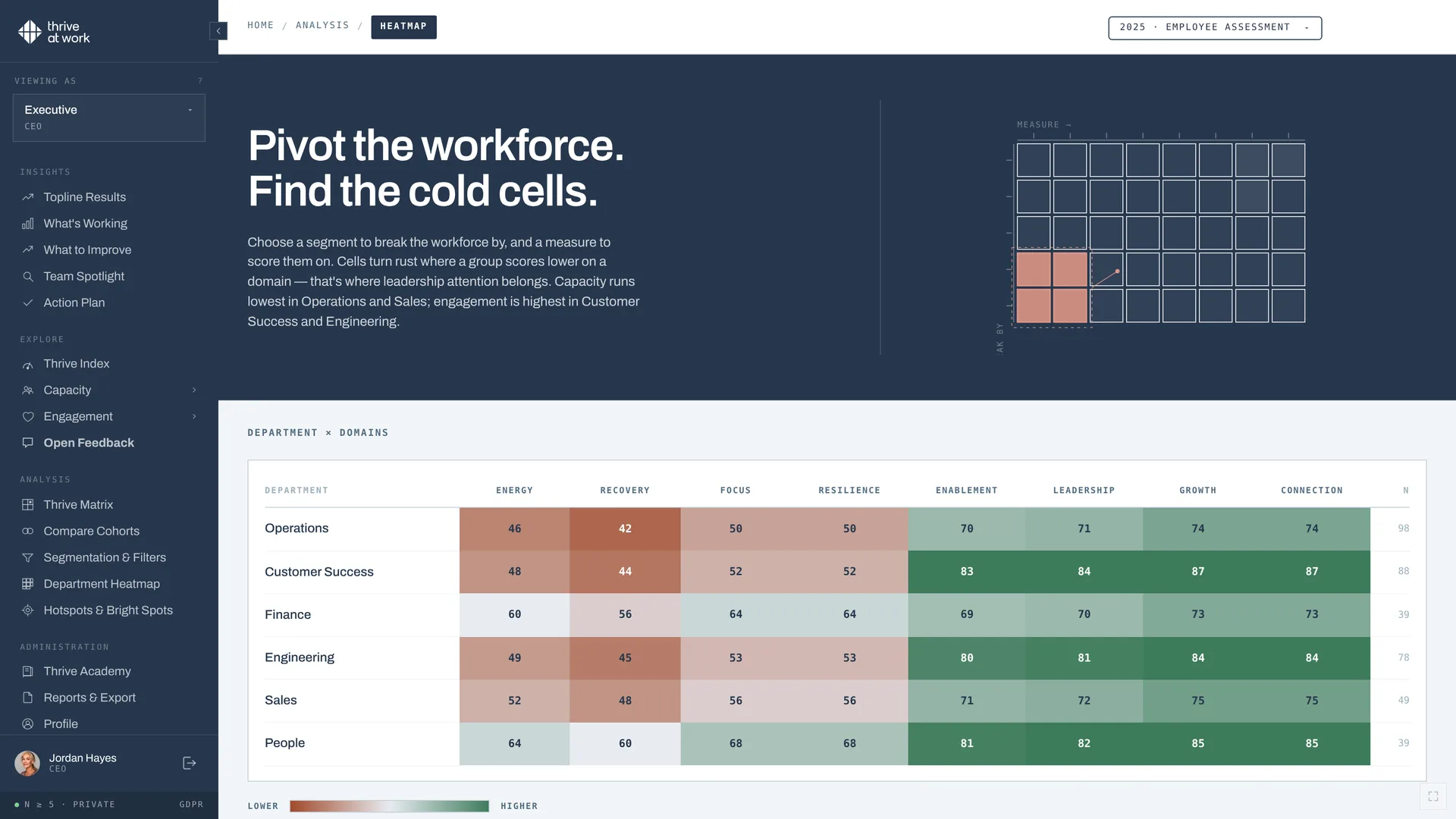
Most workplace stress problems show up first as falling energy, recovery and focus. thrive at work is a workforce performance platform: an employee engagement platform that also measures capacity to perform, so you can see strain by team before it turns into absence or resignations. Read more about employee capacity.
Sources.
- UK Health and Safety Executive Management Standards. www.hse.gov.uk
- UK Health and Safety Executive guidance on work-related stress. www.hse.gov.uk
- World Health Organization fact sheet on mental health at work. www.who.int
- European Agency for Safety and Health at Work (EU-OSHA) on psychosocial risks. osha.europa.eu
- thrive index validation study. thrive at work, 2025–26. Methodology.
Common questions
What are the most common causes of workplace stress?
What are the signs of workplace stress?
Who is responsible for workplace stress?
How do you measure workplace stress?
What is workplace stress?
How is workplace stress related to work outcomes?
Is workplace stress a health and safety issue?

Find the teams where stress is building.
A 30-minute call covers what a first measurement would show, team by team.