


thrive at work/Preventing stress in the workplace
Guide · Prevention
How to prevent stress in the workplace.
Prevention means finding where stress comes from before people get ill, and changing those conditions. It works best as a routine, not a campaign.
By Jerry Fiser, Founder & CEO · Reviewed by Marcin Bulik, Research Director · Updated November 8, 2026
How can employers prevent stress in the workplace?
Treat stress like any other workplace risk: assess it, find the teams and conditions that cause it, change those conditions, and check again. Focus on workload, control, support, relationships, role clarity and how change is managed.
- Treat stress like any other workplace risk: assess, act, check.
- Six areas to work on: demands, control, support, relationships, role and change.
- In Germany, assessing psychological strain is a legal duty.
- Recovery scores usually fall first, so they improve first too.
Why preventing workplace stress pays off.
Chronic stress shows up as lower focus, more mistakes, more short absences and higher turnover. Preventing it protects performance as well as health, and it is usually cheaper than dealing with burnout and replacing people who leave.
Six areas to prevent stress in the workplace.
- DemandsPlan workload. Match work to people and time. Stop or delay projects when teams are full.
- ControlShare decisions. Involve teams in how work is organized.
- SupportEquip managers. Give managers time and training to support their people.
- RelationshipsAct on conflict. Have clear routes to raise and resolve conflict and poor behavior.
- RoleClarify expectations. Everyone should know what good looks like in their job.
- ChangeExplain and consult. Explain why change is happening and give people a voice.

Assess workplace stress like any other risk.
Many countries require employers to assess psychological risks. In Germany this is part of the workplace risk assessment under the Occupational Safety and Health Act (Gefährdungsbeurteilung psychischer Belastung). In the UK, the UK Health and Safety Executive Management Standards give a structured approach.
The UK Health and Safety Executive guidance on work-related stress and European Agency for Safety and Health at Work (EU-OSHA) on psychosocial risks both treat stress as a workplace risk to assess and control. The OSHA guidance on workplace stress collects US resources.
Steps for managing workplace stress risks.
- 1Identify the hazards. Use a survey and team discussions to find where stress comes from.
- 2Decide who might be harmed. Look at teams and roles, not only individuals.
- 3Evaluate and act. Agree changes to workload, control, support, roles and how change is handled.
- 4Record what you found. Document the risks, actions, owners and dates.
- 5Review. Measure again after a few months and update the plan.
A 90-day plan to prevent stress in the workplace.
| Weeks | What happens | Output |
|---|---|---|
| 1 to 2 | Anonymous survey by team | Baseline: strain, capacity, engagement |
| 3 to 4 | Team workshops on results | Two or three priorities per team |
| 5 to 10 | Changes to workload, control and support | Owners and dates for each change |
| 11 to 13 | Re-measure the same questions | Evidence of what moved |
What managers control.
Managers decide most of the daily conditions that create or prevent stress: how work is allocated, how priorities are set, whether people can switch off, and whether problems can be raised safely. Training them to spot early signs and act on one condition at a time prevents more stress than any policy. See signs of burnout at work.
How managers can open a conversation about stress.
Ask privately how the person is finding their workload, listen without judging, and agree one change you can make this week. Check in again within seven days.
Practical ideas to prevent stress in the workplace.
| Idea | Why it helps |
|---|---|
| Meeting-free focus blocks | Fewer interruptions, more control over the day |
| Clear priorities each week | Less conflict between demands |
| Flexible hours or remote work where possible | More control over when and where work happens |
| Quiet spaces | Somewhere to concentrate or recover |
| Social time with colleagues | Support and connection |
| Access to counseling | Help for people who are struggling |
Combine ideas like these with changes to workload and roles. Perks alone rarely prevent stress if the underlying demands stay too high.
Team agreements that prevent workplace stress.
Simple team agreements reduce stress quickly: when messages can wait until morning, how urgent requests are flagged, how new work is prioritized against existing work, and when meetings are not scheduled. Agree them together, write them down and review them after a month.
Check whether stress prevention worked.
Prevention without measurement is guesswork. Run an anonymous survey before and after changes, report by team, and look at capacity measures such as recovery and energy as well as engagement. Recovery usually falls first, so it is the earliest place to see improvement too.
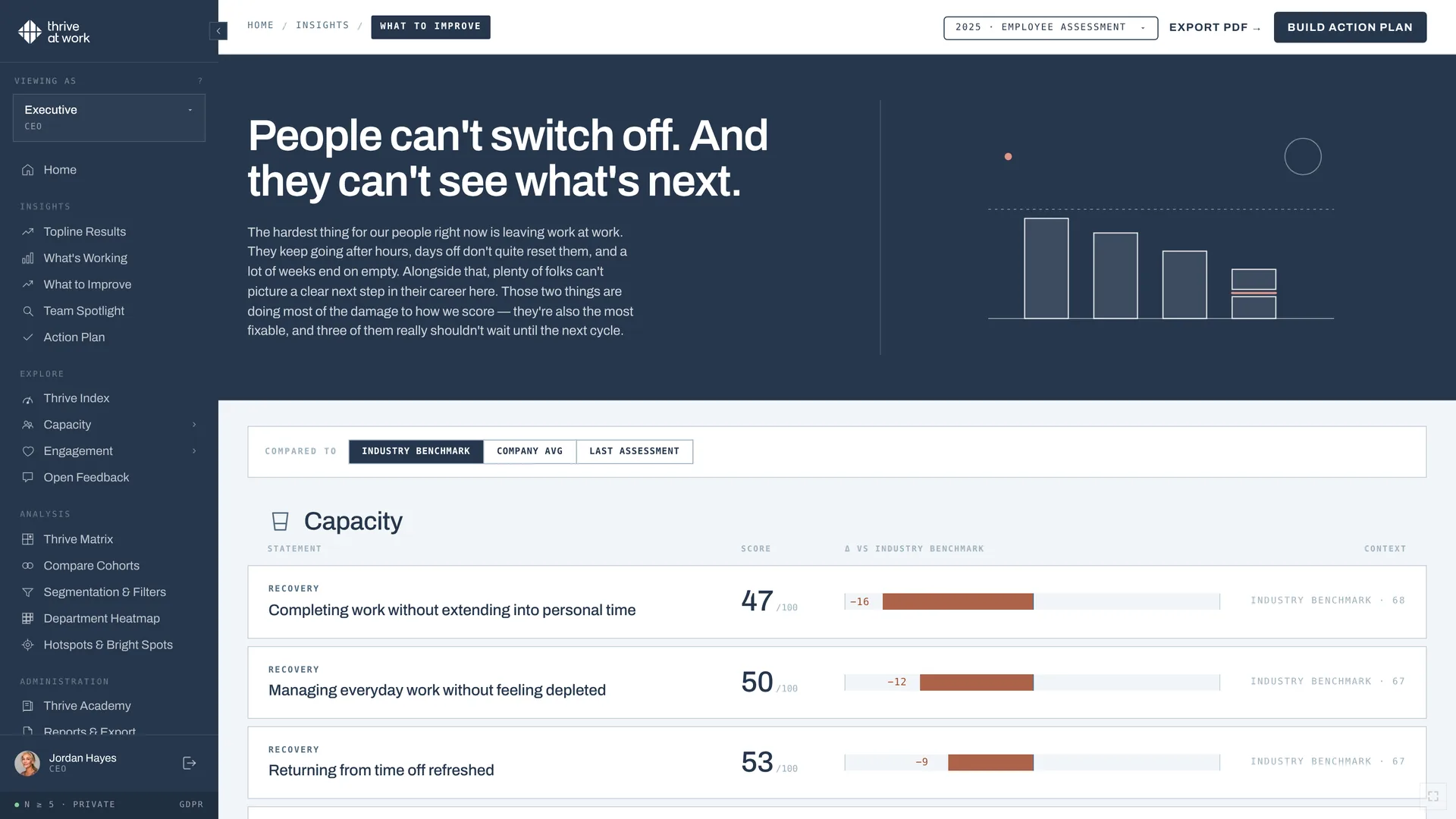
Indicators that workplace stress prevention is working.
| Indicator | Source |
|---|---|
| Workload and control scores improve | Survey |
| Energy and recovery hold in busy periods | Survey |
| Short-term absence falls | HR data |
| Fewer stress-related complaints | HR and occupational health |
thrive at work measures four capacity domains (energy, recovery, focus and resilience) alongside four engagement domains in one anonymous survey: the employee capacity assessment.
Most stress problems show up first as falling energy, recovery and focus. thrive at work is a workforce performance platform: an employee engagement platform that also measures capacity to perform, so you can see strain by team before it turns into absence or resignations. Read more about employee capacity.
Sources.
- UK Health and Safety Executive Management Standards. www.hse.gov.uk
- UK Health and Safety Executive guidance on work-related stress. www.hse.gov.uk
- European Agency for Safety and Health at Work (EU-OSHA) on psychosocial risks. osha.europa.eu
- OSHA guidance on workplace stress. www.osha.gov
Common questions
What is the first step to prevent workplace stress?
Is preventing workplace stress a legal requirement?
How often should stress be assessed?
How can employers reduce stress in the workplace?
What is a stress risk assessment?
What are the best ways to prevent stress at work?
What is the employer’s role in preventing workplace stress?

Prevent stress where it starts.
A 30-minute call covers how a first measurement shows the conditions behind stress.