

thrive at work/AI in HR
Guide · HR and AI
AI in HR: useful, risky, and worth measuring.
HR teams use AI to write, sort, summarize and answer questions. The bigger question for HR is not which tool to buy, but what AI does to the people the organization depends on.
By Jerry Fiser, Founder & CEO · Reviewed by Marcin Bulik, Research Director · Updated November 8, 2026
How is AI used in HR?
HR teams use AI to draft job descriptions and policies, screen and schedule candidates, answer employee questions, summarize survey comments, support learning and analyze workforce data. The benefits are speed and reach. The risks are bias, privacy, errors and a loss of trust. HR also owns a second question: how AI across the company affects workload, energy and engagement.
- AI already supports recruiting, employee service, learning, analytics and HR admin.
- The main risks are bias, privacy, errors and lost trust.
- In the EU, many HR uses of AI count as high-risk under the AI Act.
- HR has two jobs: use AI well, and watch what AI does to the workforce.
- Measure capacity and engagement by team as AI spreads.
How HR teams use AI today.
| Area | Typical uses | Watch out for |
|---|---|---|
| Recruiting | Job ads, screening, interview scheduling, candidate questions | Bias, transparency, works council rules |
| Employee service | Chat assistants for policy and benefits questions | Wrong answers given with confidence |
| Learning | Course recommendations, practice scenarios, summaries | Generic content, unequal access |
| Listening | Theming open survey comments, spotting trends | Small groups, anonymity |
| Analytics | Turnover risk, workforce planning | Opaque models, decisions about individuals |
| HR admin | Drafting letters, policies and reports | Accuracy, data protection |
Where AI helps HR.
The clearest gains are in repetitive writing and searching: first drafts of job ads and policies, summaries of long documents, and answers to common questions at any hour. AI can also read thousands of open survey comments and group them into themes in minutes, which helps HR teams act faster. The gain is time, and the test is whether that time goes into work that needs human judgment.
The risks of AI in HR.
- 1Bias. Models trained on past decisions can repeat past unfairness in hiring and promotion.
- 2Privacy. HR data is among the most sensitive an organization holds.
- 3Errors. Confident wrong answers on pay, leave or policy damage trust quickly.
- 4Opaque decisions. People affected by a decision have a right to understand it.
- 5Surveillance creep. Tools sold for productivity can drift into monitoring individuals.
- 6Lost human contact. Some conversations need a person, not a chat window.
The rules that apply in Europe.
The EU AI Act treats many AI systems used in employment, for example for recruiting, promotion, task allocation or performance evaluation, as high-risk. Under Article 26 of the EU AI Act, employers using such systems at work must inform workers' representatives and affected workers before use. Following the 2026 amendments, these high-risk obligations apply from December 2027. Separately, Article 4 of the EU AI Act asks employers to support AI literacy among staff who use AI. GDPR still applies to every use of personal data.
In Germany, the works council must be informed when AI is planned and has co-determination rights where AI can monitor behavior or performance. See KI und Betriebsrat.

HR's second job: the human side of AI.
HR does not only use AI. It also owns the effect of AI on the whole workforce. When AI changes how sales, finance or engineering work, HR sees the results in workload, morale, absence and resignations, usually months later.
In a 2024 survey by the Upwork Research Institute, 77% of employees who used AI said it had added to their workload, while 96% of executives expected it to raise productivity. That gap is an HR problem. So are AI fatigue, AI anxiety and AI burnout.
A practical roadmap for AI in HR.
- 01List current uses. Find every AI tool HR and managers already use, approved or not.
- 02Classify the risk. Separate low-risk drafting from decisions about people.
- 03Set rules. Who may use what, for which tasks, with which data.
- 04Involve employee representatives early. Especially for anything that touches hiring, performance or monitoring.
- 05Train HR and managers. AI literacy is now an expectation, not a bonus.
- 06Measure the human effect. Baseline capacity and engagement before major rollouts.
- 07Review every quarter. Keep what saves time and drop what adds risk or load.

What HR should measure as AI spreads.
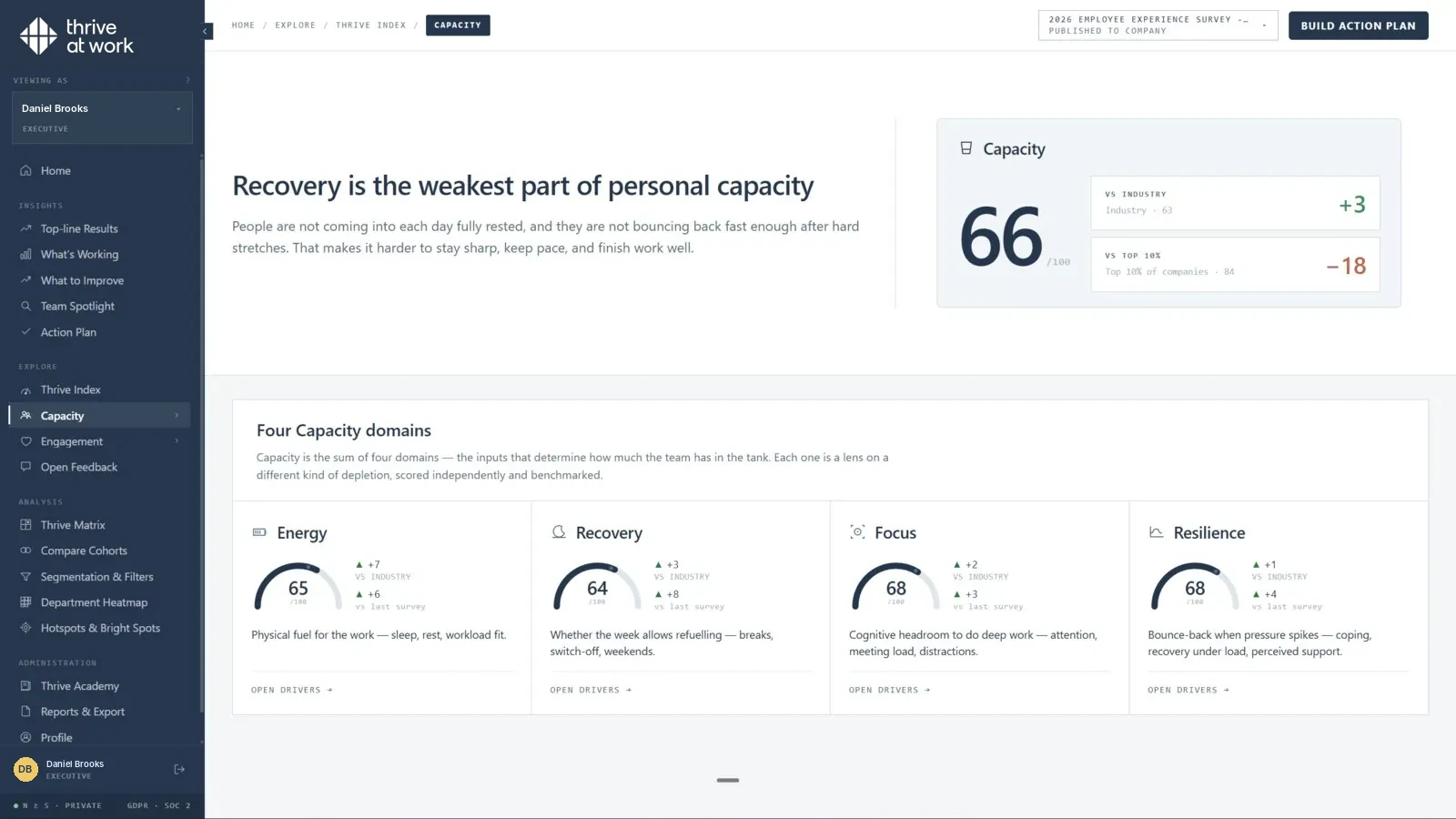
Adoption dashboards answer "are people using it?". HR also needs to answer "what is it doing to them?". Track energy, recovery, focus and resilience next to engagement, by team, before and after AI changes. Read them with turnover and absence. thrive at work reads engagement and capacity together, so HR can see the teams where AI gives time back and the teams where it quietly adds strain. The AI readiness assessment guide covers how to set the baseline.
Choosing AI tools for HR.
Ask vendors where data is stored and processed, whether customer data trains their models, how errors are handled, what audit logs exist and how the tool supports anonymity and minimum group sizes. Ask whether individuals can see and challenge decisions about them. And ask what the tool will stop your team doing; if the answer is nothing, it will add work.
thrive at work measures engagement (purpose, leadership, connection, growth) and capacity (energy, recovery, focus, resilience) in one anonymous assessment: see how the assessment works.
AI rollouts are judged on adoption and output. thrive at work is a workforce performance platform: an employee engagement platform that also measures capacity to perform, meaning energy, recovery, focus and resilience, by team. That shows whether AI is giving people time back or quietly adding load. Read more about employee capacity.
Sources.
- Article 26 of the EU AI Act. artificialintelligenceact.eu
- Article 4 of the EU AI Act. artificialintelligenceact.eu
- Upwork Research Institute. www.upwork.com
Common questions
What is AI used for in HR?
Is AI in HR high-risk under the EU AI Act?
Does the works council have a say on AI in Germany?
Will AI replace HR?
How should HR measure the impact of AI?

See what AI is doing to your workforce.
A 30-minute call covers measuring capacity and engagement as AI spreads.