


thrive at work/Employee wellbeing programs
Guide · Wellbeing
Employee wellbeing programs.
Wellbeing programs help when they sit on top of sustainable work. On top of chronic overload, they are one more thing to fit into the week.
By Jerry Fiser, Founder & CEO · Reviewed by Marcin Bulik, Research Director · Updated November 8, 2026
What makes an employee wellbeing program effective?
Effective programs start with the conditions of work (workload, control, support, recovery time) and then add individual resources such as mental health support, flexibility and healthy habits. They are measured by changes in energy, recovery and absence, not by app downloads.
- Programs that change work conditions do more than perks.
- Measure capacity first to know where to act.
- Managers matter more than apps.
- Evaluate programs on outcomes, not sign-ups.
What is an employee wellbeing program?
An employee wellbeing program is a set of policies, resources and practices that help people stay healthy and able to do their best work. Strong programs combine changes to how work is organized, such as workload, flexibility and manager support, with resources for individuals, such as counseling, health checks and learning about sleep and stress.
Benefits of employee wellbeing programs.
Programs that change working conditions can reduce absence and turnover, improve focus and make performance more sustainable. The benefit depends on design: programs that only offer individual resources while workload stays unmanageable tend to show little effect.
Employee wellbeing programs and engagement.
Wellbeing and engagement are connected but different. People can be highly engaged and still exhausted; they can be rested and still disengaged. A wellbeing program that improves energy and recovery helps engagement last, and an engagement program that ignores workload risks burning out the most committed people. Measure both together to see which one a team needs most.
Why many employee wellbeing programs change little.
Programs often offer individual tools (apps, webinars, fruit) while leaving the causes untouched. Participation is low among the people who need it most because they have no time. Measuring capacity shows whether a program is reaching the problem. See what to look for in wellbeing measurement software.
The WHO guidelines on mental health at work recommend organizational interventions alongside manager training and individual support. The CIPD factsheet on wellbeing at work and the CIPD Health and wellbeing at work report cover what UK employers do and what works.

Types of employee wellbeing programs.
| Type | Examples |
|---|---|
| Mental health | Confidential counseling, manager training, peer support |
| Physical health | Health checks, movement challenges, ergonomic support |
| Financial wellbeing | Financial education, advice, fair pay reviews |
| Social wellbeing | Team connection, volunteering, inclusion networks |
| Work design | Workload planning, flexible hours, right to disconnect |
| Recovery | Encouraging leave, recovery after peaks, focus time |
Employee wellbeing program examples by level.
| Level | Program examples | What it changes |
|---|---|---|
| Organization | Staffing to match workload; meeting-free focus days; clear limits on out-of-hours messages; fair, predictable schedules | The conditions everyone works in |
| Team and manager | Manager training in spotting strain; regular one-to-ones; team agreements on availability; workload reviews in planning | How work is shared and led day to day |
| Individual | Confidential counseling; mental health support; flexible hours; learning on sleep, recovery and stress | Personal resources and access to help |
Programs that work combine all three levels. Individual support alone helps people cope with conditions that stay the same; organization-level changes reduce the cause.
Three levels of support.
| Level | Examples | Effect |
|---|---|---|
| Organization | Workload, staffing, flexible work, fair processes | Largest, reaches everyone |
| Team and manager | One-to-ones, priorities, recovery norms | Strong, daily |
| Individual | Apps, classes, counseling | Helps people cope; does not change causes |
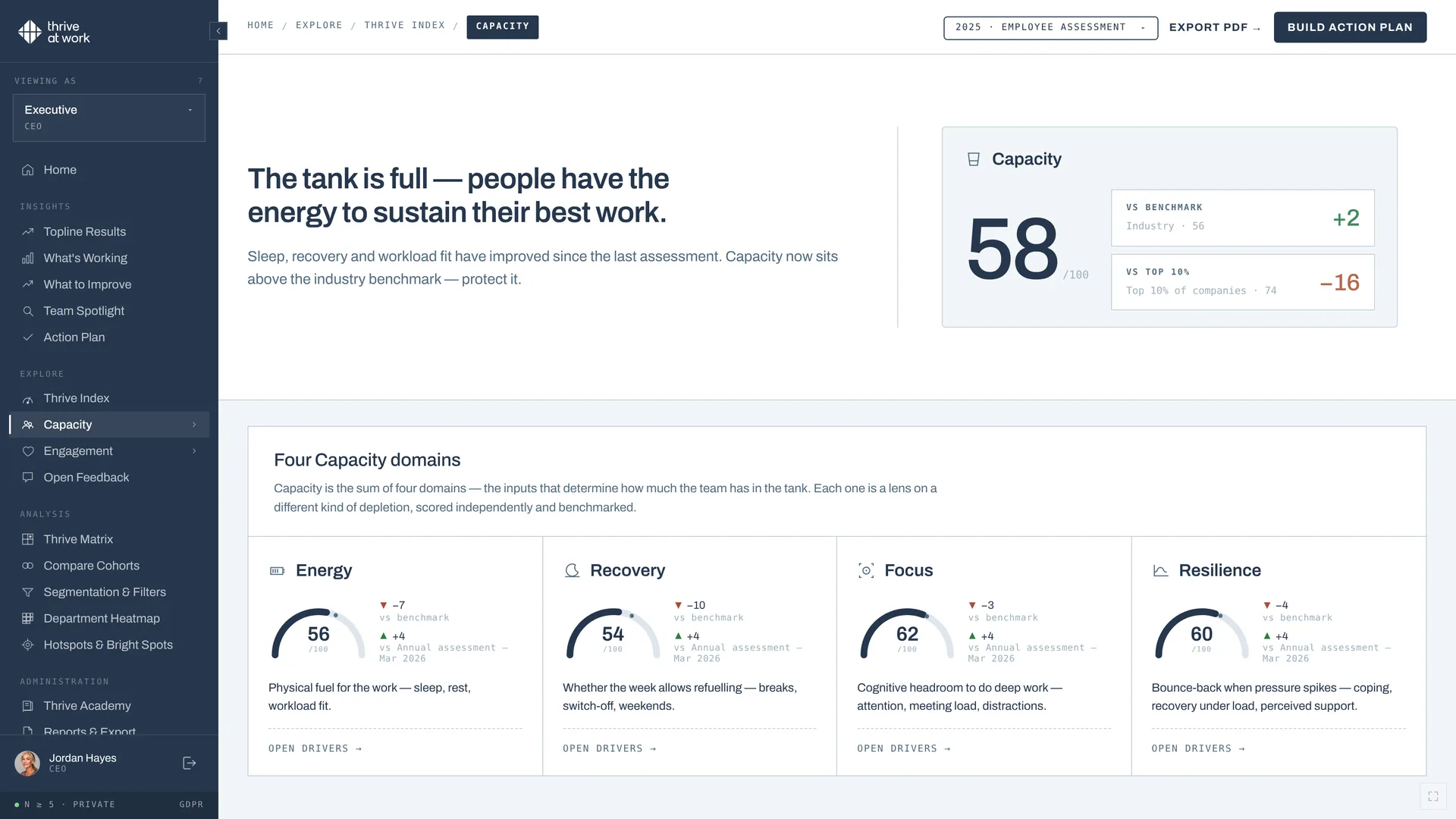
thrive research found that people in the lowest quarter for capacity (the energy, focus, recovery and resilience a person has available) lost 71 more days a year to not working effectively than those in the highest. In working time, that is worth about €19,800 a year per employee.
The manager’s role in employee wellbeing programs.
Managers shape the conditions that drive wellbeing more than any program: how work is shared, whether people can take breaks and leave, how deadlines are set and whether problems can be raised. Train managers to notice strain early, hold workload conversations and point people to support, and give them the authority to move work when a team is overloaded.
Elements of employee wellbeing programs that make a difference.
- Work designConditions. Sustainable workload, control over how work is done, protected time off.
- ManagersSupport. Managers trained to notice strain and act.
- Mental healthAccess. Confidential support such as an employee assistance program.
- FlexibilityChoice. Some control over where and when people work.
- PhysicalHabits. Movement, sleep and breaks made easy.
Communicating an employee wellbeing program.
Explain what the program offers, who can use it, how confidentiality works and what the organization is changing at work, not only what it offers individuals. People trust programs more when they see changes to workload and conditions alongside support services.
10 employee wellbeing program ideas.
- 1Measure capacity by team. Know where energy and recovery are lowest.
- 2Train managers to spot strain. And to act on workload.
- 3Set availability norms. Protect evenings and weekends.
- 4Offer confidential counseling. Easy to access, well promoted.
- 5Make leave normal. Leaders take it visibly.
- 6Flexible hours. Where the work allows.
- 7Focus time. Meeting-free blocks.
- 8Movement at work. Walking meetings, active breaks.
- 9Financial education. Practical sessions and advice.
- 10Recovery after peaks. Planned quieter periods.
Mental health in employee wellbeing programs.
Mental health support is now part of most wellbeing programs, usually as confidential counseling, an assistance program or access to therapists. These services matter, especially for people in crisis. Their use depends on trust: people use them when they are confident that the employer will not see who used them or why.
Prevention sits in daily work. Unclear roles, chronic overload, conflict and lack of control are well-documented risks for mental strain, as the WHO guidance on mental health at work describes. A program that offers counseling but leaves those conditions unchanged treats the symptoms. Train managers to notice strain early and to talk about it without judging or diagnosing.
Budgeting an employee wellbeing program.
Wellbeing spending often goes to visible benefits such as apps, events and gym subsidies, while the conditions that drain people stay unchanged. A more effective split puts the largest share into work-level changes, a solid share into manager capability and confidential support, and a smaller share into individual extras.
| Area | Examples | Value |
|---|---|---|
| Work design | Hiring to relieve overload, fixing broken processes, reducing meetings | Largest effect, reaches everyone |
| Managers | Training in workload conversations and spotting strain | Strong, daily effect |
| Confidential support | Counseling, mental health services | Essential for people who need help |
| Individual extras | Apps, classes, subsidies | Helpful for some; limited effect on causes |
How to design a wellbeing program that works.
| Step | What to do |
|---|---|
| 1. Diagnose | Survey energy, recovery, workload and support by team |
| 2. Prioritize | Pick two or three conditions to change per team |
| 3. Combine levels | Organization, team and individual actions together |
| 4. Communicate | Explain what is available and why |
| 5. Evaluate | Re-measure capacity, absence and turnover after six to twelve months |
Start by measuring, by team, where capacity is lowest and what drives it. Then pick changes at the organization and team level first: realistic workloads, protected focus time, recovery after busy periods, managers trained to notice strain. Add individual support such as counseling for people who need it.
Evaluate every part. Ask whether energy, recovery and focus improved in the teams that changed something, and whether absence and turnover moved. Programs that cannot show change after a year should be redesigned, not renewed. See how to prevent employee burnout.
Building an employee wellbeing strategy.
A wellbeing strategy connects programs to the business. Start with a clear picture of where strain sits, by team and role. Set two or three goals, such as improving recovery scores in overloaded teams or reducing short absences, and choose actions at the organization, team and individual level that address them. Give managers a central role, because they shape workload and support every day.
Review the strategy yearly. Keep what moves capacity, absence and retention, and stop what does not. A small number of well-run actions usually does more than a long menu of benefits few people use.
How to measure an employee wellbeing program.
| Measure | Source | What it tells you |
|---|---|---|
| Energy, recovery and focus by team | Survey | Whether conditions are improving |
| Workload manageability | Survey | Whether the main cause is being addressed |
| Short-term absence | HR data | Early sign of strain or relief |
| Use of support services | Provider (aggregated) | Whether people trust and know the offer |
| Voluntary turnover | HR data | Longer-term effect |
| Participation in programs | Program data | Reach, not effect |
Participation is the easiest number to collect and the least meaningful. A program used by many people can still leave energy and workload unchanged. Judge programs by changes in capacity and in the conditions behind it, measured before and six to twelve months after.
Wellbeing programs for remote and frontline employees.
Remote employees need help with boundaries, connection and ergonomics; frontline employees need support that fits shift patterns and limited screen time. Offer resources in formats people can use, such as short in-person sessions on shift or mobile-friendly content, and make sure managers in both settings know how to spot strain.
Common employee wellbeing program mistakes.
- 1Starting with perks. Benefits launched before anyone looked at workload and conditions.
- 2No measurement. No baseline, so nobody can say whether anything changed.
- 3Managers left out. Programs run by HR while daily strain is shaped by managers.
- 4One program for all. Frontline and office teams face different strains.
- 5Trust ignored. Support services nobody uses because confidentiality is unclear.
- 6Measuring participation as success. High uptake mistaken for real change.
A quick checklist.
- 1Measured first. Do you know where capacity is lowest, by team?
- 2Work-level changes. Does the program change workload, control or support?
- 3Managers involved. Are managers trained to notice strain and act?
- 4Individual support. Is confidential help available for those who need it?
- 5Evaluated. Will you measure change after six to twelve months?
Where to start with an employee wellbeing program.
Start by measuring capacity and workload by team, pick the teams under the most strain and change one condition there first.
thrive at work measures engagement (purpose, leadership, connection, growth) and capacity (energy, recovery, focus, resilience) in one anonymous survey: the employee engagement survey.
Most wellbeing problems show up first as falling energy, recovery and focus. thrive at work is a workforce performance platform: an employee engagement platform that also measures capacity to perform, so you can see strain by team before it turns into absence or resignations. Read more about employee capacity.
Sources.
- WHO guidelines on mental health at work. www.who.int
- CIPD factsheet on wellbeing at work. www.cipd.org
- CIPD Health and wellbeing at work report. www.cipd.org
- WHO guidance on mental health at work. www.who.int
- thrive index validation study. thrive at work, 2025–26. Methodology.
Common questions
What is workplace well-being?
How do you measure employee wellbeing?
What should an employee wellbeing program include?
How do you measure the success of a wellbeing program?
Why do employee wellbeing programs fail?
What should a wellbeing program include?

Measure whether wellbeing is actually improving.
A 30-minute call covers what a first measurement would show.