


thrive at work/Lattice alternative
Alternatives · Lattice
A Lattice alternative for teams that need to see capacity.
Lattice is a broad people platform built around performance management. thrive at work is narrower: it measures engagement and capacity to perform by team. The right choice depends on what you need to see.
By Jerry Fiser, Founder & CEO · Reviewed by Marcin Bulik, Research Director · Updated November 8, 2026
What is a good alternative to Lattice?
Alternatives to Lattice include Culture Amp, Leapsome, 15Five, Workday Peakon, Qualtrics and thrive at work. Choose thrive at work if your main need is to see engagement and capacity together by team, so you know which teams are committed but running low, rather than a full performance management suite.
- Lattice is a broad people platform with performance, goals, engagement, growth and compensation.
- thrive at work focuses on measuring engagement and capacity to perform.
- Lattice is stronger for running performance reviews and goals.
- thrive at work is stronger for seeing burnout risk by team.
- Some organizations use a performance suite and thrive at work together.
Why people look for a Lattice alternative.
- 1They need a different measurement. Engagement scores are not showing burnout risk.
- 2They do not need a full suite. A focused listening and capacity tool fits better.
- 3They work mainly in Europe. Hosting, languages and works council needs come first.
Why the comparison comes up.
Lattice is one of the best-known people platforms, especially among fast-growing companies, so many buyers start their search there. The question that often follows is whether a broad performance suite is the right tool for the problem they are trying to solve. If the problem is running reviews and goals consistently, a suite is a natural fit. If the problem is that good people are burning out or leaving even though engagement looks fine, the answer usually lies in what is being measured rather than in more processes. That is where the comparison with thrive at work becomes useful.
Decision criteria that matter.
Five criteria usually decide this comparison. Scope: do you need one system for many people processes, or a focused tool for one question? Measurement: do you need to see capacity and burnout risk, or is engagement enough? Manager experience: which tool will your managers open and use? Fit: hosting, languages, integrations and works council requirements. Effort: how much internal time will setup and support take? Weight these before demos, and score both tools against them honestly.
Bringing it together.
Lattice and thrive at work solve different problems. Lattice helps organizations run performance management and related people processes in one place. thrive at work shows whether teams have the engagement and capacity to keep performing, and what to change first. If your main challenge is consistent reviews and goals, a suite fits. If your challenge is that committed people are burning out or leaving, start by measuring capacity. Many organizations eventually use a performance tool for processes and a focused listening tool for insight, with one survey rather than two.
What Lattice offers.
According to its Lattice platform overview, Lattice offers performance management (reviews, talent reviews, improvement plans, succession planning, one-to-ones, updates and feedback), engagement surveys, goals and OKRs, growth, compensation, analytics and AI features. It connects to HR systems such as Workday, BambooHR, Rippling and UKG. The company says more than 5,000 teams use it.
Other alternatives to Lattice.
| Tool | Best known for |
|---|---|
| Culture Amp | Engagement surveys, performance and development |
| Leapsome | All-in-one HR and talent suite, strong in Europe |
| 15Five | Performance management and manager check-ins |
| Workday Peakon Employee Voice | Continuous listening for Workday customers |
| Qualtrics EmployeeXM | Employee listening inside a broad experience suite |
| thrive at work | Engagement and capacity to perform by team |
See our comparisons of Culture Amp, Leapsome, 15Five, Workday Peakon and Qualtrics.
Lattice and thrive at work side by side.
| Area | Lattice | thrive at work |
|---|---|---|
| Core focus | Performance management and people development | Measuring engagement and capacity to perform |
| Engagement measurement | Engagement surveys within the suite | Engagement Index from four domains, scored 0 to 100 |
| Capacity measurement | Not a separate scored index on its public platform page | Capacity Index from energy, recovery, focus and resilience, 0 to 100 |
| Team view | Analytics across modules | thrive matrix: Thriving, Burning out, Coasting, Depleted |
| Performance reviews | Core strength | Not offered; complements review tools |
| Goals and OKRs | Included | Not offered |
| Compensation | Included | Not offered |
| Action planning | Tools for managers | Three suggested priorities per team, routed by owner |
| Employee learning | Growth module | More than 300 short courses matched to each person's lowest-scoring area |
| Hosting | See vendor documentation | EU hosting |
Lattice details are from its public website, reviewed November 2026.

Where Lattice is stronger.
If you want one system for reviews, goals, one-to-ones, compensation and engagement, Lattice covers far more ground than thrive at work. Its performance tools are mature, and its many integrations make it easy to run people processes in one place. thrive at work does not run performance reviews or compensation cycles.
Where both tools do well.
Both Lattice and thrive at work aim to help managers act, not just collect data. Both give managers a team view and suggested next steps, and both connect to common HR systems. The difference is what they are built around: Lattice around performance processes that individuals and managers run through the year, thrive at work around a measurement of the team conditions behind performance. Organizations that understand this difference usually find the choice straightforward.
Total cost to consider.
Beyond license fees, consider the internal time each tool needs. A broad suite needs configuration for each module, training for managers in several processes and ongoing administration. A focused tool needs less setup but sits alongside other systems. Ask both vendors for the effort your team should expect in the first year, and ask a current customer of similar size how long it really took.
The real difference.
The question is what you need to see. An engagement survey inside a performance suite shows how people feel about their work. It does not show whether they have the energy, recovery, focus and resilience to keep performing. thrive at work measures both and reads them together, so teams that are committed but running low, the group most likely to burn out, stand out. thrive research shows that employees who are highly engaged but burning out lose three times as many days to not working effectively.
Measuring burnout risk, not just engagement.
Burnout builds slowly. The World Health Organization describes it as resulting from chronic workplace stress that has not been managed, with exhaustion, distance from the job and reduced effectiveness. An engagement score may not move until late, because committed people keep going. Scoring energy, recovery, focus and resilience shows the strain earlier. thrive research found that people with the least capacity delivered 56% of priority work on time, against 86% for those with the most.
Using both together.
Some organizations keep a performance suite for reviews and goals and add thrive at work for engagement and capacity. That works when the roles are clear: the suite manages individual performance processes, and thrive at work shows the team conditions behind performance. Avoid running two engagement surveys; use one listening tool.
What managers see in each tool.
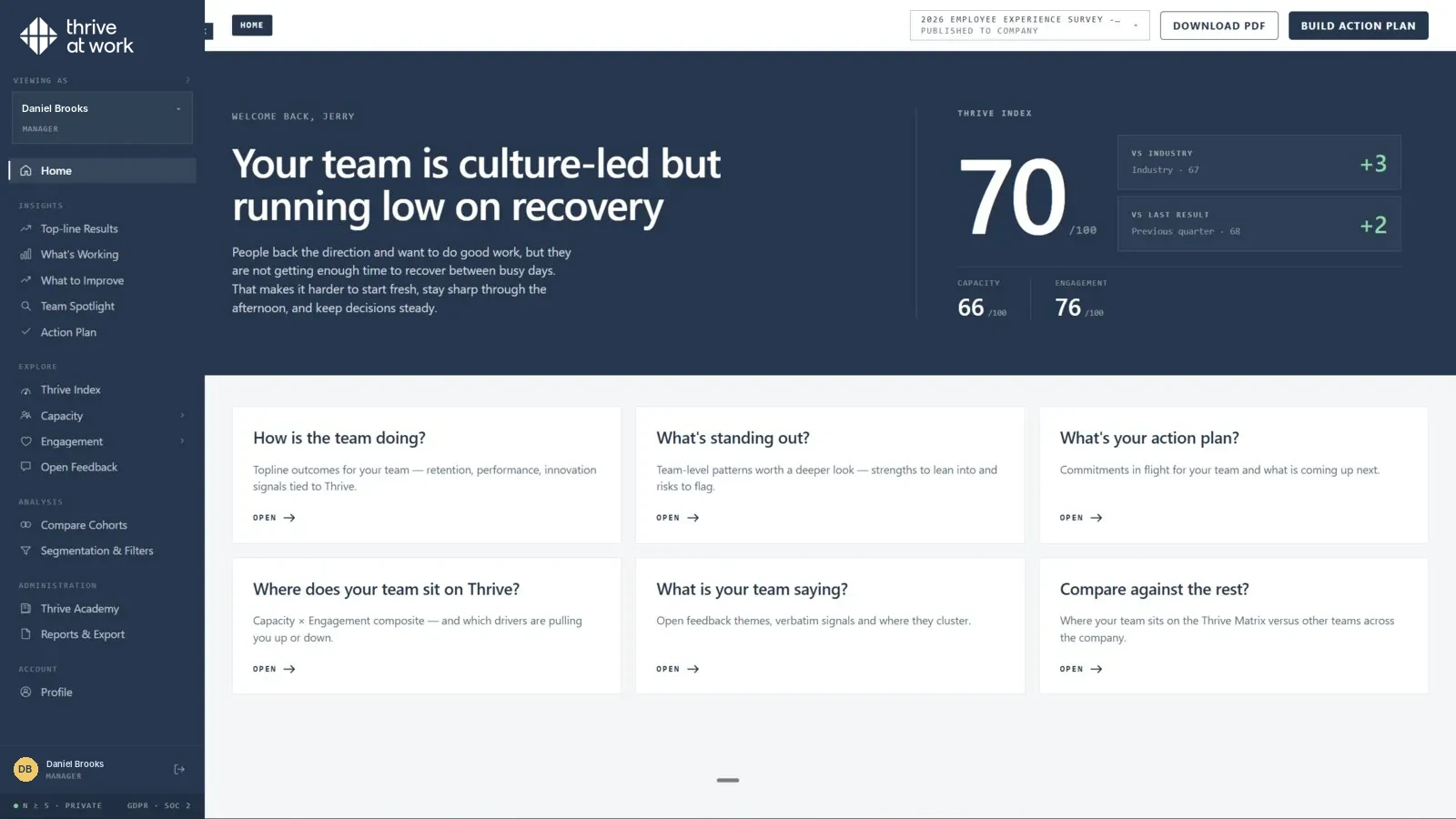
In a performance suite, a manager typically sees review cycles, goal progress, one-to-one agendas and engagement results for their team. In thrive at work, a manager sees the team's engagement and capacity scores, its place on the thrive matrix, the domains that are lowest, three suggested priorities and open-comment themes, with anonymity protected. The first helps run performance processes; the second helps decide what to change in how the team works.
When to choose which.
| Choose Lattice if | Choose thrive at work if |
|---|---|
| You need performance reviews, goals and compensation in one suite | You need to see burnout risk and capacity by team |
| Engagement is one part of a broader people process | Engagement and capacity are the main questions |
| You are already invested in its ecosystem | You want a focused tool with EU hosting and 13 languages |

Questions to settle before choosing.
- 01What problem are we solving?. Running reviews and goals, or seeing burnout risk?
- 02Do we already have an HR or performance system?. If yes, add focused listening rather than a second suite.
- 03Where are our people?. Hosting, languages and works council needs.
- 04What will managers actually use?. Ask for the manager view in demos.
- 05How will we know it worked?. Agree outcome measures before buying.
Switching or adding thrive at work.
Switching an engagement survey is simplest at the end of a survey cycle. Keep a few core statements so you can compare trends. Upload or sync your employee list, agree anonymity rules with employee representatives, and launch. See the other comparisons: Culture Amp, Leapsome and 15Five.
A migration checklist.
| Step | Detail |
|---|---|
| Timing | Switch at the end of a survey cycle |
| Core statements | Keep a few comparable items so trends carry over |
| Employee data | Sync from your HR system or upload a file |
| Anonymity rules | Agree minimum group sizes and filters |
| Representatives | Share documentation with the works council where relevant |
| Communication | Explain why the survey is changing and what stays the same |
| First results | Plan team conversations and actions in advance |
Three typical scenarios.
| Scenario | Recommendation |
|---|---|
| A growing company needs reviews, goals and engagement in one place | A performance suite such as Lattice fits |
| An organization already runs reviews well but sees burnout and turnover in engaged teams | Add thrive at work for engagement and capacity |
| A European company wants focused listening with EU hosting and works council support | thrive at work fits; compare documentation carefully |
Running a side-by-side pilot.
If you are unsure, run a short pilot with two or three teams, including one you know is under pressure. Use Lattice for the processes it is built for and thrive at work for an engagement and capacity assessment. After four to six weeks, ask the managers which tool helped them understand their team and decide what to change, and check whether the stretched team showed up clearly. A focused pilot answers the question better than any feature list.
For European organizations.
Organizations in Europe often weigh data hosting, language coverage and works council involvement early. thrive at work is hosted in the EU, supports 13 languages and provides German-language guidance on surveys and works councils. Check each vendor's documentation for your requirements.
Common misunderstandings about engagement and capacity.
"High engagement means low burnout risk." Not necessarily: highly committed people often carry the most strain. "Capacity is about individual resilience." It is shaped mostly by workload, recovery and how work is organized. "Measuring capacity means monitoring people." In thrive at work it comes from anonymous self-report, reported by team, with no individual scores.
How to evaluate both fairly.
Run the same short pilot with each tool if you can. Pick two or three teams, ideally including one that is under visible pressure. Ask managers which tool helped them understand their team and decide what to do. Ask employees whether they trusted the survey and saw results. Compare the time it took HR to set up and support each tool. And check whether either tool showed the pressure you already knew about in the stretched team. A tool that misses a problem you can already see is unlikely to catch the ones you cannot.
The cost of choosing on features alone.
Feature lists make broad suites look stronger, because they do more things. But the cost of the wrong choice comes from what a tool fails to show, not from what it lacks on paper. If burnout and turnover in committed teams are your real problem, a suite with an engagement module may leave that problem invisible, and the cost appears months later as resignations and absence. If inconsistent reviews and unclear goals are your real problem, a focused listening tool will not fix them. Start from the problem, then choose the tool.
Practical questions from buyers.
Can we migrate engagement history from Lattice? Keep a few comparable statements so trends carry over, and export historical results for reference. Do managers need training for thrive at work? A short briefing is usually enough; reports are designed to be read without analyst skills. How often do we survey? A broad assessment once or twice a year and short pulses between them work for most organizations.
Next step.
Book a short call to see your own teams on the thrive matrix, then decide whether a suite, a focused tool or both fit your needs.
In one sentence.
Lattice helps you run people processes; thrive at work shows whether your teams can keep performing, so you can act before committed people burn out or leave. Many organizations need both kinds of tool; the important thing is to know which problem each one solves.
thrive at work measures engagement (purpose, leadership, connection, growth) and capacity (energy, recovery, focus, resilience) in one anonymous assessment: see how the assessment works.
Good engagement work needs a survey people trust and results managers can act on. In Employee Experience Management (EXM) terms, thrive at work is an employee engagement platform that measures engagement and capacity to perform in one anonymous survey. See the employee survey platform or read more about employee engagement.
Sources.
- Lattice platform overview. lattice.com
- World Health Organization. www.who.int
- thrive index validation study. thrive at work, 2025–26. Methodology.
Common questions
What are the best Lattice alternatives?
Does thrive at work do performance reviews?
Does Lattice measure burnout?
Can I use Lattice and thrive at work together?
Is thrive at work hosted in the EU?

See what an engagement survey does not show.
A 30-minute call shows your teams on the thrive matrix.