


thrive at work/Leapsome alternative
Alternatives · Leapsome
A Leapsome alternative focused on engagement and capacity.
Leapsome combines HR, talent and AI tools in one platform. thrive at work does one job: measure engagement and capacity to perform by team. Here is how to decide.
By Jerry Fiser, Founder & CEO · Reviewed by Marcin Bulik, Research Director · Updated November 8, 2026
What is a good alternative to Leapsome?
Alternatives to Leapsome include Lattice, Culture Amp, Personio, 15Five, Workday Peakon and thrive at work. Choose thrive at work if you want a focused tool that measures engagement and capacity together, so you can see burnout risk by team, rather than an all-in-one HR and talent suite.
- Leapsome is an all-in-one platform covering HR, talent management and AI tools.
- thrive at work focuses on engagement and capacity to perform.
- Leapsome is stronger if you want HR admin, reviews, goals and learning in one system.
- thrive at work is stronger for seeing which teams are committed but running low.
- Both serve European customers; check hosting and works council needs for your case.
Why people look for a Leapsome alternative.
- 1They want a focused tool. Not a full HR and talent suite.
- 2Engagement is not showing strain. Scores look fine while people burn out.
- 3They already have an HR system. And need listening and insight on top of it.
Why the comparison comes up.
Leapsome is a popular choice in Europe, particularly in Germany, because it brings many people processes into one platform. Buyers comparing it with thrive at work are usually asking a different question: not which suite to buy, but how to see whether their people can keep up with everything the organization asks of them. Engagement modules in all-in-one suites show how people feel about their work. They are not designed to show whether energy, recovery and focus are running low. That gap is the reason thrive at work exists.
Decision criteria that matter.
Weigh five things. Scope: replace several HR tools, or add focused listening to what you have? Measurement: is engagement enough, or do you need capacity and burnout risk? Languages: how many does your workforce really need? Works council fit: how much needs agreeing for each scope? Effort: what will setup and support take in your team? Score both tools against the same list.
Bringing it together.
Leapsome and thrive at work answer different questions. Leapsome brings HR administration and talent processes into one platform. thrive at work measures whether teams have the engagement and capacity to keep performing. If you need to replace several HR tools, a suite fits. If you need to see where committed people are running low before they leave, start with capacity.
What Leapsome offers.
According to the Leapsome website, Leapsome covers three areas. HR: employee records, documents and e-signatures, onboarding, absence management, time tracking, payroll and whistleblowing. Talent: recruiting, performance reviews, engagement surveys, goals and OKRs, learning, one-to-ones, feedback, competencies and compensation. And AI-powered tools: agents, integrations, workflows and analytics. It lists offices in Berlin and New York, supports 38 languages and says more than 2,000 companies use it.
Other alternatives to Leapsome.
| Tool | Best known for |
|---|---|
| Lattice | Performance-led people platform with engagement and compensation |
| Personio | HR software for small and mid-size European companies |
| Culture Amp | Engagement surveys, performance and development |
| 15Five | Performance management and manager check-ins |
| Workday Peakon Employee Voice | Continuous listening for Workday customers |
| thrive at work | Engagement and capacity to perform by team |
See our comparisons of Lattice, Culture Amp, 15Five and Workday Peakon.
Leapsome and thrive at work side by side.
| Area | Leapsome | thrive at work |
|---|---|---|
| Core focus | All-in-one HR and talent platform | Measuring engagement and capacity to perform |
| Engagement measurement | Engagement surveys module | Engagement Index from four domains, 0 to 100 |
| Capacity measurement | Not a separately scored index on its public website | Capacity Index from energy, recovery, focus and resilience, 0 to 100 |
| Team view | Analytics across modules | thrive matrix: Thriving, Burning out, Coasting, Depleted |
| HR admin and payroll | Included | Not offered |
| Reviews, goals, compensation | Included | Not offered |
| Action planning | Tools within the suite | Three suggested priorities per team, routed by owner |
| Learning | Learning module | More than 300 short courses matched to each person's lowest-scoring area |
| Languages | 38, according to its website | 13 |
Leapsome details are from its public website, reviewed November 2026.

Where Leapsome is stronger.
If you want to replace several HR tools with one platform, Leapsome offers far more: HR records, payroll, recruiting, reviews, goals, learning and compensation. It supports more languages than thrive at work and is built for running everyday people processes. thrive at work does not offer HR administration, recruiting or review cycles.
Where both tools do well.
Both platforms serve European customers, both offer German-language support and both help managers act on what they learn. Leapsome does this across many processes in one system. thrive at work does it for one question, whether teams have the engagement and capacity to keep performing, in more depth. Organizations that already run an HR system often find a focused tool easier to introduce; organizations starting from scratch often prefer a suite.
How to evaluate both fairly.
Compare like with like. If you are choosing an HR system, compare suites with suites. If you are choosing how to measure engagement and burnout risk, run a short pilot of each listening approach with two or three teams, including one under known pressure. Ask which tool showed that pressure, which results managers understood and acted on, and how much effort each took to set up and support. Involve your works council early in both pilots.
The cost of choosing on features alone.
All-in-one suites win feature comparisons. The real question is what each tool shows you about the problem you have. If committed people are running low and leaving, choose the tool that makes capacity visible. If your HR processes are scattered across many tools, a suite may be the better fix.
Practical questions from buyers.
Can we keep Leapsome for HR and use thrive at work for listening? Yes, with one engagement survey rather than two. Do managers need training? A short briefing is usually enough. Is there German support? Yes, with German-language material on surveys and works councils.
Next step.
Book a short call to see your own teams on the thrive matrix and compare it with what your current engagement module shows you today.
In one sentence.
Leapsome brings HR and talent processes into one platform; thrive at work shows whether your teams have the engagement and capacity to keep performing, so you can protect committed people before they burn out or leave. Choose based on the problem you need to solve first, and test it with your own teams before you decide.
The real difference.
thrive at work does not compete on breadth. It answers a specific question that engagement modules usually leave open: do people have the energy, recovery, focus and resilience to keep performing? Reading capacity next to engagement shows teams that score well on commitment while running low, the pattern described in committed but depleted. That is often where burnout and resignations start.
Why capacity matters in an all-in-one world.
All-in-one suites make it easy to run many people processes. They also make it easy to add more: more reviews, more goals, more check-ins. Every process takes time and attention from managers and employees. Measuring capacity shows whether the organization can absorb what it asks for. thrive research shows that the share of people who did not feel regularly overwhelmed rose from 15% in the lowest-scoring tenth to 98% in the highest-scoring tenth. That spread exists in most organizations and is invisible in process completion rates.
For DACH organizations.
Both platforms work with European customers. For German organizations, check how each handles works council involvement, anonymity thresholds and data hosting. thrive at work is hosted in the EU and offers German-language material on Mitarbeiterbefragung and Betriebsrat.
Works councils and both tools.
In Germany, introducing either platform usually involves the works council, particularly under § 87 Abs. 1 Nr. 6 BetrVG, because software can be technically suited to monitoring behavior or performance. Engagement surveys may also touch § 94 BetrVG. A broader suite covers more processes and therefore more points to agree. A focused listening tool has a smaller scope to document. Plan the conversation with your works council early either way.
When to choose which.
| Choose Leapsome if | Choose thrive at work if |
|---|---|
| You want one platform for HR admin and talent processes | You already have an HR system and need deeper listening |
| You need recruiting, payroll and reviews together | Burnout risk and capacity are the main questions |
| Many languages are essential | Thirteen languages cover your workforce |

Questions to settle before choosing.
- 01Do we need to replace our HR system?. If not, an all-in-one suite may duplicate what you have.
- 02Which processes do managers struggle with most?. Reviews, goals or seeing team strain?
- 03How many languages do we need?. 38 versus 13 matters for some workforces.
- 04What do employee representatives need?. Documentation and reporting levels.
- 05How will we measure success?. Agree outcomes before buying.
Using thrive at work with an HR suite.
thrive at work connects to HR systems through SSO and HRIS sync, or works from a simple employee file. Organizations that run an all-in-one suite can use thrive at work as their listening and capacity layer. Run one engagement survey, not two.
What managers see in each tool.
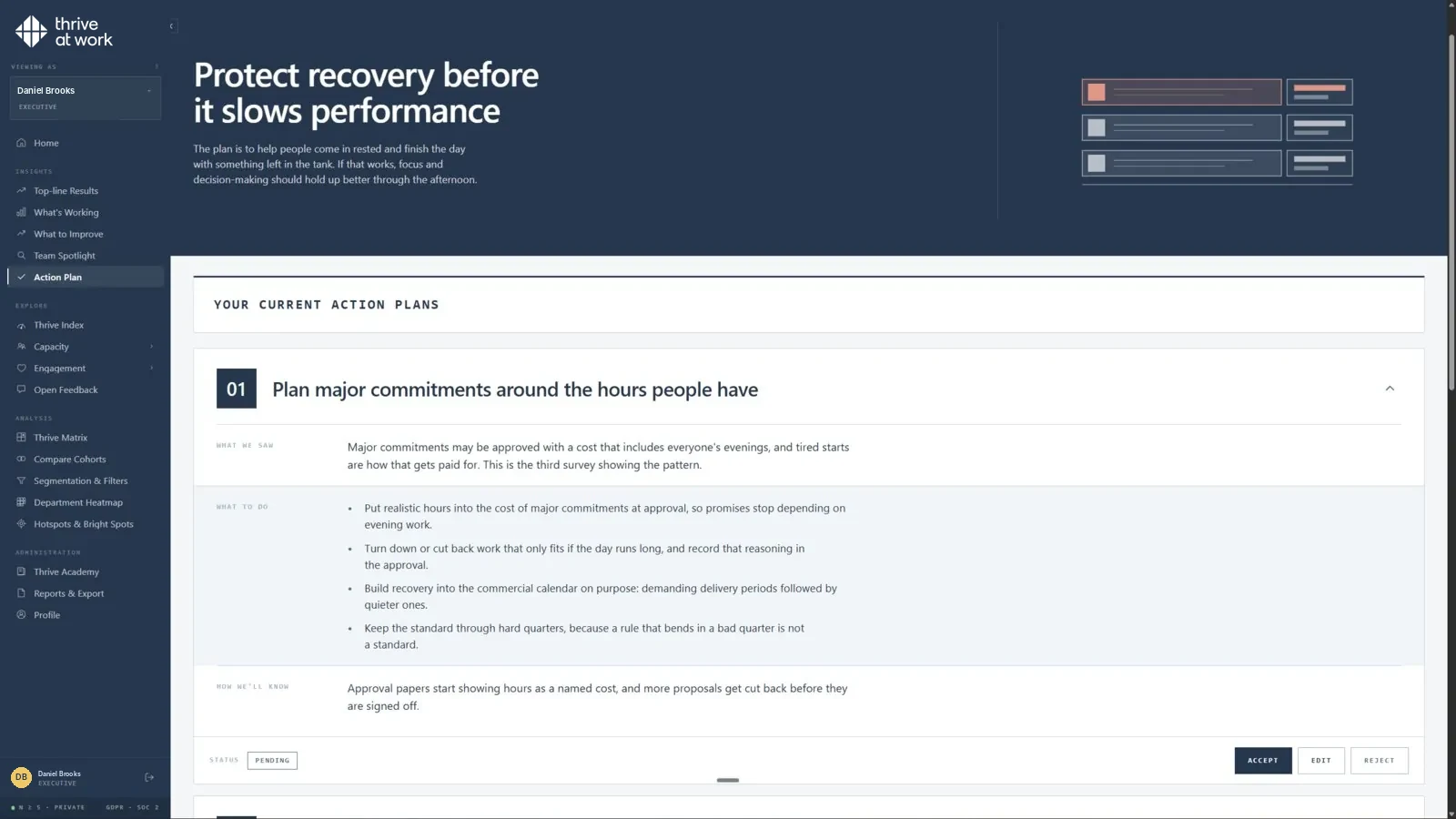
In an all-in-one suite, a manager typically sees employee records, absence, reviews, goals, meetings and engagement results in one place. In thrive at work, a manager sees the team's engagement and capacity scores, its place on the thrive matrix, the lowest domains, three suggested priorities and comment themes. The suite organizes people processes; thrive at work shows what to change in how the team works.
Common misunderstandings about capacity.
"Capacity is the same as wellbeing." Wellbeing programs offer support; capacity measures whether people have the energy, recovery, focus and resilience to keep performing, and shows where work design needs to change. "Capacity data is about individuals." In thrive at work it is anonymous and reported by team. "Engagement surveys already cover it." Most engagement surveys do not score these four domains separately.
A migration checklist.
| Step | Detail |
|---|---|
| Scope | Decide which processes stay in your suite and which move |
| Timing | Switch surveys at the end of a cycle |
| Core statements | Keep a few comparable items for trends |
| Employee data | Sync or upload from your HR system |
| Representatives | Update the works council agreement for the new tool |
| Communication | Explain the change and the anonymity rules |
Three typical scenarios.
| Scenario | Recommendation |
|---|---|
| A company without an HR system wants one platform for everything | An all-in-one suite such as Leapsome fits |
| A company with an HR system wants deeper insight into strain | Add thrive at work as the listening and capacity layer |
| A company runs many processes but still loses engaged people | Measure capacity before adding more processes |
Running a side-by-side pilot.
A short pilot with two or three teams, including one under visible pressure, shows the difference quickly. Ask managers which results they understood and acted on, and whether the stretched team stood out. Involve your works council before the pilot starts.
thrive at work measures engagement (purpose, leadership, connection, growth) and capacity (energy, recovery, focus, resilience) in one anonymous assessment: see how the assessment works.
Good engagement work needs a survey people trust and results managers can act on. In Employee Experience Management (EXM) terms, thrive at work is an employee engagement platform that measures engagement and capacity to perform in one anonymous survey. See the employee survey platform or read more about employee engagement.
Sources.
- Leapsome website. www.leapsome.com
- § 87 Abs. 1 Nr. 6 BetrVG. www.gesetze-im-internet.de
- thrive index validation study. thrive at work, 2025–26. Methodology.
Common questions
What are the best Leapsome alternatives?
Is thrive at work an HR system?
Does Leapsome measure capacity or burnout?
Which is better for German companies?
Can I use Leapsome and thrive at work together?

See the strain engagement scores miss.
A 30-minute call shows your teams on the thrive matrix.