


thrive at work/Employee turnover
Explainer · Turnover
What employee turnover is.
Turnover is the rate at which people leave and have to be replaced. Some turnover is healthy. The kind that hurts is losing people you wanted to keep.
By Jerry Fiser, Founder & CEO · Reviewed by Marcin Bulik, Research Director · Updated November 8, 2026
Free download
Exit interview questions and form
30 questions by theme, a one-page form and how to read the results.
Download (Word)Download (PDF)What is employee turnover?
Employee turnover is the number of employees who leave an organization over a period, usually expressed as a percentage of average headcount. It includes voluntary turnover (people who resign) and involuntary turnover (dismissals and redundancies).
- Turnover counts everyone who leaves; attrition usually means roles not refilled.
- Voluntary, avoidable turnover is the part to manage.
- Causes cluster around the manager, growth, pay fairness and workload.
- Exit interviews come too late; ask current employees.
Types of employee turnover.
The CIPD factsheet on employee turnover and retention explains voluntary and involuntary turnover and how to analyze it. In the US, the US Bureau of Labor Statistics Job Openings and Labor Turnover Survey (JOLTS) publishes monthly quit and separation rates by industry.
- VoluntaryResignations. The employee chooses to leave.
- InvoluntaryDismissals. The employer ends the employment.
- RegrettedLoss. People you wanted to keep. The most important number to track.
- EarlyFirst year. People leaving within their first year, often a sign of hiring or onboarding problems.
Common causes of employee turnover.
Poor management, lack of growth, unfair pay, unsustainable workload, little recognition, a poor fit with the role and better offers elsewhere. Exhaustion is often underestimated: committed people who run out of energy resign even when they like the job.

Consequences of high employee turnover.
High turnover raises costs for recruiting and onboarding, lowers productivity while roles are empty and new hires ramp up, and adds load to the people who stay. It can damage customer relationships, slow projects and erode knowledge. Over time, it also affects reputation: candidates notice when a team or employer is always hiring for the same roles.
Is some turnover healthy?
Some turnover is normal and even useful: people move on to new challenges, and new hires bring fresh skills. The question is not whether people leave, but who leaves and why. Losing low performers after fair support is different from losing your strongest people to burnout.
Track regretted turnover separately, meaning leavers you would have wanted to keep. That number, more than the total, tells you whether conditions at work are pushing good people out.
Early warning signals.
| Signal | Where you see it |
|---|---|
| Falling energy and recovery | Capacity scores in surveys |
| Fewer ideas, quieter meetings | Team behavior |
| More short absences | HR data |
| Less interest in the future | One-to-ones |
| Rising workload with no end date | Planning and overtime |
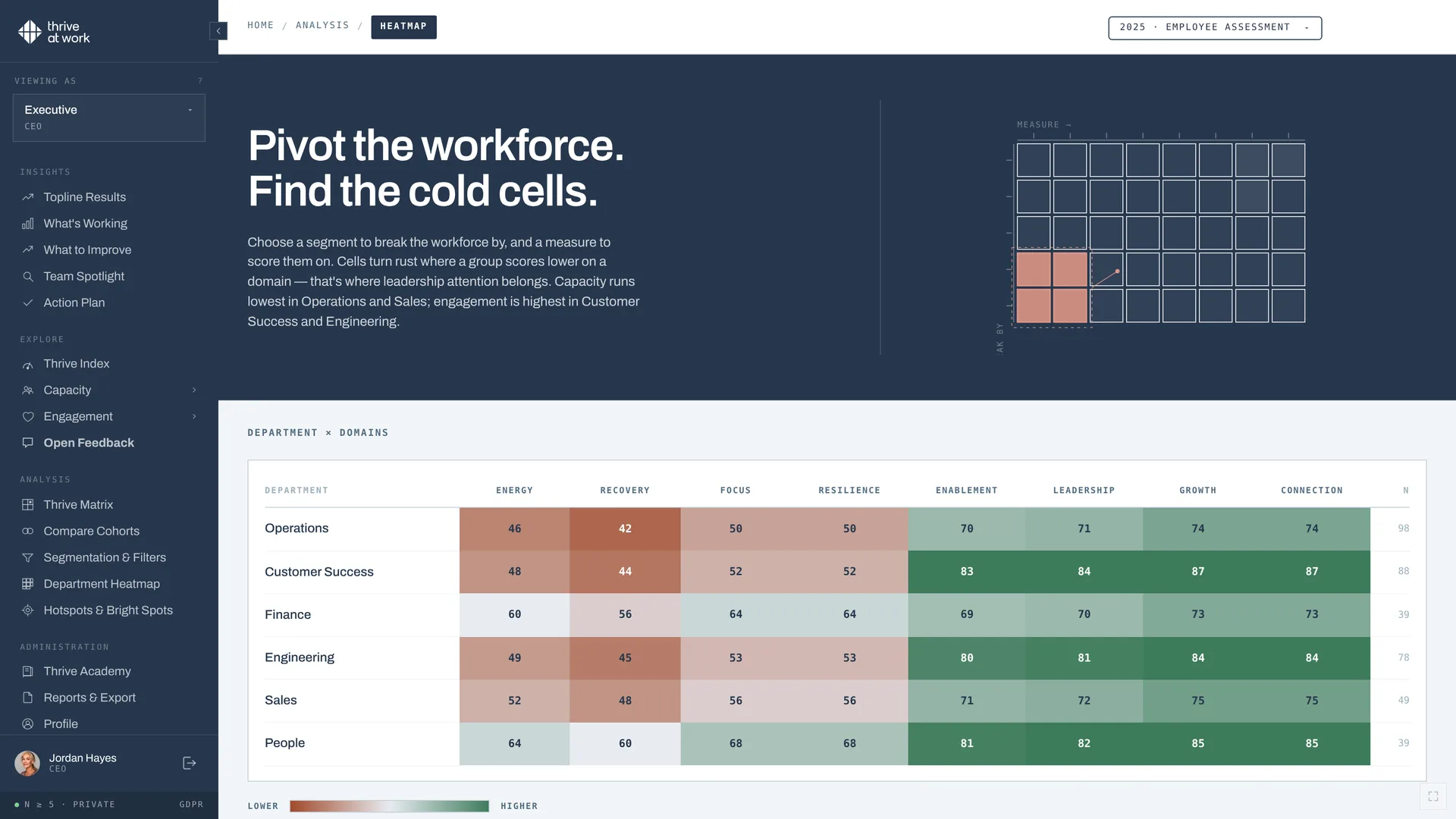
thrive research found that people with the least capacity, meaning energy, focus, recovery and resilience, delivered 56% of priority work on time, against 86% for those with the most.
How to predict employee turnover.
Turnover is easier to prevent when you can see it coming. Useful early signals include falling engagement and intention to stay, low energy and recovery in surveys, rising short absences, fewer internal applications and a manager change in the team. Combine these signals by team and review them each quarter. See how to calculate employee turnover rate.
Measuring employee turnover.
The basic turnover rate is the number of leavers in a period divided by the average headcount, multiplied by 100. Split it into voluntary and involuntary, and look separately at first-year leavers, high performers and each team. A company average often hides the teams where turnover is concentrated.
Pair the numbers with reasons. Exit interviews help, but people often give polite answers on the way out. Regular anonymous surveys of current employees show the conditions that lead to leaving while there is still time to act. Use the turnover rate calculator and the turnover cost calculator to size the problem.
How to reduce employee turnover.
Measure turnover by team, find the patterns, and act on the causes. See employee retention strategies and how to calculate the turnover rate.
thrive at work measures engagement (purpose, leadership, connection, growth) and capacity (energy, recovery, focus, resilience) in one anonymous survey: the employee engagement survey.
Turnover numbers only show who has already gone. thrive at work is a workforce performance platform: an employee engagement platform that reads engagement next to capacity to perform, so you can spot the teams at risk months earlier. Read more about employee engagement.
Sources.
- CIPD factsheet on employee turnover and retention. www.cipd.org
- US Bureau of Labor Statistics Job Openings and Labor Turnover Survey (JOLTS). www.bls.gov
- thrive index validation study. thrive at work, 2025–26. Methodology.
Common questions
What is the difference between turnover and attrition?
Is some employee turnover good?
What causes high employee turnover?
How do you reduce employee turnover?
What is a normal employee turnover rate?

Find turnover risk early.
A 30-minute call covers what a first measurement would show.