


thrive at work/Employee retention strategies
Guide · Retention
Employee retention strategies.
People stay where they trust their manager, can see a future and can keep up the pace. Retention strategies work when they fix one of those three. Here is how to find which one is broken in your teams, and fifteen strategies that address them.
By Jerry Fiser, Founder & CEO · Reviewed by Marcin Bulik, Research Director · Updated November 8, 2026
Free download
Employee retention plan template
Metrics, hot spots by team, drivers, actions with owners and a stay-conversation guide.
Download (Word)Download (PDF)Free download
Exit interview questions and form
30 questions by theme and a one-page form.
Download (Word)Download (PDF)What are the most effective employee retention strategies?
Develop managers, hold stay interviews, give people visible growth paths, recognize good work, pay fairly, offer flexibility where the work allows and keep workload sustainable. Start by finding out why people actually leave, through exit and stay interviews and an anonymous survey reported by team, because retention problems are usually concentrated in specific teams.
- Find where turnover concentrates before choosing tactics.
- Stay interviews tell you what to fix while people are still there.
- The direct manager is the strongest retention lever.
- Engaged but exhausted people are a hidden flight risk; measure capacity.
Employee retention strategies start with why people leave.
Before choosing tactics, look at who is leaving, from which teams, after how long, and whether you wanted to keep them. Exit interviews tell you why people left; stay interviews tell you why people stay and what would make them go, while you can still act.
| Signal | Where to look | What it usually means |
|---|---|---|
| Early leavers | Leavers in first 12 months | Hiring or onboarding problem |
| One team spiking | Turnover by team | Manager or workload problem |
| Top performers leaving | Regretted turnover | Growth or overload problem |
| "Better offer" in exit interviews | Exit data plus pay review | Pay or progression gap |
For the evidence on why people leave and how to measure it, see the CIPD factsheet on employee turnover and retention and the SHRM toolkit on managing employee retention.
| Reason | Retention strategy that addresses it |
|---|---|
| Manager relationship | Manager training, one-to-ones, feedback on managers |
| No growth | Development plans, internal moves, mentoring |
| Pay | Transparent, regularly reviewed pay principles |
| Workload | Workload planning, recovery after peaks |
| Lack of recognition | Specific, frequent recognition |
| Inflexibility | Flexible hours or location where possible |
| Poor fit | Realistic job previews, better onboarding |
Using exit data to choose retention strategies.
Exit interviews and surveys tell you why people leave, but only if you read them in aggregate. Group exit reasons into themes, such as manager, growth, pay, workload and personal reasons, and count them by team and role. A theme that appears again and again in one team is a team problem; a theme that appears everywhere is an organization problem.
Exit data has limits: people often give the most comfortable reason rather than the real one, and by the time they leave it is too late. Combine exit data with stay interviews and survey measures, such as intention to stay and energy, to act earlier.
15 employee retention strategies.
- 01Hire for fit and be honest. Realistic job previews reduce early turnover.
- 02Onboard well. A structured first 90 days with a named buddy.
- 03Develop managers. The manager relationship is the strongest single retention lever.
- 04Hold stay interviews. Twice a year with key people, before they start looking.
- 05Show the next step. Clear growth paths, including specialist routes.
- 06Hold development conversations. Separate from pay, at least twice a year.
- 07Recognize often. Specific, timely and fair recognition.
- 08Pay fairly. Review pay against the market and fix outliers before people find them.
- 09Offer flexibility. Choice over where and when, where the work allows.
- 10Keep workload sustainable. Chronic overload drives out your most committed people first.
- 11Protect recovery. Real vacations and no expectation of evening replies.
- 12Act on feedback. Visible action after surveys builds trust.
- 13Build connection. People stay for people; invest in time together.
- 14Deal with poor behavior. Tolerating one difficult high performer can cost you several good people.
- 15Measure and repeat. Track turnover, regretted turnover and survey results by team.
Onboarding as a retention strategy.
Many people decide whether to stay within their first months. Strong onboarding gives new hires a clear plan for the first weeks, a buddy, early wins, regular check-ins with the manager and an honest picture of the job. Ask new hires at 30 and 90 days what is working and what is missing, and fix the gaps for the next group.
Employee retention strategies by career stage.
| Stage | What matters most | Strategies |
|---|---|---|
| New hires | Clarity and welcome | Structured onboarding, a buddy, 30- and 90-day check-ins |
| Early career | Learning and feedback | Regular feedback, stretch tasks, visible next steps |
| Experienced staff | Growth and recognition | Ownership, internal moves, fair pay reviews |
| Managers | Support and influence | Manager training, peer networks, a voice in decisions |
| Long tenure | Respect and sustainability | Recognition, flexible arrangements, protected workload |
Stay interview questions.
What do you look forward to most at work? What would make you think about leaving? What would you change about your job if you could? Do you feel recognized for your work? Is your workload sustainable? What do you want to learn next? What can I do to make your work better?

The manager’s role in employee retention.
Managers shape most of what makes people stay or leave: how work is shared, whether effort is noticed, whether a next step is visible and whether problems can be raised. Retention strategies that bypass managers rarely work.
Give managers three things: their team’s survey results, including capacity, so they see risk early; training in stay conversations and workload discussions; and a route to escalate problems they cannot fix, such as staffing gaps. Include team retention in how managers are evaluated.
Employee retention strategies for small businesses.
Small businesses rarely compete on salary alone, but they have other strengths: closer relationships, more varied work and faster decisions. Use them. Give people visible responsibility early, involve them in decisions, recognize contributions personally and be flexible where the work allows. Losing one person in a small team hurts more, so stay interviews and regular one-to-ones matter even more.
Retention advantages of small businesses.
Small businesses can offer closeness to leaders, broad roles and fast decisions, which many people value.
Low-cost employee retention strategies.
| Strategy | Cost |
|---|---|
| Regular one-to-ones | Manager time only |
| Specific recognition | None |
| Stay interviews | Manager time only |
| Flexible hours where the work allows | Little or none |
| Clear priorities and fewer meetings | Saves time |
| Internal job postings | Little |
| Learning time | Working time |
The most effective retention measures cost attention rather than money. Pay still matters: if pay is clearly below the market, no other strategy will compensate for long.
The retention risk engagement surveys miss.
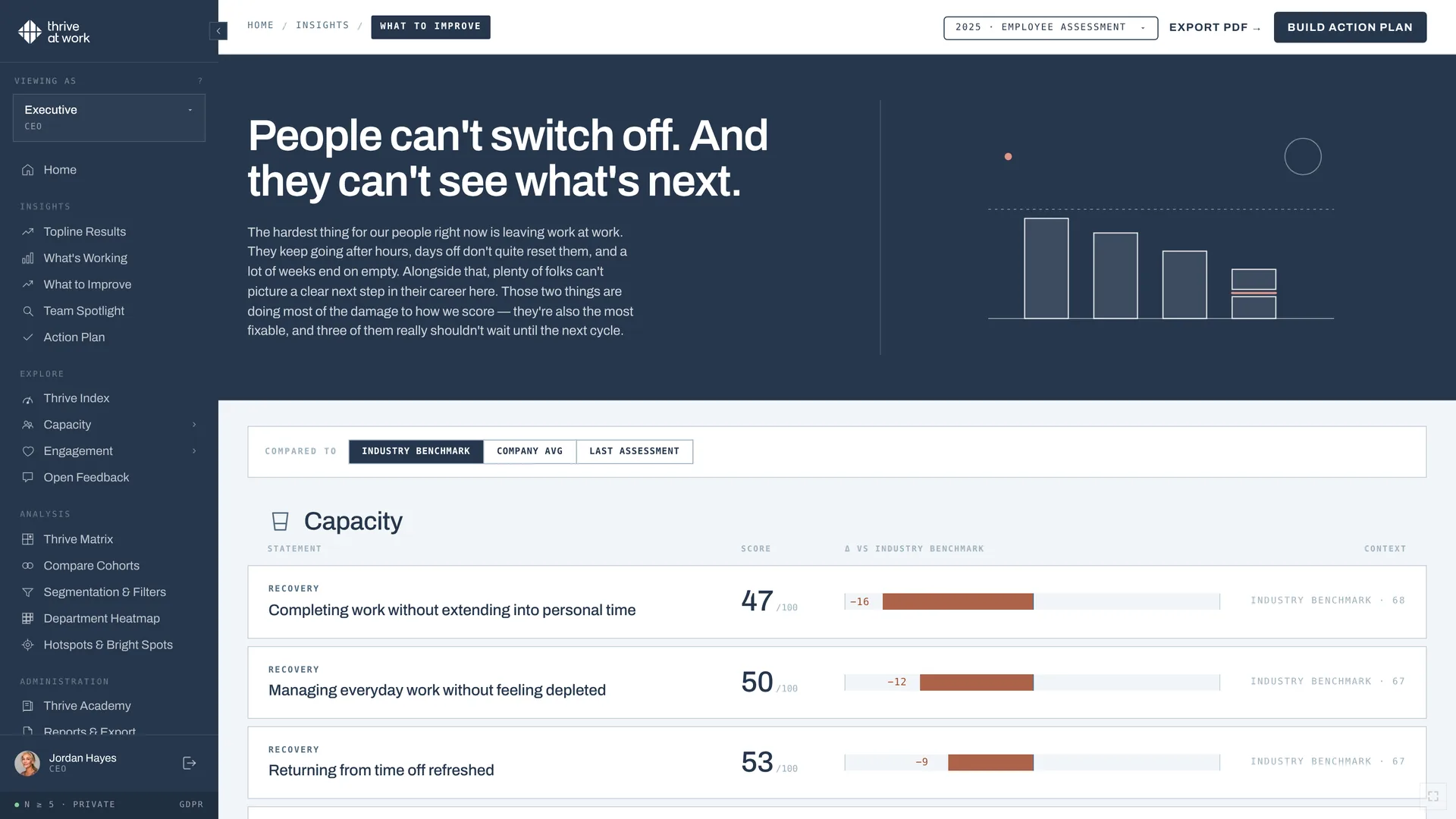
Some of your most engaged people are your biggest flight risk. They care, take on more and keep going until they cannot. Their engagement scores stay high, so the risk is invisible until the resignation. thrive research found that people in the lowest quarter for capacity (the energy, focus, recovery and resilience a person has available) lost 71 more days a year to not working effectively than those in the highest. Measuring energy and recovery next to engagement shows this group in time to act. See engagement and retention.
Sustainable workload as a retention strategy.
Chronic overload drives out the most committed people first, because they take on the most. Protect workload by planning against the people actually available, adding cover before peak periods, saying no to new work when the team is full and making sure people take their leave. Track overtime and energy by team, and treat a sustained rise as a retention risk.
Measure whether retention strategies work.
Track the retention rate and turnover rate by team, regretted turnover, first-year turnover and intention to stay in surveys. Estimate what turnover costs you with the turnover cost calculator.

Reviewing retention strategies every quarter.
Once a quarter, look at turnover and regretted turnover by team, intention to stay and capacity from the latest survey, and the themes from exit and stay interviews. Keep strategies that move these measures, drop those that do not, and focus effort on the teams where risk is highest.
thrive at work measures four capacity domains (energy, recovery, focus, resilience) and four engagement domains (purpose, leadership, connection, growth) in one anonymous survey, reported by team from five people: the employee capacity assessment.
Retention numbers only show who has already gone. thrive at work is a workforce performance platform: an employee engagement platform that reads engagement next to capacity to perform, so you can spot the teams at risk months earlier. Read more about employee engagement.
Sources.
- CIPD factsheet on employee turnover and retention. www.cipd.org
- SHRM toolkit on managing employee retention. www.shrm.org
- thrive index validation study. thrive at work, 2025–26. Methodology.
Common questions
What is the number one reason employees leave?
How can I improve employee retention quickly?
What is an employee retention strategy?
What are good retention ideas for small companies?
How do you measure employee retention?
What are the 5 Cs of employee retention?

See who is at risk before they resign.
A 30-minute call covers what a first measurement would show.