


thrive at work/Engagement and retention
Explainer · Retention
Engagement and retention.
Engaged people report stronger intent to stay. But some of your most engaged people leave anyway, and the reason is usually not motivation.
By Jerry Fiser, Founder & CEO · Reviewed by Marcin Bulik, Research Director · Updated November 8, 2026
How does employee engagement affect retention?
Engaged employees report stronger commitment and intent to stay, so engagement is one of the best early indicators of retention risk. Trust in the manager, growth and recognition are the drivers most closely linked to intention to stay. Engaged people still leave when workload is unsustainable or growth stops.
- Engagement and retention move together, but engagement alone does not keep people.
- Engaged people with low capacity are a quiet flight risk.
- Track drivers, not just the headline score.
- Act on the manager relationship, growth and workload first.
Employee engagement and retention: definitions.
Employee engagement is the commitment and willingness people bring to their work: how much they care about the outcome and how much discretionary effort they give. Employee retention is an organization’s ability to keep the people it wants to keep over time, usually measured as a retention rate or, from the other side, as voluntary turnover.
The two are linked but not identical. Engagement describes how people feel and behave at work today; retention describes whether they are still there next year. Engagement is one of the strongest early signals of retention, but it is not the only one. Pay, career options, the local job market and, often overlooked, whether people can sustain their workload all shape the decision to stay or go.
Engagement and retention: how they connect.
Engagement and retention are linked but not the same. Engagement is a present state: how committed people feel and how much effort they want to give. Retention is an outcome: whether they are still there after a period. Engagement usually moves first, which makes it useful as an early signal, but the link is loose enough that organizations need to watch both.
| Pattern | Retention risk | Why |
|---|---|---|
| High engagement, high capacity | Low | People want to stay and can sustain the pace |
| High engagement, low capacity | High and hidden | Committed people running down their reserves |
| Low engagement, high capacity | Moderate | People can cope but do not see the point |
| Low engagement, low capacity | High | People are disengaging and tired |
Why engagement affects employee retention.
Engaged people feel connected to their work, their team and their manager, and that connection makes leaving costly in a personal sense. They are more likely to see a future in the organization, to talk about it positively and to stay through difficult periods. Disengaged people, by contrast, often start looking long before they resign; the decision is usually made months before the letter arrives.
This is why engagement surveys are useful for retention: they show the conditions that come before resignations, by team, while there is still time to act. The weakness is that engagement alone misses one group. People who are highly engaged but running out of energy look like success in an engagement report, yet they are among the most likely to leave suddenly. thrive research shows that employees who are highly engaged but burning out lose three times as many days to not working effectively.
Why engaged employees still leave.
Engagement lowers the risk of leaving, but it does not remove it. People with strong commitment to their work still leave for five common reasons, and only some of them show in an engagement score.
| Reason | What it looks like | Does an engagement survey see it? |
|---|---|---|
| Exhaustion | High commitment, falling energy and recovery, longer hours | Rarely, unless capacity is measured alongside engagement |
| No next step | Strong performer with no visible promotion or new challenge | Partly, through growth statements |
| Pay gap | Market offers well above current pay | Seldom; pay is usually asked about only broadly |
| A new manager | Trusted manager leaves or the team is reorganized | Only after the change, if the survey is frequent |
| Life changes | Moving, caring responsibilities, study | No, and it should not try to |
The first reason is the one organizations most often miss. People who care most about their work keep delivering while their reserves fall, so their engagement score stays high until the day they resign. Measuring capacity, meaning the energy, focus, recovery and resilience people have available, alongside engagement shows that pattern months earlier.
Seven engagement drivers linked to employee retention.
- 1A good manager relationship. Regular one-to-ones, fair treatment and support when things get hard.
- 2Visible growth. A clear next step, learning on the job and internal moves.
- 3Recognition. Specific, timely acknowledgment of good work.
- 4Meaningful work. Knowing how the work matters and to whom.
- 5Trust in leadership. Decisions that are explained and consistent with stated values.
- 6Belonging. Feeling part of a team that helps each other.
- 7Sustainable workload. Enough energy and recovery to keep going.
Trust in the manager and retention.
Of all the engagement drivers, the relationship with the direct manager is the one most often named in exit interviews. People rarely leave because of one bad conversation. They leave after months of unclear priorities, feedback that never comes, problems that are not addressed and workload that nobody seems to notice.
Managers can change this with a few habits: a regular one-to-one that belongs to the employee, honest conversations about workload, recognition that names what someone did, and following through on what they promise. These habits cost time, not money, and they are the strongest retention lever most organizations have.
The hidden retention risk.
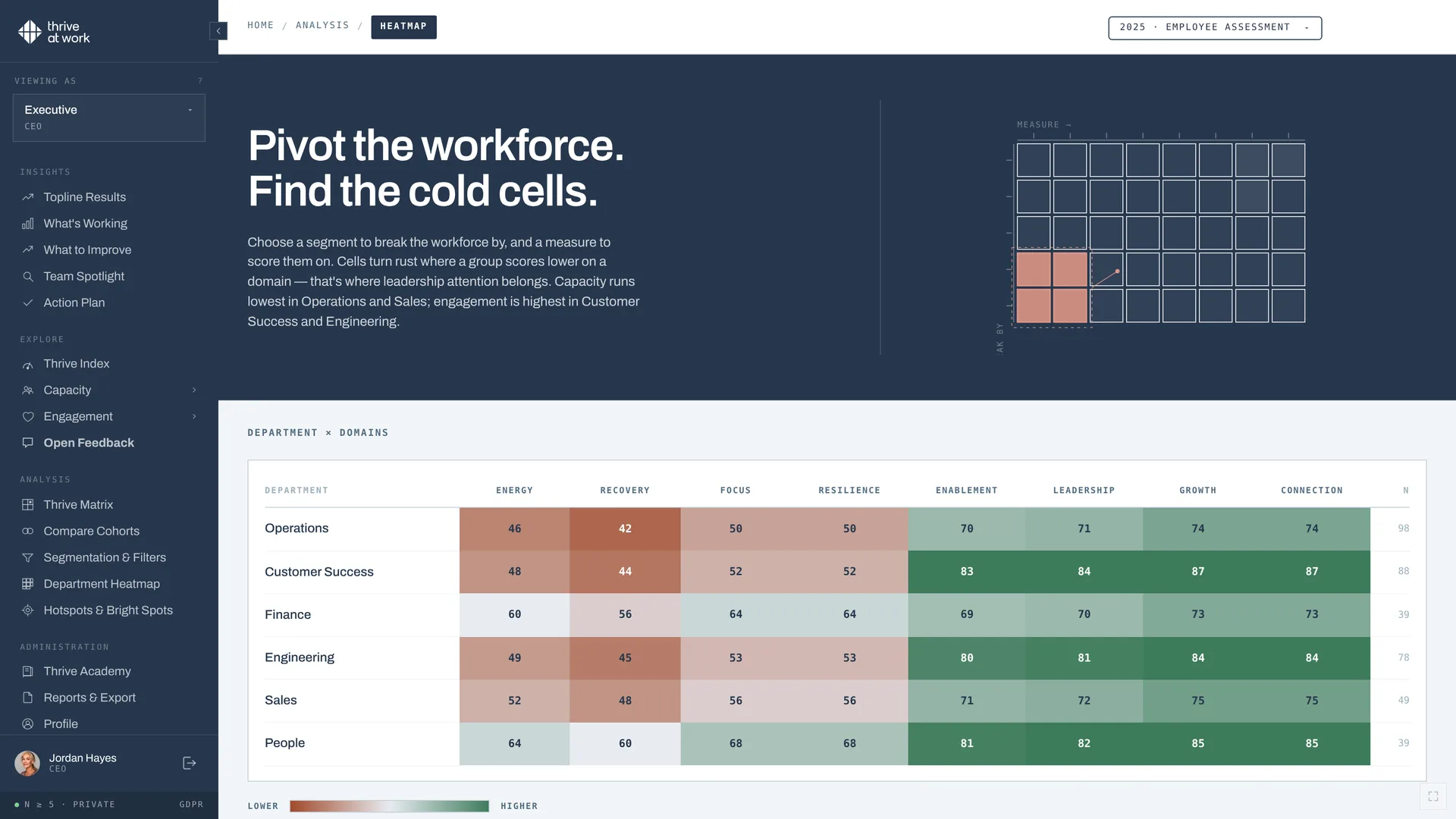
The people you least want to lose are often the most engaged, and they leave when the load becomes unsustainable. On the Thrive Matrix, high engagement with low capacity is the quadrant called Burning out.
Early signals of retention risk in engaged employees.
Engaged people rarely signal that they are about to leave. They keep delivering, often taking on more. The signals are quieter: working later more often, skipping leave, fewer ideas in meetings, more irritation under pressure, and less talk about the future. In surveys, energy, recovery and focus fall while commitment holds.
When managers see these signals, the right response is a conversation about load, not about loyalty. Ask what can stop or move, protect recovery time and check in again within a few weeks.
Engagement and retention across the employee lifecycle.
| Stage | Retention risk | What helps |
|---|---|---|
| First 90 days | Mismatch between job and expectations | Realistic job previews, structured onboarding, early check-ins |
| First two years | Unclear growth, weak manager relationship | Development plans, regular feedback, internal moves |
| Established employees | Plateau, workload creep | Stretch projects, recognition, workload reviews |
| High performers | Overload, being taken for granted | Ceilings on priorities, visible career paths, recovery after peaks |
| Before leaving | Silent disengagement | Stay interviews, anonymous surveys, acting on what you hear |
Why timing matters for retention.
Acting at the right moment, such as after a reorganization or before a known exit risk, does more than any yearly program.
Engagement and retention risks at each stage of employment.
Retention risk is not spread evenly across a career. It peaks at a few predictable moments, and each moment needs a different response.
| Stage | Typical risk | What helps |
|---|---|---|
| First 90 days | The job does not match what was promised; slow onboarding | Honest job previews, a buddy, clear first goals, a 30-day check-in |
| End of first year | No feedback, unclear future, first pay review disappoints | A development conversation and a visible next step |
| Two to four years | Plateau: learning slows, the same work repeats | Stretch projects, internal moves, new responsibility |
| After a reorganization | Trusted manager or team lost, role unclear | Explain the change, clarify roles, check in individually |
| Long tenure, high load | The most relied-on people carry the most work | Share the load, protect recovery, recognize the contribution |
| Before a known exit risk | Competing offer, end of a project, parental return | Stay conversations before the decision is made |
Who drives engagement and retention: leaders, HR, managers, employees.
| Role | Main contribution |
|---|---|
| Senior leaders | Set direction, explain decisions, fund the changes that matter, model sustainable working |
| HR and people teams | Run listening, analyze results by team, equip managers, design fair processes for pay and promotion |
| Managers | Hold one-to-ones, recognize work, plan workload, remove obstacles, act on team results |
| Employees | Give honest feedback, take part in choosing and testing changes, raise problems early |
Engagement and retention programs stall when they sit only with HR. Most of the daily experience that shapes both is created by managers, so most of the effort belongs with them.
A monthly forum for managers and leaders.
Hold a short monthly meeting where managers raise obstacles they cannot solve alone, such as staffing or conflicting priorities, and leaders decide on them.
What leaders, HR and managers each do for engagement and retention.
Engagement and retention improve when each group does the part only it can do. Leaders set direction and remove obstacles that teams cannot remove themselves. HR runs listening, shares results and equips managers. Managers turn results into daily changes. Employees answer honestly and take part in choosing what to change.
The most common gap is between managers and leaders. Managers are asked to act on survey results but cannot change workload, staffing or priorities alone. A short monthly forum where managers raise the obstacles they cannot fix, and leaders decide on them, closes that gap.
A combined engagement and retention plan.
Treat engagement and retention as one plan. Measure engagement and capacity by team, then look at turnover for the same teams over the following months. Where both engagement and capacity are low, people tend to leave quietly; where engagement is high but capacity is low, the risk is losing your strongest people.
For each group, act on the conditions behind the scores: manager support and growth for low engagement, workload and recovery for low capacity. Recheck after three to six months and compare with turnover. See employee retention strategies for more ideas.
What it costs when engaged employees leave.
Losing an engaged, experienced employee costs more than the visible recruiting bill. The work they carried lands on colleagues, often the next most engaged people. Knowledge goes with them. And the replacement takes months to reach the same level.
Use the cost of employee turnover calculator with your own figures. Then look at who leaves: losing a person you would have kept is a different problem from turnover in roles with high natural churn. Track regretted turnover separately, because that number tells you whether conditions are pushing good people out.
Stay interviews: questions to ask.
A stay interview asks current employees why they stay and what might make them leave, before they decide to go. Useful questions include "What do you look forward to at work?", "What would make you think about leaving?" and "What can I do to make your work better?".
Hold them once or twice a year, especially with people in critical roles. Write down one action from each conversation and follow up. See employee retention strategies for more questions.
Engagement actions that support retention.
The actions that raise engagement and retention together are mostly the same: managers who hold regular one-to-ones and act on feedback, visible growth, specific recognition, explained decisions and a workload people can sustain. Prioritize them in teams where both engagement and intention to stay have fallen, and check the same statements three months later.
A stay interview guide for engagement and retention.
Stay interviews work best as a short, informal conversation of about 20 minutes, held by the direct manager once or twice a year. The goal is to learn what keeps a person and what might make them leave, and to act before they decide.
| Part | Questions | Why it helps |
|---|---|---|
| Open | What do you look forward to most at work? | Starts with what is working |
| Energy | What drains your energy at work? What gives you energy? | Surfaces workload and recovery problems early |
| Growth | What would you like to learn or do next? Where do you see yourself in a year? | Shows whether a next step is visible |
| Risk | Have you thought about leaving recently? What prompted it? | Asks directly, which most people respect |
| Support | What is one thing I could do differently as your manager? | Gives the manager something concrete |
| Close | What should we keep exactly as it is? | Protects what already works |
Write down one action from each conversation and come back to it within a month. A stay interview without follow-up does more harm than none, because it shows that listening was a formality.
Engagement and retention metrics to track.
Track intention to stay and engagement by team in surveys, and turnover, early turnover and regretted turnover in HR data. When a team's engagement stays high but its capacity falls, retention risk is rising. See retention strategies.
For retention measures and causes, see the CIPD factsheet on employee turnover and retention and the SHRM toolkit on managing employee retention; the Gallup State of the Global Workplace report tracks intent to leave alongside engagement.
Combine survey measures and HR data for the same teams. From the survey: engagement, intention to stay, manager support, growth and capacity (energy, recovery, focus and resilience). From HR data: voluntary turnover, regretted turnover, first-year turnover and internal moves. Then look at the combinations. Teams with falling engagement and capacity usually show rising turnover a few months later; teams with high engagement and low capacity are where the strongest people are at risk. See the retention rate calculator and the turnover rate calculator.

An engagement and retention dashboard: what to track monthly.
A small dashboard reviewed every month keeps engagement and retention in the same conversation. Keep it to measures you will act on, and show them by team.
| Measure | Source | What a warning looks like |
|---|---|---|
| Engagement by team | Survey | A fall of several points between two surveys |
| Capacity by team (energy, recovery, focus) | Survey | Falling while engagement holds |
| Intention to stay | Survey | Fewer people who see themselves here in a year |
| Voluntary turnover | HR system | Rising in one team or role |
| Regretted turnover | HR system and managers | Any increase among people you would have kept |
| First-year turnover | HR system | People leaving in their first months |
| Short absences | HR system | More single days off, often before longer absence |
| Internal moves | HR system | Few moves suggest growth paths are blocked |
An engagement and retention model.
A simple model helps teams act. Conditions at work, such as manager support, growth, recognition, fair pay and workload, shape two states: engagement (do people want to give effort?) and capacity (can they sustain it?). Together these states drive outcomes such as performance, absence and retention. When engagement and capacity are both high, people stay and perform. When engagement is high but capacity is low, people are at risk of burning out and leaving suddenly. When both are low, people disengage and drift away.
Using this model, each team can see which conditions to work on first and track whether changes move engagement, capacity and, later, retention.
Using the engagement and retention model with teams.
Share the model with managers as a simple two-by-two: engagement on one axis, capacity on the other. Ask each manager where their team sits and what evidence they have. Teams in the high-engagement, low-capacity corner need workload relief first; teams in the low-engagement corner need direction, recognition and growth. Revisit the picture after each survey to see whether teams have moved.
Why engagement and retention efforts fall short.
Three patterns explain most failures. First, measuring without acting: a survey that leads to no visible change lowers trust and response rates next time. Second, acting only at company level: a new benefit or an all-hands message rarely fixes a problem that sits in one team with one manager. Third, measuring the wrong thing: an engagement score that looks healthy can hide exhausted teams, so the strongest people leave while the dashboard stays green.
The fix is a simple loop run team by team: measure engagement and capacity, share results within weeks, agree two or three actions with owners and dates, and measure again after three to six months.
Where to start with engagement and retention.
Start with the teams where engagement or intention to stay fell most since the last survey, and with roles where regretted turnover is highest. Share results with those teams, ask what sits behind them and agree one or two changes with owners and dates. Check the same measures after three months, and widen the approach only once it works in the first teams.
Engagement and retention in practice: three team examples.
The following examples are illustrative. They show how the same survey results lead to different actions depending on what sits behind them.
| Team pattern | What it means | What the team did |
|---|---|---|
| High engagement, falling capacity | Committed people running down their reserves | Moved two projects to next quarter, added cover for peak weeks, protected one focus day a week |
| Low engagement, normal capacity | People can cope but do not see the point | Leader explained the team’s role in company goals; manager started regular one-to-ones |
| Both low | People are disengaging and tired | Reset priorities with the team, fixed the two biggest process blockers, checked in monthly |
In each case the team checked the same statements three months later, and turnover in the following months showed whether the change held.
thrive at work measures engagement (purpose, leadership, connection, growth) and capacity (energy, recovery, focus, resilience) in one anonymous survey: the employee engagement survey.
Retention numbers only show who has already gone. thrive at work is a workforce performance platform: an employee engagement platform that reads engagement next to capacity to perform, so you can spot the teams at risk months earlier. Read more about employee engagement.
Sources.
- CIPD factsheet on employee turnover and retention. www.cipd.org
- SHRM toolkit on managing employee retention. www.shrm.org
- Gallup State of the Global Workplace report. www.gallup.com
- thrive index validation study. thrive at work, 2025–26. Methodology.
Common questions
Do engaged employees stay longer?
What are engagement and retention metrics?
How does employee engagement affect retention?
What is the best way to retain engaged employees?
Which comes first, engagement or retention?
What is the relationship between employee engagement and retention?
What is an employee retention strategy?
Does higher engagement reduce turnover?
What is the difference between engagement and retention?
How often should you hold stay interviews?
What is regretted turnover?

See retention risk before the resignation.
A 30-minute call covers what a first measurement would show.