


thrive at work/EXM software
Buyer guide · Software
Employee Experience Management (EXM) software.
EXM software listens to employees across their working life and helps the organization improve what it hears about. It is the analyst term for a category that overlaps heavily with engagement platforms.
By Jerry Fiser, Founder & CEO · Reviewed by Marcin Bulik, Research Director · Updated November 8, 2026
What is EXM software?
Employee Experience Management (EXM) software collects feedback across the employee lifecycle, from onboarding to exit, analyzes it by team and moment, and helps the organization act. It usually includes engagement and pulse surveys, lifecycle surveys, comment analysis, dashboards and action planning. The best EXM platforms also measure whether people have the capacity to perform, not only how they feel.
- EXM is the analyst and procurement term for employee listening platforms.
- It covers the whole lifecycle, not just an annual survey.
- EXM and employee engagement platforms overlap heavily.
- Check lifecycle coverage, anonymity, analytics and action support.
- Adding capacity to EXM shows strain that experience scores miss.
Where EXM fits in the market.
Analysts and procurement teams use Employee Experience Management, or EXM, for platforms that listen to employees and help organizations act. Buyers searching on Google more often use "employee engagement platform" or "employee survey software". In practice the categories overlap. The main difference is scope: EXM stresses the full lifecycle and many listening channels, while engagement tools often start with one survey. See Employee Experience Management for the concept.
How EXM grew out of engagement surveys.
For decades, employee listening meant one annual engagement survey run by HR or a consultancy. Results arrived months later, by which time teams had changed. Software made it possible to run shorter surveys more often, see results immediately and ask about specific moments such as onboarding or change. Analysts began calling the broader category Employee Experience Management. The idea is simple: listen at the moments that matter and act while it still makes a difference.
EXM, engagement and employee experience platforms.
| Term | Usually means |
|---|---|
| Employee engagement platform | Surveys and analytics focused on engagement and its drivers |
| Employee Experience Management (EXM) | Listening across the lifecycle and acting on it; the analyst term |
| Employee experience platform | Often a broader suite: intranet, communication, apps and sometimes surveys |
| Digital employee experience (DEX) | IT monitoring of devices and software performance |
The names overlap. Ask vendors what they actually measure and do, rather than relying on the category label. See employee experience platform.
What good EXM delivers.
A well-run EXM program changes how an organization makes decisions about people. Leaders hear about problems while there is still time to act, not in exit interviews. Managers get clear, team-specific priorities instead of company averages. HR can show which programs work and which do not. Employees see that speaking up leads to change, which makes them more likely to raise problems early. Over time, these effects show up in the measures leaders already track: fewer regretted leavers, fewer short absences, faster onboarding and steadier delivery in busy periods.
Building a listening strategy.
A listening strategy decides what you will ask, when, of whom and why. Start with three or four questions leadership needs answered this year, such as where burnout risk is highest, why new hires leave early or how a reorganization is landing. Choose the channels that answer them: a baseline survey, a few pulses, onboarding and exit surveys. Set the rhythm so that every listening moment leads to visible action before the next one. Write the strategy down in one page and share it with managers and employee representatives, so everyone knows what to expect.
Lifecycle moments EXM software covers.
| Moment | What to learn |
|---|---|
| Recruiting | How candidates experience the process |
| Onboarding | Whether new hires have what they need |
| Daily work | Engagement, workload, tools and manager support |
| Development | Growth, learning and career paths |
| Change | How reorganizations and new tools land |
| Exit | Why people leave and what would have kept them |

Listening channels.
| Channel | Best for | Limits |
|---|---|---|
| Annual or twice-yearly survey | Broad baseline, drivers, benchmarks | Slow to show change |
| Pulse survey | Tracking a few measures, checking actions | Narrow by design |
| Lifecycle survey | Onboarding, internal moves, exit | Small groups, timing |
| Open comments | Reasons in people's own words | Needs theming and anonymity care |
| Focus groups | Depth on one topic | Not anonymous, small samples |
| System data | Turnover, absence, overtime | Shows what, not why |
Most organizations get further with two or three well-run channels than with every channel at once.
How often to listen.
More listening is not always better. Each survey costs people time and raises expectations of action. A practical rhythm for most mid-size organizations: one broad survey a year, short pulses every one to three months on a stable core, onboarding surveys at 30 and 90 days, and exit surveys. Add topic surveys only when a real decision depends on the answer.
Designing pulses that people answer.
Short pulses keep EXM programs alive between broad surveys, but only if people keep answering. Keep pulses to five to fifteen statements with a stable core, so trends mean something. Include a few capacity statements, because energy and recovery change faster than engagement drivers and are often the first sign of trouble. Rotate a small block of statements that follow up on the actions teams chose. Close with one open question. Send pulses on a predictable rhythm, share team results within days and make sure every pulse leads to at least one visible change. When people see that pattern, participation stays high for years.
The four capacity domains in EXM.
Energy covers the physical and mental fuel people bring to work. Recovery covers whether they can switch off and recharge between working days. Focus covers whether they can concentrate on important work without constant interruptions. Resilience covers whether they can handle pressure and setbacks without lasting harm. Adding these four to an EXM program gives a fuller picture than experience scores alone: it shows not only how people feel about work, but whether they can sustain it. Each domain points to a different fix, from workload and staffing to meeting habits and support, which makes action planning more specific.
Read capacity next to engagement for every team. Teams that are engaged but low on capacity need relief first; teams with energy but low engagement need purpose, growth and recognition.
First steps with EXM.
Run a baseline of engagement and capacity, share results within weeks, agree one or two actions per team and set the first pulse date. Add onboarding and exit surveys once the first loop is working.
Why it is worth doing.
Organizations that listen well and act visibly see more honest feedback, earlier warning of problems and better retention of the people they most want to keep. The effort is modest compared with the cost of finding out too late.
Connecting EXM to your HR systems.
EXM software needs accurate employee data to send the right surveys to the right people and report results by team. Most platforms connect to HR systems through an integration or a regular file upload, and use single sign-on so employees do not need another password. Lifecycle surveys depend on these connections: an onboarding survey is triggered by a start date, an exit survey by a leaving date. Check how often data refreshes, how organizational changes are handled mid-cycle and what happens to historical results when teams are restructured.
Working with open comments.
Open comments often hold the most useful insight in an EXM program, and the most risk. They explain the reasons behind scores in people's own words, but they can also reveal who wrote them. Good EXM software groups comments into themes, shows which themes appear most in which teams, and flags comments that contain names or identifying details before they are shared. Share themes with managers rather than raw comments when groups are small. And respond to the most common themes publicly; nothing builds trust faster than "you told us X, so we changed Y".
Privacy and trust in EXM.
EXM collects a lot of information about how people experience work, which makes privacy central. Report at group level, set minimum group sizes, protect comments, limit access to raw data and be transparent about how results are used. In the EU, check the legal basis for processing, data hosting, retention periods and any use of AI on employee data. In Germany, agree the program with the works council. Trust is the foundation of honest feedback; once people believe their answers could be used against them, the data stops being useful.
Scaling an EXM program.
Start with one or two business units or a single country, prove that listening leads to action, then expand. Each expansion brings new languages, new team structures and sometimes new employee representatives to involve. Keep the core statements and anonymity rules the same everywhere so results stay comparable. Expect participation to dip briefly in new units until people see the first changes; it usually recovers by the second pulse.
Bringing it together.
EXM software helps organizations listen at the moments that matter and act while it still makes a difference. Choose a platform that covers the lifecycle moments you care about, protects anonymity, gives managers clear priorities and closes the loop with visible action. Add capacity to see where good experience is being paid for with exhaustion. Start small, prove that listening leads to change, and grow from there. Judge the program by what changes for people and teams, not by how many surveys it sends.
The most common reason EXM programs stall is that they collect more than the organization can act on. A focused program with a baseline, a few pulses and two lifecycle surveys, read carefully and acted on quickly, usually beats a sprawling one.
EXM software vs engagement surveys.
| Engagement survey | EXM software | |
|---|---|---|
| Scope | One survey, usually annual | Many surveys across the lifecycle |
| Rhythm | Once a year | Continuous or regular pulses |
| Data | Engagement scores and drivers | Engagement, lifecycle, comments, sometimes system data |
| Action | Often left to managers | Built-in action planning and follow-up |
Moments that matter most.
- 1First 90 days. Early experience decides whether new hires commit or leave in year one.
- 2New manager. A change of manager is a common turning point for engagement and retention.
- 3Reorganization. How change is explained shapes trust for years.
- 4Peak workload. Busy seasons reveal whether capacity is sustainable.
- 5Return from leave. Parental or sick leave returns need support to stick.
- 6Exit. The most honest feedback many organizations get.
Features to compare in EXM software.
- 01Measures what you need. Engagement drivers, and whether people have the capacity to perform.
- 02Protects anonymity. A minimum group size before results show, and no individual scores.
- 03Gives managers a plan. Results arrive with clear next steps, not just charts.
- 04Works in your languages. Same questions, properly translated, for every team.
- 05Fits your systems. SSO, HRIS sync or a simple employee file upload.
- 06Handles data properly. Where data is hosted, who can see it, how long it is kept.
- 07Shows trends. Stable core questions so you can compare over time.
- 08Works with employee representatives. Documentation that supports works council and privacy reviews.
Analytics in EXM software.
Look beyond dashboards. Useful analytics answer three questions: where are we strongest and weakest, which topics matter most for outcomes such as intent to stay, and which teams need attention first. Driver analysis, heatmaps and trend lines answer these. Text analytics turns thousands of comments into themes. Be cautious with predictions about individuals; team-level insight is easier to act on and protects trust.
Closing the feedback loop.
The weakest part of most EXM programs is what happens after results. People stop answering when nothing changes. A strong loop has four steps: share results with each team within a few weeks, agree one or two priorities together, act visibly, and report back at the next pulse on what changed. Software should support each step with team reports, suggested actions, reminders and a record of progress.
| Step | Owner | Typical timing |
|---|---|---|
| Share results | Manager with HR support | Within 2 to 4 weeks |
| Agree priorities | Team and manager | Same meeting |
| Act | Manager, team, sometimes leadership | Next 4 to 8 weeks |
| Report back | Manager | At the next pulse |

Supporting managers in EXM.
Managers carry most of the work after a survey, usually on top of a full job. Help them with short reports that show one or two priorities, a script for the team conversation, suggested actions they can start that week and a reminder before the next pulse. Recognize managers whose teams improve. If managers are themselves low on capacity, address that first; they cannot lift a team they are too tired to lead.
An example of EXM in practice.
A mid-size technology company ran one long annual survey and struggled to show any impact. It moved to a shorter baseline survey of engagement and capacity, quarterly pulses and onboarding and exit surveys. The first baseline showed that two fast-growing product teams were highly engaged but low on recovery. Leaders paused one roadmap item, added cover for on-call duties and set a rule against weekend messages. Recovery scores rose at the next two pulses, and neither team lost a senior engineer that year. The example is illustrative, but the pattern is common: measure the right things, act on a few, check again.
What experience scores can miss.
Experience surveys ask how people feel about their work. A team can feel good about its manager, mission and colleagues while its energy and recovery fall, often because those good things make people keep going. Measuring capacity, the energy, recovery, focus and resilience people have available, shows that strain before it turns into burnout and resignations.
AI in EXM software.
Many EXM vendors now use AI to summarize comments, suggest actions and answer questions about results. This can save time, especially with large comment volumes. Ask how the AI works, what data it uses, whether your data trains the vendor's models and how errors are caught. In the EU, AI systems used for decisions about individual employees can be high-risk under the AI Act, so check how any AI feature handles individual data. Use AI to speed up reading and drafting, and keep decisions about people with people.
Capacity in an EXM program.
Experience surveys are good at measuring how people feel about leadership, colleagues and growth. They are weaker at measuring whether people can keep going. thrive research shows that a team can report strong engagement while its capacity is low, and that employees who are highly engaged but burning out lose three times as many days to not working effectively. Adding a capacity measure to EXM shows where good experience is being paid for with exhaustion. See committed but depleted.
What thrive at work does differently.
Most engagement tools ask how people feel about their work, manager, leadership and company. thrive at work asks that too, and adds a second question: do people have the energy, recovery, focus and resilience to keep performing? The two answers sit side by side as an Engagement Index and a Capacity Index, each from 0 to 100, and place every team on the thrive matrix: Thriving, Burning out, Coasting or Depleted.
That second index matters because a strong engagement score can hide a team that is close to exhaustion. thrive research shows that employees who are highly engaged but burning out lose three times as many days to not working effectively. An engagement-only tool reports those teams as a success.
thrive at work features.
| Feature | What it means in practice |
|---|---|
| Engagement Index | Purpose, leadership, connection and growth, scored 0 to 100 |
| Capacity Index | Energy, recovery, focus and resilience, scored 0 to 100 |
| thrive matrix | Every team placed as Thriving, Burning out, Coasting or Depleted |
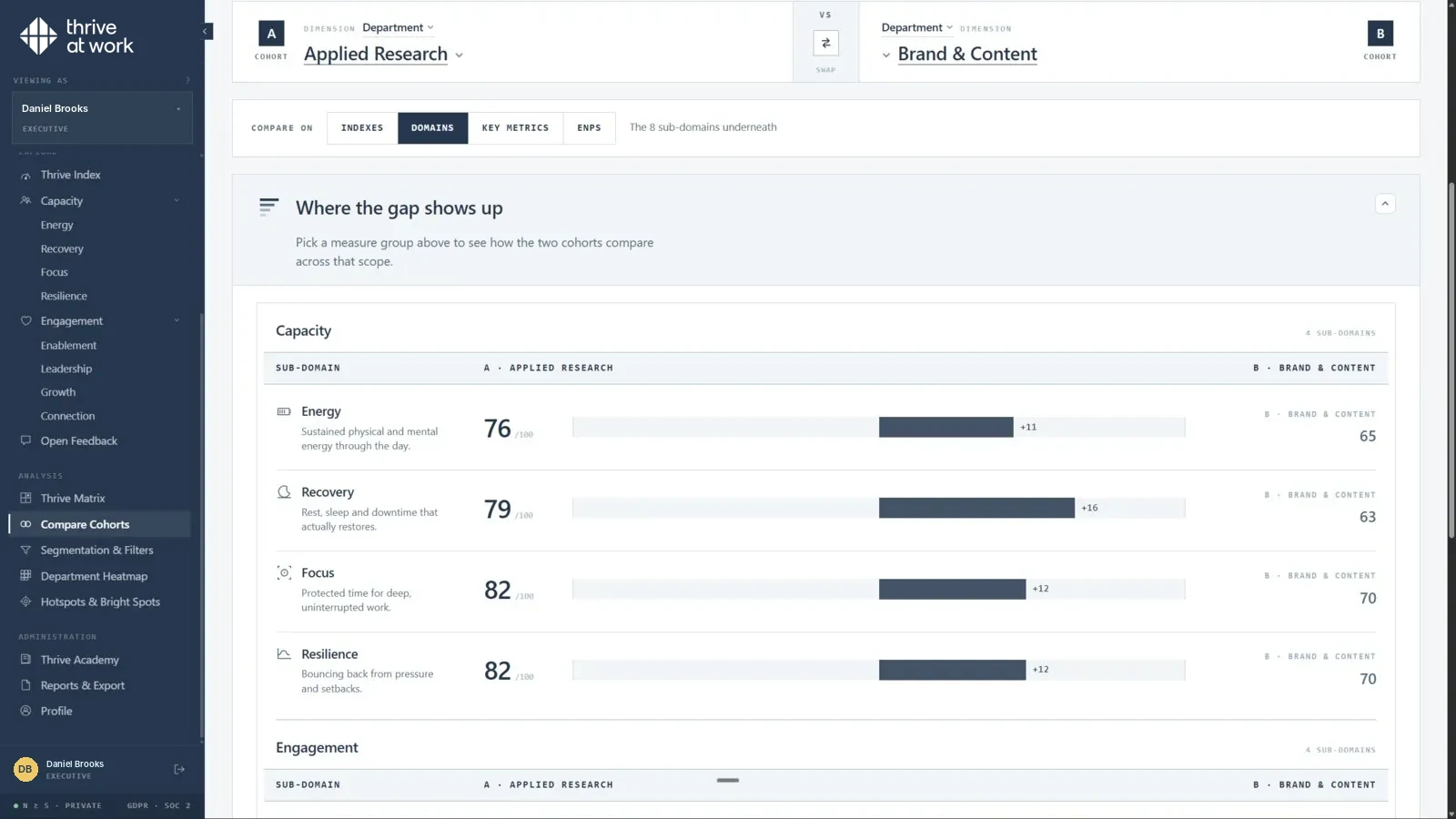
| Team heatmaps and cohort comparisons | See where scores differ by team, location or group |
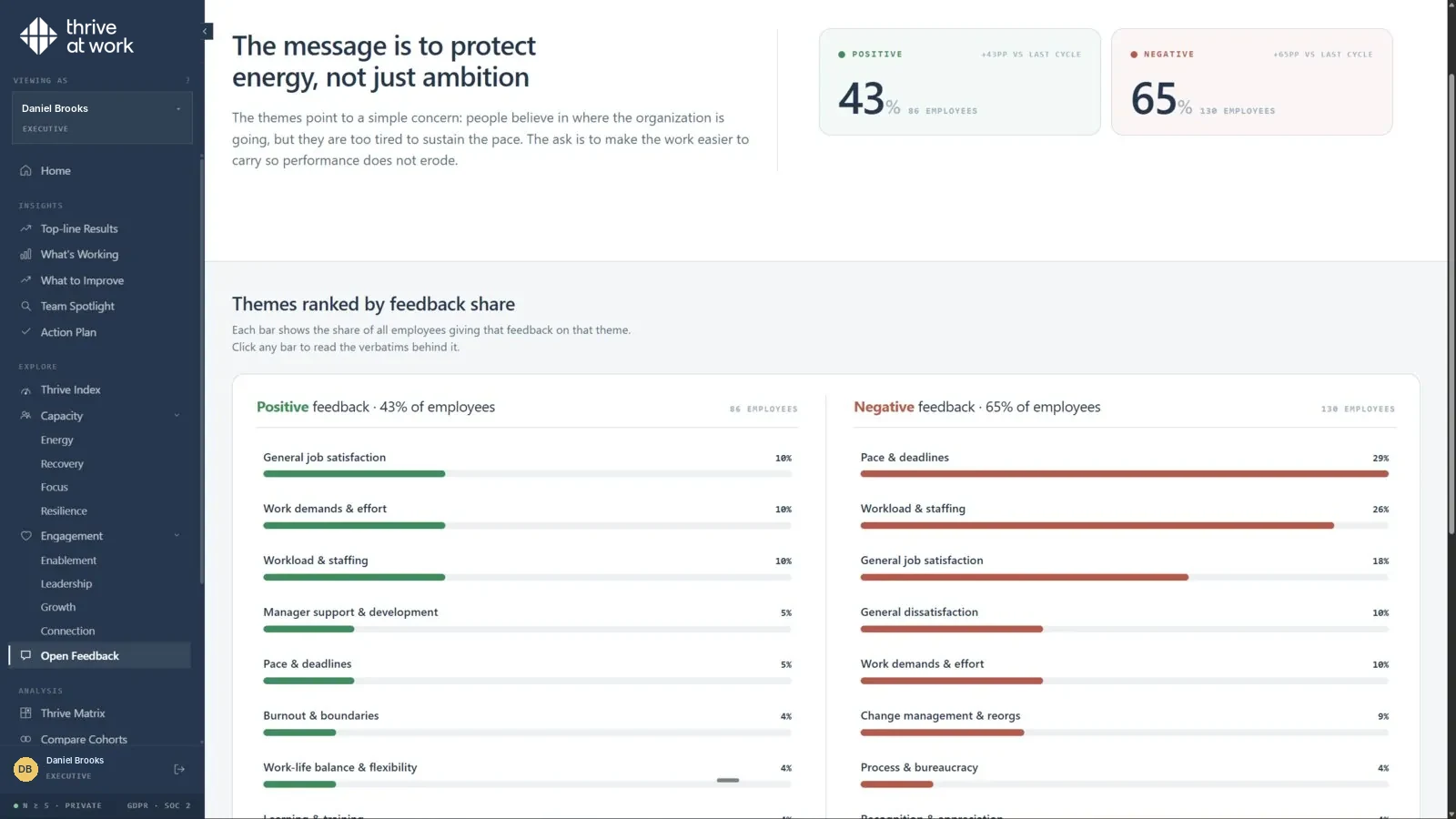
| Open feedback themes | Comments grouped into themes, with anonymity protected |
| Action plans | Three suggested priorities per team, routed to the manager, the organization or the individual |
| Thrive Academy | More than 300 short courses matched to each person's lowest-scoring area |
| Languages and setup | 13 languages, SSO, HRIS sync or file upload, hosted in the EU |
Who does what in EXM.
| Role | Responsibility |
|---|---|
| Executive sponsor | Sets priorities, funds changes, explains decisions |
| People team | Runs listening, designs surveys, supports managers |
| Managers | Discuss results with teams, agree and deliver actions |
| Employees | Answer honestly, help shape fixes |
| Employee representatives | Agree on rules for surveys and data |
| IT and data protection | Integrations, security, privacy reviews |
Measuring the EXM program itself.
| Measure | What it shows |
|---|---|
| Participation | Whether people trust the process |
| Time from close to team results | Whether results arrive while still relevant |
| Share of teams with an action plan | Whether managers act |
| Change in priority scores | Whether actions work |
| Outcomes by team | Turnover and absence alongside scores |
How to choose EXM software.
- 01Start with decisions. Which decisions should listening improve?
- 02Map the moments. Which lifecycle stages matter most right now?
- 03Check the manager view. Can a manager act on results without training?
- 04Check privacy and representatives. Anonymity, hosting, works council documentation.
- 05Ask about capacity. Does the platform show burnout risk, not only experience?
- 06Pilot before scaling. One business unit first.
Questions to ask EXM vendors.
- 01Which lifecycle moments are supported out of the box?. And how surveys are triggered.
- 02How are comments analyzed?. Themes, sentiment, protection of identities.
- 03How do managers act on results?. Ask for the manager view with real data.
- 04What benchmarks are available?. Industries, regions and how current they are.
- 05How do you measure burnout risk?. A capacity index, or engagement only?
- 06Where is data hosted?. Region, subprocessors, retention.
- 07How do you support employee representatives?. Documentation and reporting levels.
- 08What does it take to launch?. Weeks, roles and data needed.
A first-year EXM plan.
| Quarter | Focus |
|---|---|
| Q1 | Baseline survey of engagement and capacity; share results; first team actions |
| Q2 | Pulse on priority topics; onboarding survey launched |
| Q3 | Pulse; exit survey; review which actions moved scores |
| Q4 | Second broad survey; compare with baseline; set next year's priorities |
Start small and add channels only when the organization is acting on what it already hears.
Common EXM mistakes.
Collecting more feedback than the organization can act on, so people stop answering. Measuring every moment at once instead of the two or three that matter. Leaving managers alone with dashboards. And treating EXM as an HR project when the changes people ask for usually sit with leaders and managers.
EXM glossary.
| Term | Meaning |
|---|---|
| EXM | Employee Experience Management: listening across the employee lifecycle and acting on it |
| Listening strategy | The plan for which channels and moments to measure, and how often |
| Lifecycle survey | A survey tied to a moment such as onboarding or exit |
| Closed loop | Sharing results, acting and reporting back |
| Driver | A topic linked to an outcome such as engagement or intent to stay |
| Capacity | The energy, recovery, focus and resilience people have available to sustain performance |
Making the case for EXM.
Leaders approve EXM investments when they see a clear link to outcomes they care about. Start with the problem: turnover in critical roles, burnout in growing teams, low trust after a restructure, or slow onboarding. Show the cost of the problem in the organization's own numbers. Explain how listening will help managers act earlier, and how you will know whether it worked. Keep the first year small and focused, and report results in the same terms you used to make the case.
The future of EXM.
EXM is moving from measuring how people feel to understanding whether they can keep performing. Experience scores remain important, but buyers increasingly want early warning of burnout and turnover, clearer links to business outcomes and fewer, more useful surveys. AI is speeding up analysis of comments and suggesting actions, which raises new questions about data and fairness, especially in Europe. Platforms that combine experience, capacity and action in a simple workflow for managers are best placed for this shift.
thrive at work measures engagement (purpose, leadership, connection, growth) and capacity (energy, recovery, focus, resilience) in one anonymous assessment: see how the assessment works.
Good EXM work needs a survey people trust and results managers can act on. In Employee Experience Management (EXM) terms, thrive at work is an employee engagement platform that measures engagement and capacity to perform in one anonymous survey. See the employee survey platform or read more about employee engagement.
Sources.
- thrive index validation study. thrive at work, 2025–26. Methodology.
Common questions
What does EXM stand for?
Is EXM the same as an employee engagement platform?
What features should EXM software have?
Who uses EXM software?
Why add capacity to EXM?

EXM that shows capacity, not just mood.
A 30-minute call shows how engagement and capacity look for your teams.